
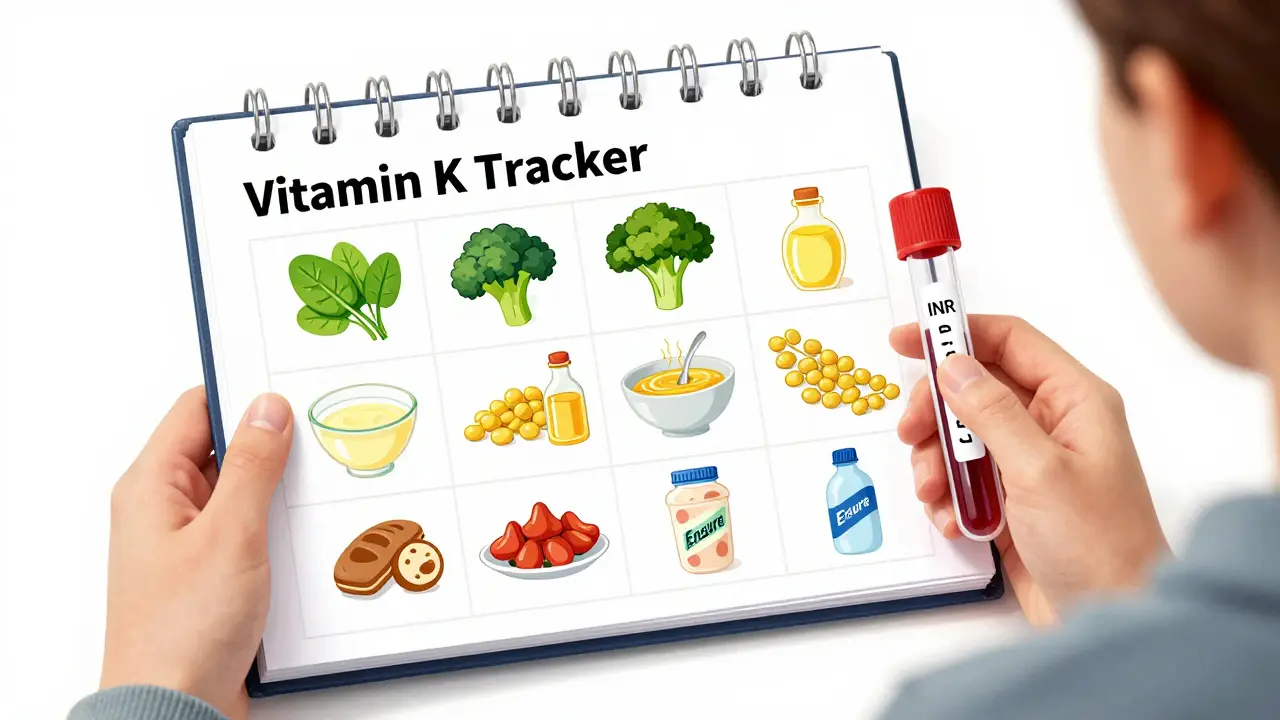
Vitamin K Tracker for Warfarin Patients
Track Your Vitamin K Intake
Your Daily Log
No foods logged yet
Today's Vitamin K Intake
Track Your INR
Daily Tracking Guide
Why Consistency Matters
Your body adapts to your vitamin K intake. Eating the same amount daily helps maintain stable INR levels. A sudden change in intake can cause your INR to swing.
Daily Recommendation
For most patients, 120 mcg of vitamin K daily is a good target for consistent intake. This is the average daily requirement.
What to Do
If you're consistently eating the same foods each day, your INR should stay stable. If you see your INR changing significantly, check your vitamin K intake.
Why Your Diet Matters When You're on Warfarin
Warfarin is a powerful blood thinner. It stops dangerous clots from forming in your veins and arteries-especially if you have atrial fibrillation, a replaced heart valve, or a history of deep vein thrombosis. But here’s the catch: warfarin doesn’t work the same way for everyone. One day your blood might be too thin, the next too thick. And a big reason why? Your food.
Vitamin K is the silent player in this game. It’s the exact thing warfarin tries to block. When you eat more vitamin K, your body makes more clotting factors, which weakens warfarin’s effect. Eat less, and your blood gets thinner. That’s why your INR (a blood test that measures how long it takes your blood to clot) can swing wildly if your diet changes.
Studies show that inconsistent vitamin K intake causes nearly one in three warfarin-related ER visits. The cost? Over $14,000 per patient each year in complications. But there’s a simple fix: track what you eat. Not just any food diary-this one focuses on vitamin K.
What Foods Actually Have Vitamin K?
It’s not just spinach. Vitamin K1 (phylloquinone) is in green leafy vegetables, but it’s also hiding in oils, sauces, and even protein shakes. Here’s what really matters:
- Cooked kale: 817 mcg per 100g
- Cooked spinach: 483 mcg per 100g
- Cooked broccoli: 220 mcg per 100g
- Raw romaine lettuce: 138 mcg per 100g
- Soybean oil: 183 mcg per tablespoon
- Canola oil: 198 mcg per tablespoon
- Ensure nutritional drink: 25 mcg per 8 oz
One cup of cooked spinach can give you more vitamin K than your entire daily recommended intake. That’s fine-if you eat it every day. The problem isn’t the amount. It’s the change.
Doctors don’t want you to avoid these foods. They want you to eat the same amount, every day. If you usually have a big salad for lunch, keep having it. If you never eat kale, don’t suddenly start. Your body adapts to your pattern. Change the pattern, and your INR goes off track.
Paper Diaries vs. Apps: Which One Works Better?
For decades, patients wrote down meals in notebooks. Some still do. But today, digital tools are changing the game.
A 2022 clinical trial with 327 patients found that those using the Vitamin K Counter & Tracker app stayed in their safe INR range 72% of the time. Paper users? Only 62%. That’s a big difference when you’re trying to avoid a stroke or a bleed.
But apps aren’t perfect. Out of 27 vitamin K apps reviewed, only 3 had real clinical validation. Most free apps get the numbers wrong by 30% or more. The Vitamin K-iNutrient app is one of the few with lab-tested accuracy-94.7% correct. But it costs $2.99 and isn’t easy for older users.
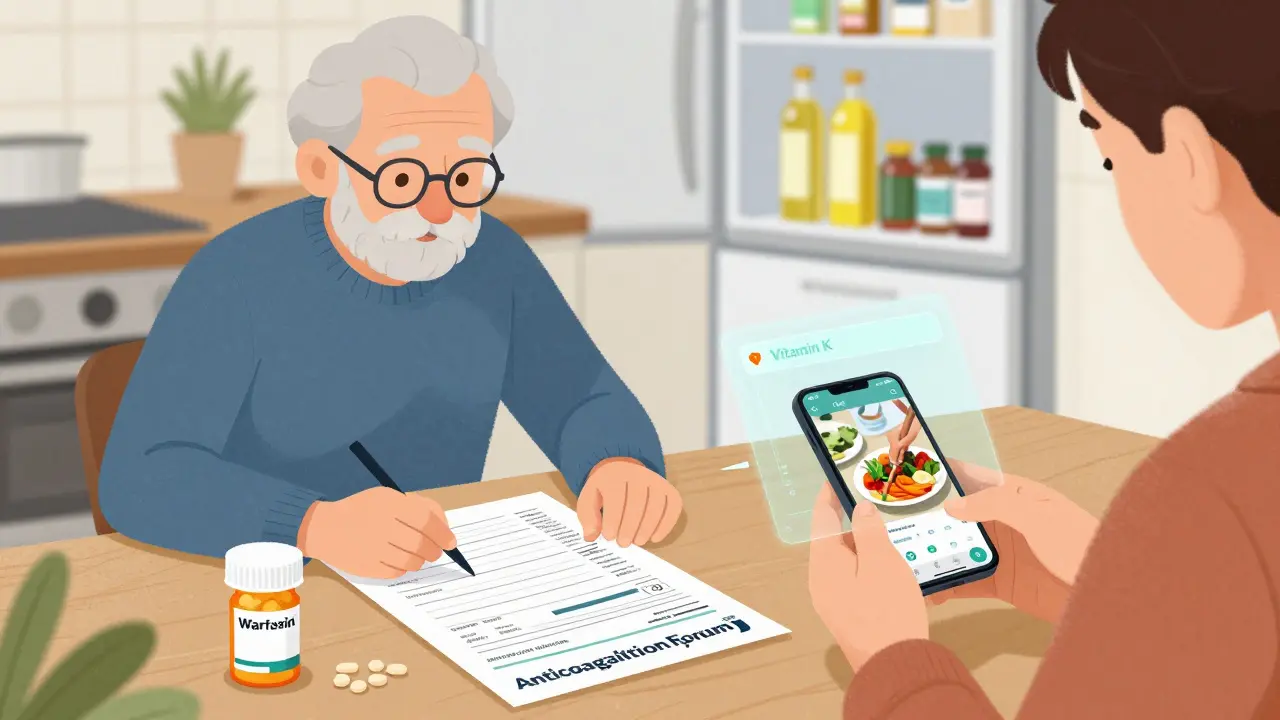
That’s why paper still has value. A 2022 study found that 82% of patients over 75 stuck with paper logs. Only 57% used apps. Why? Phones are confusing. Typing in meals feels like homework. If you’re not tech-savvy, a simple notebook with a food list and INR column works just fine.
What to Track Every Day
You don’t need to log every bite. Focus on these key items:
- Leafy greens (kale, spinach, collards, chard)
- Cruciferous veggies (broccoli, Brussels sprouts, cabbage)
- Vegetable oils (soybean, canola, olive oil in large amounts)
- Fortified foods (Ensure, Boost, meal replacement shakes)
- Multivitamins (many contain 25-100 mcg of vitamin K)
Don’t forget hidden sources. Salad dressings made with soybean oil? That’s vitamin K. Buttered popcorn made with canola oil? Also vitamin K. Even a spoonful of pesto made with basil and olive oil adds up.
Write down the food, the amount (cup, tablespoon, slice), and your INR value from your last blood test. Do this every day. Don’t wait until your appointment. Consistency is the whole point.
Common Mistakes (And How to Fix Them)
Most people fail at food diaries-not because they don’t care, but because they make the same errors over and over.
- Mistake: Guessing portion sizes. “I had a little spinach.” That’s not enough. A cup of cooked spinach is 483 mcg. A handful? Maybe 100 mcg. Use a measuring cup or visual guide (a deck of cards = 1/2 cup cooked veggies).
- Mistake: Skipping days. If you miss two days, your log is useless. Set a daily alarm. Leave the diary on your kitchen counter.
- Mistake: Not tracking multivitamins. Many people take a daily vitamin without realizing it has vitamin K. If you take one, note the brand and dose. Don’t switch brands without telling your doctor.
- Mistake: Eating a big salad the day before your INR test. That’s when your INR drops. Your doctor thinks your dose is too high. It’s not. You just ate a lot of kale.
Solutions? Use a portion guide from your clinic. Take a photo of your plate if you forget to write it down. Keep your diary and your warfarin pill bottle next to each other. Make it part of your routine.
What Experts Really Say
Dr. Gary Raskob, a leading anticoagulation expert, puts it plainly: “Don’t change your diet. Just keep it the same.”
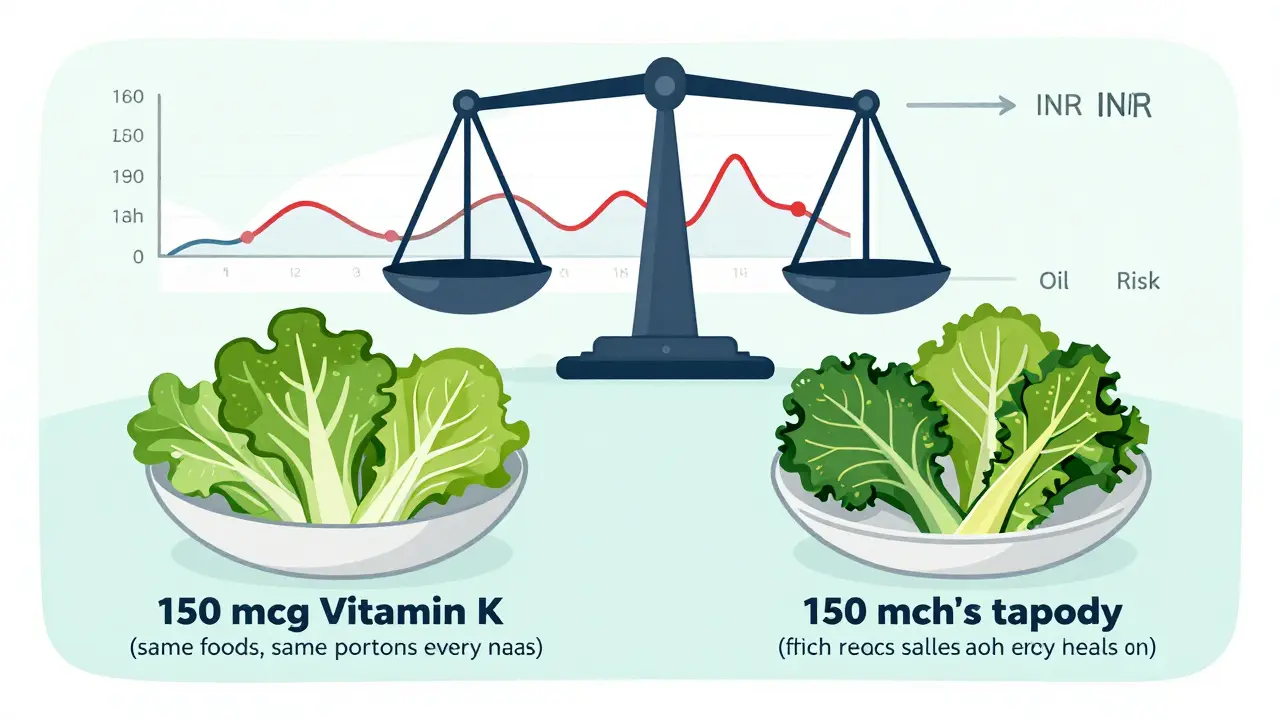
It’s not about eating less vitamin K. It’s about eating the same amount every day. One study showed that people who ate exactly 150 mcg of vitamin K daily-even if it’s more than the average person-had 18% fewer INR swings than those who ate variable amounts averaging the same total.
The American Heart Association calls dietary tracking a “Class I recommendation”-meaning it’s as essential as taking your pill on time. And the numbers back it up: patients who track their diet improve their time in therapeutic range by over 8 percentage points. That’s the difference between being safe and being at risk.
Even newer anticoagulants like apixaban and rivaroxaban don’t need diet tracking. But if you’re on warfarin, your diet is your co-pilot. Ignore it, and you’re flying blind.
How to Start Today
You don’t need to be perfect. You just need to start.
- Choose your tool: paper notebook or app. If you’re under 65, try Vitamin K Counter & Tracker. If you’re over 75, grab a notebook and print out a free template from the Anticoagulation Forum website.
- Write down your top 5 vitamin K foods. Know how much you usually eat. If you eat spinach every Monday, Wednesday, and Friday-write that down now.
- Track for 30 days straight. No exceptions. Even if you eat junk food, write it down. Your doctor needs the full picture.
- Bring your diary to every blood test. Don’t wait until you feel off. Show it to your nurse or pharmacist. They’ll spot patterns you miss.
- After 30 days, look at your INR log. Are your numbers steadier? If yes, you’re doing it right.
It takes time. Most patients need two clinic visits to learn how to use their diary properly. That’s normal. You’re learning a new skill-just like managing insulin or blood pressure.
What’s Next for Food Diaries?
The future is already here. In January 2024, the FDA approved the first AI-powered app that takes a photo of your meal and estimates vitamin K content. It’s 89% accurate. Hospitals like those using Epic’s MyChart system are now linking food logs directly to your electronic health record.
Soon, your app might warn you: “You ate 600 mcg of vitamin K today. Your INR may drop. Hold your next warfarin dose.”
But for now, the best tool is still the one you’ll actually use. Whether it’s a notebook, an app, or a simple checklist taped to your fridge-use it. Your blood is watching what you eat. Make sure it’s paying attention.
laura Drever
January 15, 2026 AT 10:14lol i just eat spinach every day and forget about it my inr stays fine why do u need an app for that
Gregory Parschauer
January 16, 2026 AT 13:18Oh for fuck's sake. Another one of these ‘track your kale’ gospel posts. Let me guess-you’re the guy who measured his pesto with a pipette and cried when his INR dropped 0.2? The real issue isn’t vitamin K variability-it’s the medical-industrial complex turning a simple anticoagulant into a full-time job. You don’t need an app. You need a doctor who doesn’t treat you like a walking lab rat. And no, I don’t care if the ‘Vitamin K-iNutrient’ app is 94.7% accurate. If I have to log my buttered toast like it’s a NASA mission, I’d rather just bleed out quietly.
Meanwhile, the people who actually survive on warfarin? They’re the ones who eat the same damn eggs and spinach every Tuesday and Friday and don’t give a shit about soybean oil in their salad dressing. The data? It’s skewed by hypochondriacs with Excel spreadsheets. Your ‘Class I recommendation’ is just institutional anxiety dressed up as science.
And don’t get me started on the ‘AI photo app.’ Next they’ll implant a microchip that buzzes when you eat a carrot. This isn’t medicine. It’s performance art for people who think their diet is a clinical trial.
Randall Little
January 17, 2026 AT 09:22So let me get this straight-you’re telling me that eating 817 mcg of vitamin K from kale is fine… as long as you eat it every single day? That’s not consistency, that’s dietary Stockholm syndrome. And yet, somehow, the same people who’ll meticulously log their broccoli intake will down a whole bottle of soybean oil in one sitting and think it’s ‘fine’ because they didn’t ‘change’ anything. The real villain here isn’t vitamin K-it’s the fact that we’ve turned nutrition into a mathematical puzzle no one asked for.
Also, the fact that 82% of patients over 75 prefer paper logs tells you everything you need to know. The problem isn’t the patients. It’s the tech bros who think every medical problem needs an app. I’m 38 and I still use a notebook. My INR’s stable. My sanity? Also stable. You don’t need an algorithm to tell you not to eat a salad every other day. You need a brain.
James Castner
January 18, 2026 AT 04:35It is imperative to recognize, with the utmost gravity, that the management of warfarin therapy through dietary vigilance is not merely a clinical best practice-it is an existential imperative for the preservation of human life. The human body, in its exquisite and terrifying complexity, responds not to whims or convenience, but to the immutable laws of biochemistry. Vitamin K, that ancient, silent architect of coagulation, does not negotiate. It does not apologize. It does not care if you are ‘too busy’ to log your meals or if your phone died or if you forgot your notebook at work.
When your INR fluctuates, it is not a ‘mistake’-it is a symphony of molecular imbalance, a cascade of thrombin and fibrinogen dancing to the tune of inconsistent phylloquinone intake. The 18% reduction in INR swings observed in those who maintained precisely 150 mcg daily is not a statistic-it is a lifeline. And to dismiss the digital tools as ‘tech bro nonsense’ is to ignore the fact that the same technology that brought us GPS navigation now prevents strokes in grandmothers who never used a smartphone before.
Yes, paper logs work. But so did quill pens. We do not abandon progress because it is inconvenient. We adapt. We evolve. We integrate. The future is not a notebook taped to the fridge-it is an AI that recognizes your omelette, cross-references your medication, and whispers, ‘Hold the warfarin today.’ That is not dystopia. That is dignity. That is care. And if you refuse it because it requires effort, then perhaps you are not ready to be responsible for your own survival.
Adam Rivera
January 20, 2026 AT 00:19Hey, I just started tracking my vitamin K with a sticky note on the fridge. Spinach on Mon/Wed/Fri, broccoli on Tues, and I never touch kale-too bitter anyway. My INR’s been stable for 4 months now. No app, no stress. Just write it down when you eat it. You don’t need to be perfect, just consistent. And yeah, multivitamins are sneaky-I didn’t know mine had K until my nurse pointed it out. Good stuff, thanks for the reminder!
Rosalee Vanness
January 21, 2026 AT 20:16I’ve been on warfarin for 7 years and I used to be the person who’d eat a kale smoothie one day and then eat nothing green for a week. My INR was a rollercoaster. Then I made a simple rule: I eat one serving of dark leafy greens every single day, same time, same amount. I use a measuring cup-I don’t guess. I even take a photo of my plate sometimes if I’m in a rush. And I keep my diary right next to my pill organizer. It’s not about being perfect-it’s about being predictable. Your body loves routine. It doesn’t care if you’re ‘healthy’ or ‘eating clean.’ It just wants to know what’s coming next. That’s the magic. I used to think this was boring. Now I think it’s empowering. You’re not fighting your body. You’re speaking its language.
And for the love of all things holy, if you take a multivitamin, check the label. I once switched brands and didn’t realize the new one had 50 mcg of K. My INR dropped to 1.8. I thought I was having a stroke. Turned out it was just a vitamin. So dumb. So avoidable.
Start small. One food. One day. One log. You don’t need to become a nutritionist. Just become consistent. Your future self will thank you.
lucy cooke
January 23, 2026 AT 20:06Oh, so now we’re all supposed to be culinary anthropologists of coagulation? Tracking vitamin K like it’s the sacred text of some ancient blood cult? How profoundly banal. The entire paradigm of warfarin management is a relic of 20th-century medicine-reductive, mechanical, and utterly devoid of existential nuance. We reduce the body to a series of micrograms and INR values, as if the soul doesn’t also influence clotting. Do you think your anxiety doesn’t affect your INR? Do you think grief doesn’t alter your metabolism? No, of course not. We’d rather blame your salad than your spirit.
And yet, the ‘Vitamin K-iNutrient’ app? A digital sacrament for the technocratic faithful. How poetic. We have replaced the priest with a smartphone. The altar? Your kitchen counter. The holy grail? A 94.7% accurate database of leafy greens. How utterly, tragically modern.
The real tragedy isn’t inconsistent vitamin K intake. It’s that we’ve forgotten how to live with uncertainty. We demand control over every molecule, every bite, every second. But life doesn’t operate on spreadsheets. Warfarin isn’t a puzzle to be solved-it’s a dance. And sometimes, you just have to let go.
Trevor Davis
January 25, 2026 AT 02:32Just wanted to say thanks for this. My mom’s on warfarin and she’s 81. She uses a little notebook she keeps by the coffee maker. Every morning, she writes down what she ate and her INR from last week. She doesn’t know what ‘phylloquinone’ means. Doesn’t care. But she knows spinach = same day, every day. And she’s been stable for 2 years. No app. No stress. Just routine. This post made me realize how simple it really is. Sometimes the best tech is just a pen and a habit.