
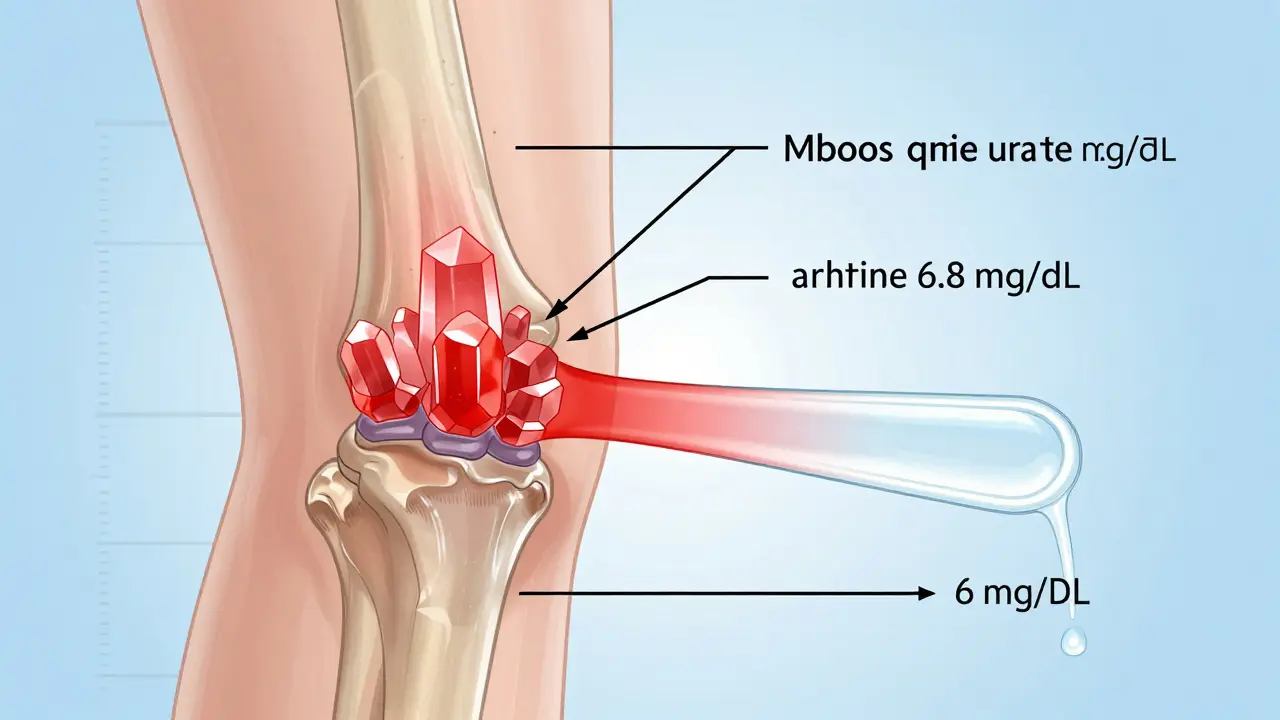
For decades, gout was treated like a flare-up you had to live with-painkillers for the pain, maybe a bit of rest, and hope it didn’t come back too soon. But that’s not how it works anymore. Today, gout is managed like high blood pressure or diabetes: with a clear, measurable goal. That goal? Keeping your serum urate below 6 mg/dL. Not just sometimes. Not just when you feel okay. All the time.
This shift didn’t happen overnight. It came from real data. Studies tracking thousands of patients showed that if your serum urate stays above 6.8 mg/dL, crystals keep forming in your joints. But if you bring it down below 6 mg/dL, those crystals start to dissolve. And when they dissolve, flares become rare. Maybe even disappear.
What’s the Target? And Why Does It Matter?
The magic number is 6 mg/dL. That’s 360 micromol/L. Or 0.36 mmol/L. Same thing. All major guidelines-ACR, NICE, EULAR-agree on this. It’s not a guess. It’s the point where monosodium urate crystals can no longer form. Below this, your body starts pulling existing crystals out of your joints, tendons, and tissues.
But here’s the catch: if you have tophi (those visible lumps under the skin), frequent flares, or joint damage seen on X-rays, you need to go lower. Target under 5 mg/dL (300 micromol/L). Why? Because those crystals are stubborn. They’ve been there for years. You need to push harder to dissolve them.
And no, you don’t want to go too low. Below 3 mg/dL? No benefit. Maybe even risk. We don’t know what happens long-term when urate drops that far. So 3-6 mg/dL is the sweet spot.
Allopurinol: The Old Workhorse with New Life
Allopurinol is the most common drug used to lower urate. It’s cheap, safe, and effective-if you take it right. Too many people start at 100 mg a day and think that’s enough. It’s not. Most need more.
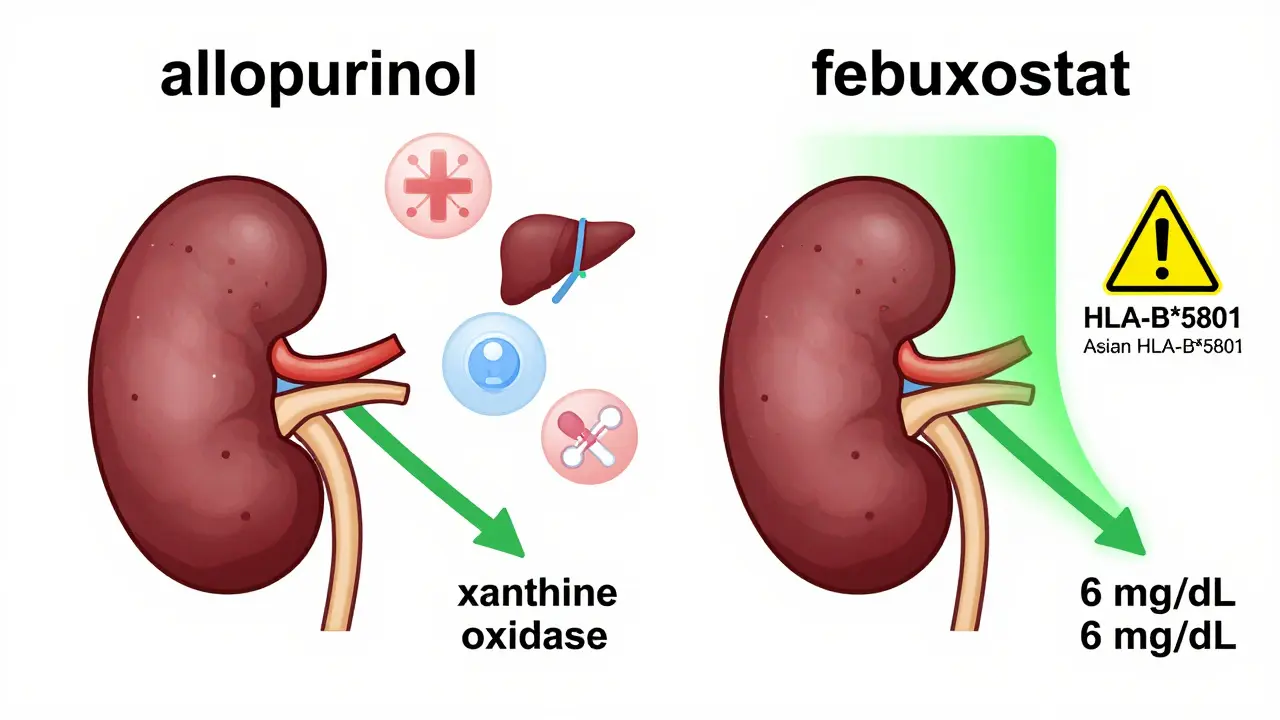
Here’s how it works: allopurinol blocks xanthine oxidase, the enzyme that makes uric acid. Less production = lower serum levels. Simple. But dosing isn’t. A 100 mg dose might work for someone with mild gout and healthy kidneys. For others? They need 300 mg. 400 mg. Even 600-800 mg a day. Real-world data from New Zealand shows 30-50% of patients need doses above 300 mg to hit target. And 75-80% of those with normal kidney function reach their goal at those higher doses.
Start low. Go slow. Begin at 50-100 mg/day. Check your serum urate after 4-6 weeks. If it’s still above 6 mg/dL, bump up by 50-100 mg. Repeat. Most patients need 3-6 months to get there. And yes, your doctor should be checking your levels every month during titration. Monthly monitoring increases success by 31% compared to quarterly checks.
One big concern: allopurinol hypersensitivity syndrome. Rare-0.1-0.4% of users-but deadly. If you’re of Asian descent, especially Han Chinese, Korean, or Thai, get tested for HLA-B*5801 before starting. It’s a genetic marker that raises your risk 25-fold. If positive, skip allopurinol. Use febuxostat instead.
Febuxostat: The Stronger, Costlier Alternative
Febuxostat does the same thing as allopurinol-blocks uric acid production-but it’s not affected by kidney function the same way. That makes it a go-to for people with moderate to severe kidney disease. A 2023 meta-analysis found febuxostat achieved target levels 15% more often than allopurinol in patients with CKD stage 3 or worse.
Dosing is similar: start at 40 mg/day. If after 4-6 weeks your urate is still too high, go to 80 mg/day. No need to titrate slowly beyond that. It’s more potent, so it works faster. But it’s also more expensive. In the U.S., generic allopurinol costs $4-12/month. Febuxostat? $30-50. That’s a big barrier.
There’s also a lingering concern about heart risk. Early studies suggested febuxostat might raise cardiovascular death risk compared to allopurinol. Later analyses, including a 2023 FDA review, found no clear signal. Still, if you have heart disease, your doctor might lean toward allopurinol unless your kidneys are failing.
Who Gets What? Guidelines Compared
Guidelines don’t always line up. Here’s how they differ:
| Guideline | First-Line Choice | Severe Gout Target | Asymptomatic Hyperuricemia? |
|---|---|---|---|
| ACR 2020 | Allopurinol (all patients) | <5 mg/dL | No ULT recommended |
| NICE NG219 (2023) | Allopurinol or Febuxostat | <5 mg/dL | No specific guidance |
| EULAR 2023 | Allopurinol (normal kidneys) | <5 mg/dL | Not recommended |
ACR says: start with allopurinol, no exceptions. NICE says: pick based on cost, kidney function, or patient preference. EULAR says: allopurinol unless kidneys are bad. All agree on targets. All agree on avoiding ULT for asymptomatic high urate. No one wants to treat someone who’s never had a flare.
Why Do So Many People Fail?
Here’s the ugly truth: only 42% of patients hit their target within a year. Why?
- Underdosing: Doctors start too low and don’t titrate. Patients think 100 mg is enough.
- Poor monitoring: Only 54% of U.S. patients get monthly urate tests during titration. You can’t manage what you don’t measure.
- Fear of side effects: 68% of dose failures come from patients refusing higher doses because they’re scared of rash or liver issues.
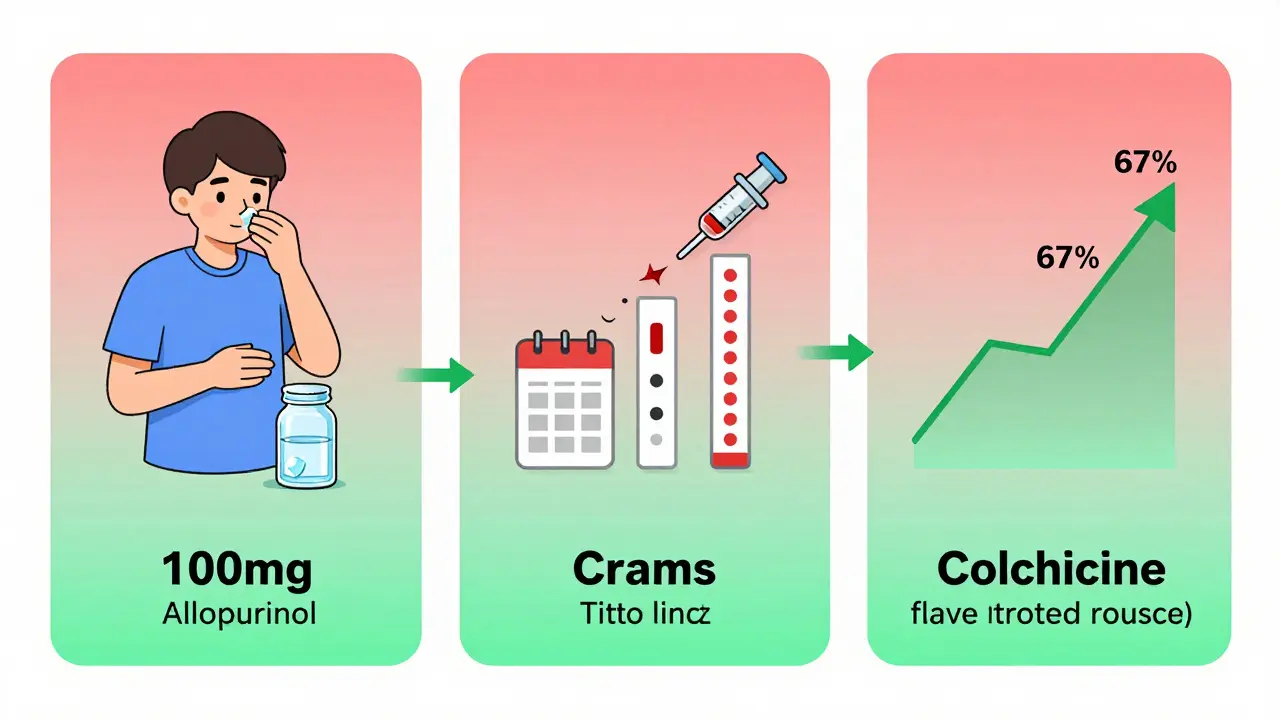
- The flare paradox: When you start ULT, crystals start dissolving. That can trigger flares. Patients panic and stop the drug. They need to know: this is normal. Keep going. Add colchicine or NSAIDs for 3-6 months to prevent flares during this phase.
- Systemic barriers: In New Zealand, Māori and Pacific patients are more likely to be prescribed ULT-but less likely to reach target. Access, education, and trust gaps play a role.
One study in Kaiser Permanente showed that using fixed protocols-where pharmacists manage dosing and testing-boosted target achievement from 39% to 67%. That’s huge. It’s not about the drug. It’s about the system.
What’s Next? The Future of Gout Treatment
Science is moving fast. The 2024 GOUT-PRO study found that testing for ABCG2 and SLC22A12 gene variants helped predict who responds to allopurinol. With genetic guidance, target achievement jumped from 61% to 83% in six months. Personalized dosing is coming.
Also on the horizon: verinurad, a new uricosuric drug that helps kidneys flush out more urate. It might let people hit targets without massive allopurinol doses. And the ULTRA-GOUT trial (results due late 2025) will compare fixed-dose versus treat-to-target strategies. Will we still need monthly blood tests? Maybe not.
For now, though, the answer is simple: know your number. Get your serum urate checked. Adjust your dose. Don’t quit when flares happen. And if you’ve got tophi or kidney disease, aim lower. Because gout isn’t about pain anymore. It’s about healing.
Real Talk: What Patients Need to Know
- Your urate target isn’t a suggestion. It’s your treatment goal.
- Don’t stop your pill because you had a flare. That’s the healing phase.
- Ask for a blood test every 4-6 weeks while adjusting dose.
- If allopurinol isn’t working, ask about febuxostat-especially if you have kidney issues.
- If you’re Asian, ask about HLA-B*5801 testing before starting allopurinol.
- Cost matters. If you can’t afford febuxostat, allopurinol works fine-if you take enough.
What is the ideal serum urate target for gout?
For most people with gout, the target is below 6 mg/dL (360 micromol/L). If you have tophi, frequent flares, or joint damage, aim lower-below 5 mg/dL (300 micromol/L). Never go below 3 mg/dL. These targets are based on decades of research showing crystal dissolution and flare prevention happen within this range.
Is allopurinol better than febuxostat?
It depends. Allopurinol is cheaper, widely used, and recommended as first-line by most guidelines. But febuxostat works better in people with moderate to severe kidney disease. If you have heart disease, some doctors still prefer allopurinol due to past safety concerns, though recent data doesn’t confirm major risks. Cost, kidney function, and genetics all play a role in choosing between them.
Why do I get more flares when I start taking allopurinol?
That’s called the "flare paradox." As urate crystals dissolve, they irritate your joints and trigger inflammation. It’s not the drug failing-it’s the treatment working. To manage this, doctors often prescribe low-dose colchicine or NSAIDs for the first 3-6 months. Keep taking your urate-lowering pill. Don’t stop.
How often should my serum urate be checked?
During dose titration, check every 4-6 weeks. Once you reach target, check every 6 months. Monthly monitoring during adjustment increases success by 31%. Many patients only get tested once a year, which is too late to catch underdosing. Ask your doctor for a schedule.
Can I stop taking urate-lowering medication if I haven’t had a flare in years?
Don’t stop without talking to your doctor. Even if you haven’t had a flare, crystals may still be in your joints. Stopping medication lets urate rise again, and crystals reform. Long-term studies show most people relapse within a year of stopping. Gout is a chronic condition. Think of it like blood pressure medication-you take it to prevent damage, not just treat symptoms.
If you’ve been told to "just live with it," you were given outdated advice. Gout is preventable. It’s reversible. But only if you treat it like the disease it is-by tracking your numbers, adjusting your dose, and staying the course.
Kenneth Zieden-Weber
March 12, 2026 AT 00:23So let me get this straight-we’re treating gout like diabetes now? Cool. I just thought it was that thing you blamed on beer and steak. Turns out it’s a metabolic disorder with a hard number you gotta hit. Kinda wild how medicine evolves when someone actually tracks the data instead of just saying "take a pill and hope."
Alexander Erb
March 13, 2026 AT 07:27YES. This. I’ve been on allopurinol for 2 years and my doc kept me at 100mg until I pushed back. Now I’m at 400mg and haven’t had a flare in 14 months. 🙌 It’s not about being "scared of side effects"-it’s about not being lazy with dosing. Monthly labs changed my life. 💉
Denise Jordan
March 15, 2026 AT 02:01Wow. So now we’re all supposed to be biochemists just to manage a painful joint? I get it, numbers are cool. But honestly? If I’m not in pain, why do I care what my urate is? Just let me nap.
David L. Thomas
March 15, 2026 AT 14:23Allopurinol titration is the most underutilized tool in rheumatology. The 31% boost from monthly monitoring? That’s not a stat-it’s a revolution. We’re still operating in a 1990s mindset where "start low, go slow" gets misinterpreted as "start low and never go anywhere." The data says otherwise. Time to update the protocols.
Mike Winter
March 15, 2026 AT 16:36I’m intrigued by the genetic angle-ABCG2 and SLC22A12 variants. It feels like we’re finally moving from population-based dosing to precision medicine. Not everyone metabolizes urate the same way. Why should we treat them the same? The future isn’t just about lowering urate-it’s about understanding *why* someone’s body makes too much in the first place.
Gene Forte
March 17, 2026 AT 01:44This is the kind of post that reminds me why I got into medicine. Gout isn’t a lifestyle flaw-it’s a biochemical imbalance that can be healed. We’ve spent decades making people feel guilty for eating shrimp, when the real problem was we didn’t know how to treat it properly. Now we do. And that’s hope. That’s dignity. That’s science.
If you’re reading this and you’re scared of your dose going up-don’t be. You’re not failing. You’re healing. And that’s worth every blood test, every doctor visit, every moment of discomfort.
Keep going. Your joints will thank you.
Adam Kleinberg
March 17, 2026 AT 13:02So now we’re telling people to take massive doses of allopurinol and test their blood every month? Who’s really benefiting here? The patients? Or the labs? I’ve seen this movie before-every new "evidence-based" protocol ends up being a cash grab for Big Pharma and diagnostic companies. And don’t even get me started on febuxostat. That 2023 FDA review? Please. They buried the real data. You think they’d let a cheaper generic beat a $50 drug if it wasn’t rigged?
Chris Bird
March 17, 2026 AT 21:54Y’all in the US talk about allopurinol like it’s magic. But here in Nigeria? We don’t even have consistent access to the 100mg dose. My cousin has gout and his only option is paracetamol. You talk about targets and genes and labs. We talk about whether the clinic has medicine today. This is beautiful science. But it’s not for everyone. Not yet.
Bridgette Pulliam
March 19, 2026 AT 14:16Thank you for writing this. As someone who’s been managing gout for 12 years, I can say this: the flare paradox is real. I stopped allopurinol twice because I panicked during flares. Both times, I ended up in the ER. The third time, my rheumatologist gave me colchicine as a buffer. It was the best decision I ever made. I’ve been flare-free for 3 years. Don’t quit. Just add the buffer.