
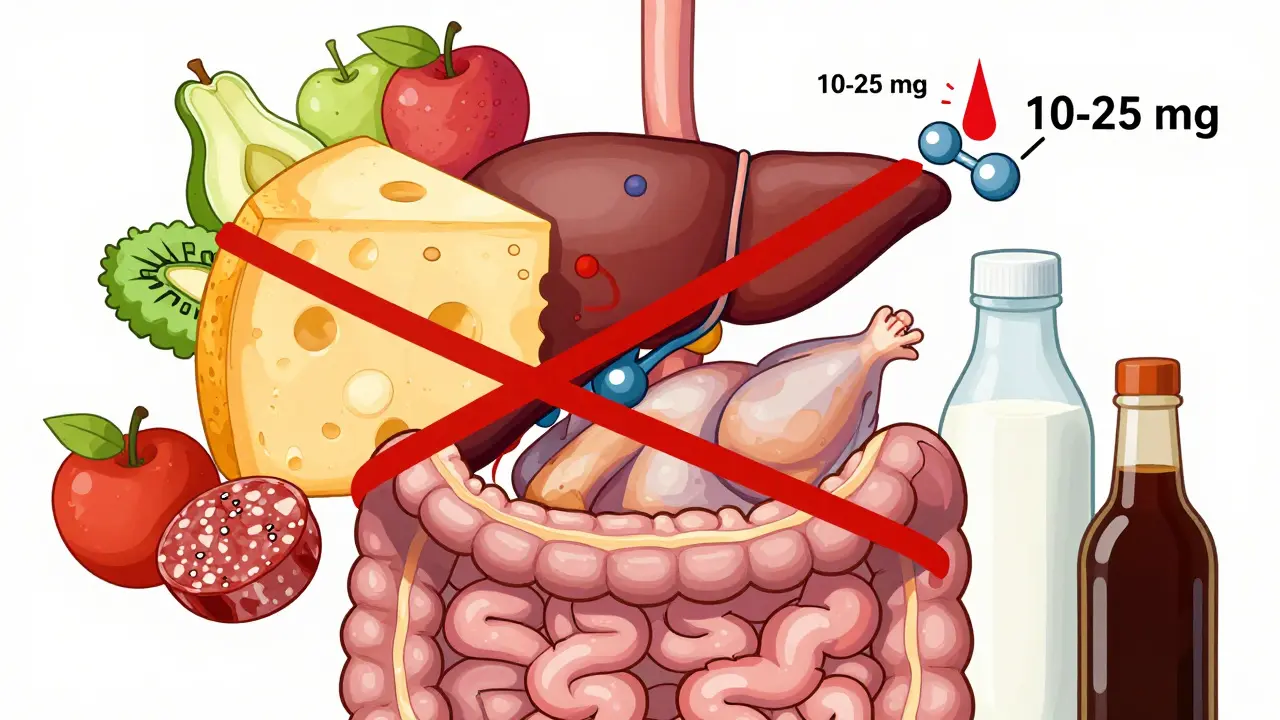
When you're taking an MAOI antidepressant, what you eat isn't just about nutrition-it can be a matter of life or death. Monoamine Oxidase Inhibitors (MAOIs) like phenelzine, tranylcypromine, and isocarboxazid are powerful tools for treating depression, especially when other meds don’t work. But they come with a hidden danger: tyramine. This naturally occurring compound in certain foods can cause a sudden, dangerous spike in blood pressure if your body can’t break it down. And because MAOIs block the enzyme that normally clears tyramine, even a small amount can trigger a medical emergency.
Why Tyramine Is Dangerous with MAOIs
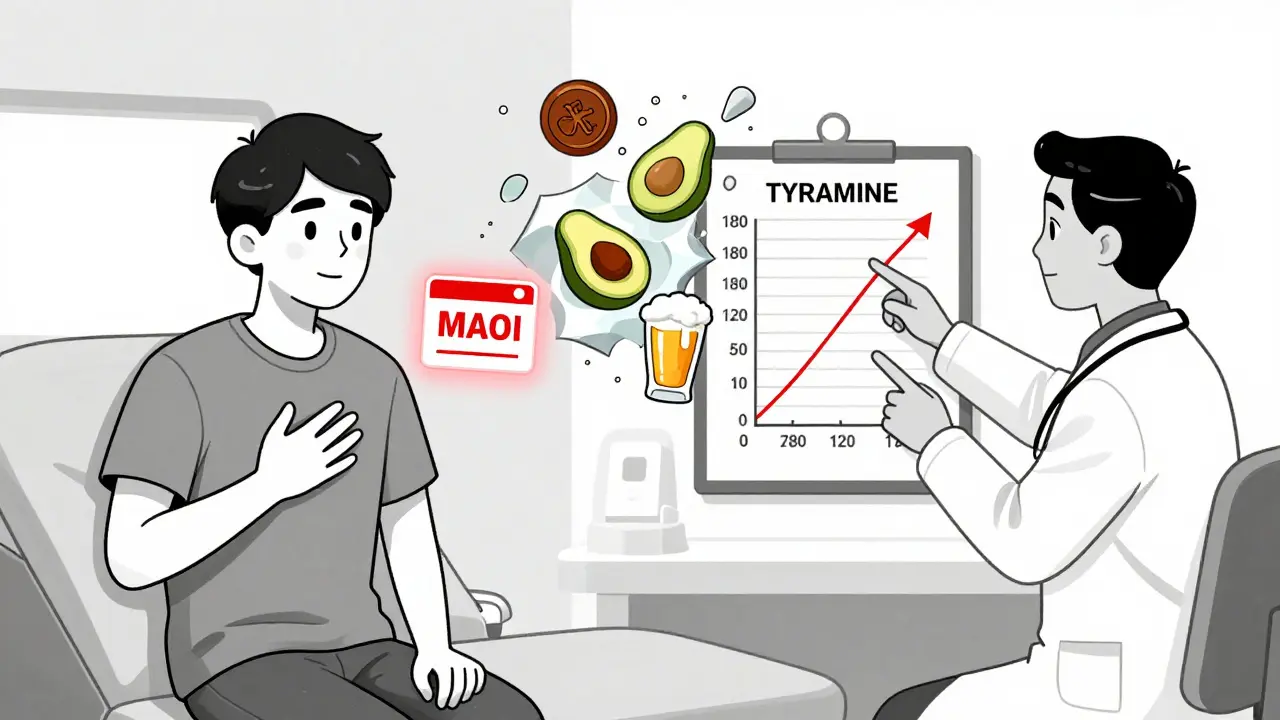
Your body usually breaks down tyramine using an enzyme called monoamine oxidase-A (MAO-A), found mostly in your gut and liver. When you take an irreversible MAOI, that enzyme is shut down for weeks. Without it, tyramine builds up in your bloodstream. Once it hits a certain level-just 10 to 25 milligrams-it forces your nerve cells to dump stored norepinephrine. That’s a chemical that tightens blood vessels and spikes your heart rate. The result? Blood pressure can rocket to 180/120 mmHg or higher. That’s not just a headache. That’s a risk of stroke, heart attack, or brain hemorrhage.
It sounds scary, but it’s rare when people follow the rules. Studies show fewer than 0.5% of patients on properly managed MAOIs experience a hypertensive crisis each year. The key isn’t avoiding food forever-it’s knowing which foods to skip and which are safe.
Foods That Can Trigger a Crisis
Tyramine doesn’t sit in fresh food. It forms when proteins break down over time-through aging, fermentation, or spoilage. That’s why the danger isn’t in the food itself, but how it’s processed or stored.
- Aged cheeses: Cheddar, Swiss, blue cheese, parmesan, and gouda can contain 50 to 400 milligrams of tyramine per 100 grams. One slice of aged cheddar? About 30 mg. That’s enough to push you over the edge if you’re on an MAOI. Fresh cheeses like mozzarella, cottage cheese, or cream cheese are fine-they have less than 10 mg per serving.
- Dried or fermented meats: Salami, pepperoni, summer sausage, and other air-dried or cured meats pack 50 to 100 mg per 100 grams. Even a small slice can be risky. Fresh, unprocessed meats like chicken, beef, or fish are safe.
- Fermented soy products: Traditional soy sauce, miso paste, and tempeh are loaded with tyramine. Soy sauce can have 30 to 50 mg per tablespoon. Commercial soy sauce today is often lower-around 30 mg per 100 ml-but still not safe. Tamari or low-sodium versions aren’t any better. Stick to fresh tofu or plain soy products.
- Overripe fruits: Bananas, avocados, and figs get riskier as they ripen. A ripe avocado has about 0.5 to 3 mg per 100 grams. But if it’s mushy or brown-spotted? That can jump to 10 mg. Eat them while they’re firm and yellow.
- Tap beer and fermented drinks: Draft beer and home-brewed beer can have 10 to 30 mg per 100 ml. Bottled or canned beer is usually lower, but still not recommended. Wine-especially Chianti-has 10 to 20 mg per 100 ml, and while some doctors allow small amounts, it’s safer to avoid it entirely. Distilled spirits like vodka, gin, or whiskey are generally okay in moderation.
- Yeast extracts and meat tenderizers: Products like Marmite, Vegemite, or bouillon cubes made from yeast extracts can contain high levels of tyramine. Read labels carefully.
What’s Actually Safe to Eat
You don’t have to live on plain rice and steamed broccoli. Many common foods are perfectly safe.
- Fresh, frozen, or canned meats, poultry, and fish
- Most fresh fruits and vegetables (except overripe bananas, avocados, figs)
- Whole grains, pasta, bread, and crackers (unless they contain yeast extract)
- Low-fat dairy like milk, yogurt, and fresh cheese
- Eggs and peanut butter (in moderation)
- Decaf coffee and herbal teas
One big myth: all alcohol is off-limits. That’s not true. A small glass of wine or a shot of vodka might be okay for some people, but only if your doctor says so. Never mix alcohol with MAOIs without talking to your prescriber first.
Not All MAOIs Are the Same
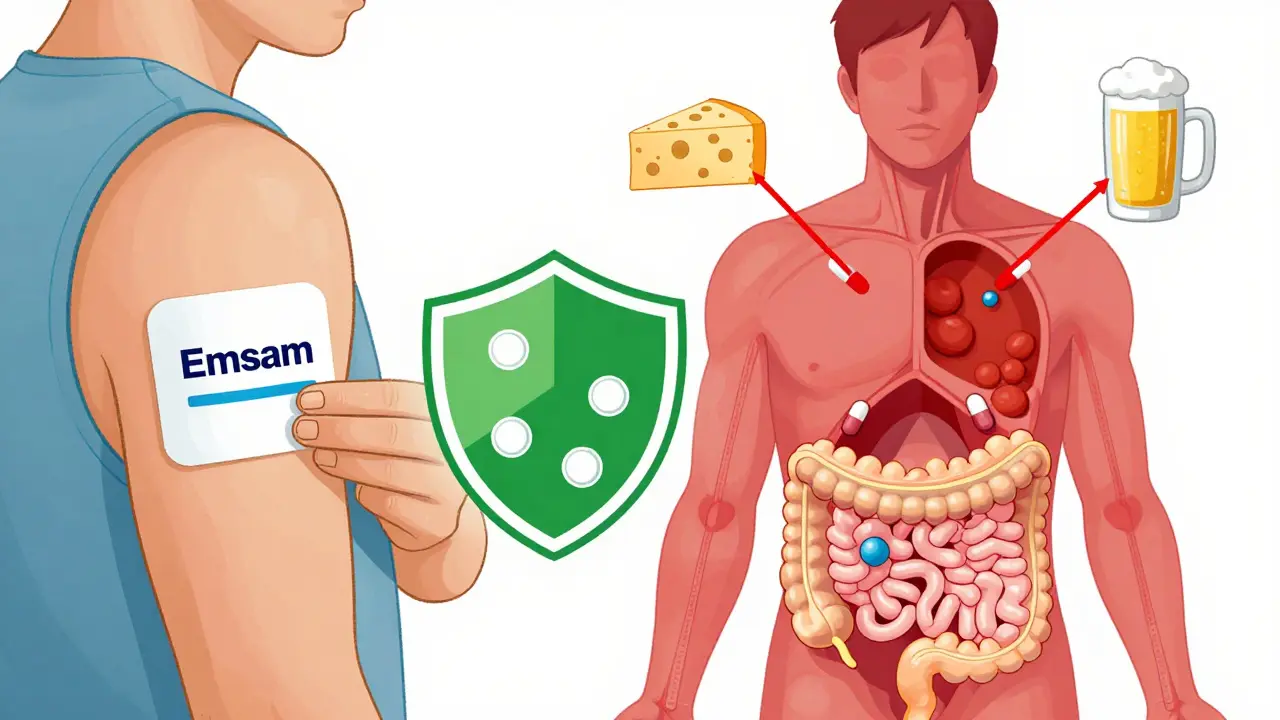
Not every MAOI comes with the same restrictions. The newer transdermal patch, selegiline (Emsam), changes the game. At the lowest dose (6 mg/24 hours), it mostly affects the skin and doesn’t block MAO-A in the gut. That means you don’t need to avoid tyramine-rich foods at all. At higher doses, restrictions return-but only gradually.
Then there’s moclobemide, a reversible MAOI. It doesn’t permanently disable the enzyme. If tyramine shows up, the enzyme can still do its job. That’s why moclobemide isn’t banned from most diets. But it’s not widely available in the U.S. and is mostly used in Europe and Australia.
If you’re on phenelzine or tranylcypromine, you still need to be strict. If you’re on the Emsam patch at 6 mg, you’re in the clear. Always confirm your specific medication’s rules with your doctor.
Other Hidden Risks
It’s not just food. Many over-the-counter meds can cause the same dangerous spike in blood pressure.
- Decongestants: Pseudoephedrine and phenylephrine (found in Sudafed, Claritin-D, and many cold remedies) are a no-go. They work the same way as tyramine-pushing out norepinephrine.
- Herbal supplements: St. John’s wort, ginseng, and L-tyrosine can interfere with MAOIs and raise serotonin or norepinephrine levels dangerously.
- Other antidepressants: Never start an SSRI like sertraline or fluoxetine without a 14-day washout period after stopping an MAOI. Combining them can cause serotonin syndrome-a potentially fatal condition with high fever, seizures, and muscle rigidity. There have been documented deaths from this mix.
Always tell every doctor, dentist, or pharmacist you see that you’re on an MAOI. Even a simple local anesthetic with epinephrine can be risky.
What to Do After Stopping MAOIs
Don’t relax your diet the day you stop your pill. MAOIs bind permanently to enzymes. It takes 2 to 4 weeks for your body to make new ones. Until then, tyramine is still dangerous.
Wait at least 14 days before starting another antidepressant. For irreversible MAOIs, 14 days is the minimum. Some doctors recommend waiting 21 days to be safe. Don’t guess-ask your psychiatrist.
How to Stay Safe
Managing MAOIs isn’t about fear. It’s about awareness.
- Keep a printed list of safe and unsafe foods. The University of Iowa’s patient guide gives exact tyramine levels per serving-use that as a reference.
- Read labels. Look for “yeast extract,” “aged,” “fermented,” or “cured.”
- When in doubt, skip it. If you’re not sure if something’s safe, don’t eat it.
- Carry an MAOI alert card. It can save your life if you end up in the ER.
- Use a food tracker app or journal. Write down everything you eat. If you feel a headache, pounding heart, or stiff neck, check what you ate.
MAOIs are not the first-line treatment for depression anymore. But they’re still one of the most effective tools for treatment-resistant cases. Thousands of people take them safely every year. The difference between success and crisis? Knowledge.
What’s Changing Now
Research is moving fast. In 2021, the FDA approved a new extended-release selegiline patch that further reduces dietary risks. Clinical trials are underway for a new reversible MAO-A inhibitor called befloxatone-early results show no tyramine interaction at therapeutic doses. That could mean a future where MAOIs are safer and more widely used.
For now, the rules are clear: know your medication, know your food, and never skip the conversation with your doctor. You’re not giving up your favorite meals-you’re protecting your life.
Can I drink wine while on MAOIs?
Some people on MAOIs can have a small glass of wine, especially Chianti, which contains 10-20 mg of tyramine per 100 ml. But it’s not risk-free. Many doctors recommend avoiding all alcohol to prevent unpredictable reactions. Always check with your prescriber before drinking.
Is soy sauce safe on MAOIs?
No. Traditional soy sauce has 30-50 mg of tyramine per tablespoon. Even commercial versions, which are lower, still exceed the 6 mg per serving safety limit. Tamari and low-sodium soy sauce aren’t safer-they’re made the same way. Avoid all soy sauce unless your doctor confirms a specific brand is safe.
What if I accidentally eat high-tyramine food?
If you eat something like blue cheese or salami and feel a sudden headache, pounding heart, stiff neck, or blurred vision, sit down and call emergency services immediately. Don’t wait. These symptoms can escalate quickly. Keep your MAOI alert card handy so paramedics know what’s happening.
Are there MAOIs that don’t require dietary restrictions?
Yes. The transdermal selegiline patch (Emsam) at the lowest dose (6 mg/24 hours) doesn’t block tyramine breakdown in the gut, so no dietary restrictions are needed. At higher doses, restrictions return. Moclobemide, a reversible MAOI, also has fewer restrictions but isn’t available in the U.S. Always confirm your specific medication’s guidelines.
How long do I need to follow a low-tyramine diet?
You must follow the diet for the entire time you’re on the MAOI and for 2 to 4 weeks after stopping. That’s how long it takes your body to regenerate the MAO-A enzyme. Stopping the diet too soon-even a few days after your last pill-can still put you at risk.
Can I take over-the-counter cold medicine with MAOIs?
No. Decongestants like pseudoephedrine and phenylephrine can cause a dangerous spike in blood pressure when mixed with MAOIs. Avoid all cold, flu, and allergy meds unless your doctor approves them. Look for alternatives like saline nasal sprays or antihistamines like loratadine (Claritin), which are generally safe.
Naomi Walsh
February 1, 2026 AT 07:32Let’s be real-most people have no idea how dangerous MAOIs are. I’ve seen so many patients in Dublin just wing it with ‘a little cheese’ and then show up in A&E with BP through the roof. It’s not just about avoiding blue cheese; it’s about understanding that tyramine isn’t some myth-it’s a biochemical landmine. And no, ‘organic’ or ‘artisanal’ doesn’t make it safer. If it’s aged, fermented, or cured, it’s a no-go. Period.
Nidhi Rajpara
February 2, 2026 AT 18:07Dear author, your article is exceptionally well-researched and meticulously structured. However, I must point out a minor typographical inconsistency: in the section regarding soy sauce, you wrote ‘30 to 50 mg per tablespoon’ but later refer to ‘6 mg per serving’ as the safety threshold without explicitly clarifying the conversion. This could cause confusion for readers unfamiliar with metric-to-ounce equivalencies. Kindly consider adding a footnote for precision.
Donna Macaranas
February 4, 2026 AT 08:12Thanks for this. I’ve been on Emsam for 6 months and honestly, the freedom of not having to stress over food has been life-changing. I still avoid fermented stuff just out of habit, but knowing I don’t *have* to is such a relief. If you’re considering MAOIs, talk to your doc about the patch. It’s not magic, but it’s close.
June Richards
February 5, 2026 AT 18:49LOL so basically don’t eat anything that tastes good? 😂 I mean, I get it, but this is why people stop taking meds. Who wants to live on boiled chicken and rice for life? 🙄
Jaden Green
February 6, 2026 AT 20:31It’s fascinating how modern medicine reduces complex neurochemistry to a simplistic dietary checklist. The real issue isn’t tyramine-it’s the systemic failure of pharmaceutical oversight. We’re told to avoid cheese while Big Pharma quietly markets SSRIs that carry their own cocktail of metabolic and sexual side effects, none of which come with warning labels as dramatic as ‘DEATH BY SALAMI.’ The hypocrisy is staggering. This isn’t medical guidance; it’s fear-based compliance engineering.
Lu Gao
February 7, 2026 AT 18:54Wait-so I can have a glass of wine but not a slice of cheddar? 🤔 That’s like saying ‘you can touch fire with your finger but not your hand.’ Also, why is soy sauce worse than miso? They’re basically the same thing. 🤷♀️
Angel Fitzpatrick
February 9, 2026 AT 00:58They don’t want you to know-this whole tyramine thing is a smokescreen. The FDA and Big Pharma are suppressing the real truth: MAOIs work too well. They’re too cheap. Too effective. That’s why they’re buried under layers of dietary restrictions and scare tactics. If everyone knew you could treat depression without lifelong SSRI dependency, the profit margins would collapse. The ‘danger’ is manufactured. The real danger is losing your autonomy to corporate medicine.
Nicki Aries
February 10, 2026 AT 06:35This is so important. I’ve been on phenelzine for three years, and I carry a printed list in my wallet. I’ve even laminated it. I’ve told every pharmacist, every ER nurse, every dentist-no exceptions. One time, a doctor tried to give me pseudoephedrine for a cold. I had to show them the list. They apologized. I cried. This isn’t just about food-it’s about being seen, being heard, being taken seriously. Please, if you’re on an MAOI: speak up. Even if it’s awkward. Your life depends on it.
Melissa Melville
February 11, 2026 AT 06:59So… I can eat avocado? But only if it’s not brown? 😂 I’m just here for the snack rules. Also, can I get a medal for surviving 18 months without soy sauce? 🏅
Bryan Coleman
February 11, 2026 AT 17:41Just want to add: if you're on an MAOI and you're ever in doubt about a food, check the FDA’s tyramine database or ask a clinical pharmacist. They’re usually way more helpful than your regular doc. Also-don’t trust random Reddit advice. I once saw someone say ‘one beer’s fine’ and they ended up in the hospital. Play it safe.
Naresh L
February 12, 2026 AT 17:11There’s a deeper question here: why do we treat the body as a machine that must be controlled, rather than a system that can be understood? The fear around MAOIs reflects our alienation from food, from biology, from the rhythms of fermentation and aging. Perhaps the real cure isn’t just avoiding tyramine-but learning to live with uncertainty, with tradition, with the slow, messy wisdom of food. Still, I’d never risk it. Safety first.
Sami Sahil
February 13, 2026 AT 22:03Bro this is fire! I’m on MAOI and I thought I was the only one stressed about cheese 😅 but seriously, this saved my life. I used to eat pepperoni like it was candy. Now I just eat grilled chicken. Still happy. Still alive. Keep sharing this stuff!
franklin hillary
February 14, 2026 AT 07:54MAOIs are the last great frontier of psychiatric treatment. They’re not for everyone-but for those who’ve tried everything else, they’re the only thing that works. The dietary restrictions? Annoying, yes. Dangerous? Only if you ignore them. The fact that we still use these 60-year-old drugs with 1950s-level warnings is a testament to how little progress we’ve made in psychiatric pharmacology. But if you’re one of the lucky few who finds relief? You owe it to yourself to do it right. No shortcuts. No compromises. This isn’t dieting. It’s survival.