
Running hurts. Not the good kind of hurt - the kind that tells you you’re pushing limits. This is the sharp, persistent ache along your shin that won’t go away, no matter how much you stretch or ice it. You might think it’s just shin splints, but what if it’s something worse? A stress fracture? The difference matters more than you think - and getting it wrong can mean months of lost running, not weeks.
Shin Splints vs. Stress Fractures: What’s Actually Going On?
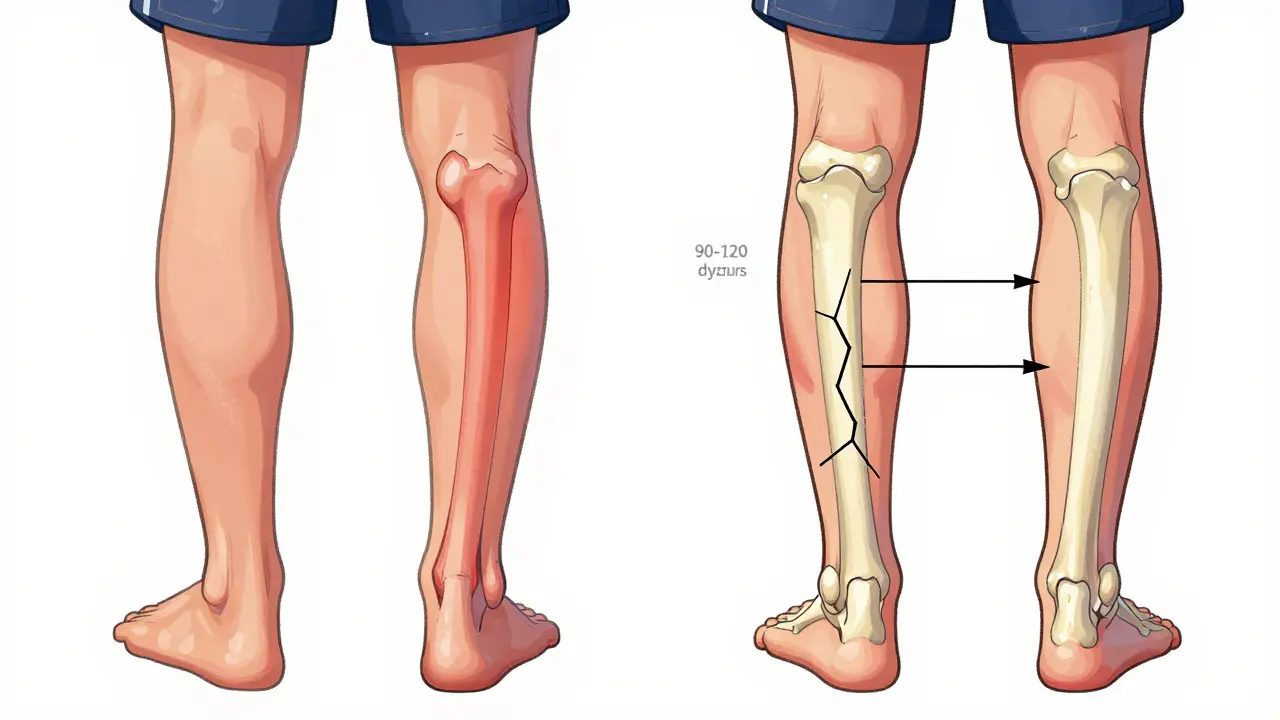
Shin splints - or medial tibial stress syndrome (MTSS) - are a diffuse, dull ache along the inner edge of your shinbone. It’s usually caused by repetitive stress on the muscle attachments and bone surface. Think of it like a bad sunburn on the inside of your leg. Pain tends to feel better after warming up, but returns after running or when you press on the area.
A tibial bone stress injury (BSI), on the other hand, is a tiny crack or severe micro-damage in the bone itself. This isn’t just inflammation. It’s structural. The pain is sharper, more localized, and often worse at night or first thing in the morning. You might even feel it when you hop on one foot. If you’ve had pain for more than two weeks despite rest, it’s not just shin splints - you’re likely dealing with a stress reaction or fracture.
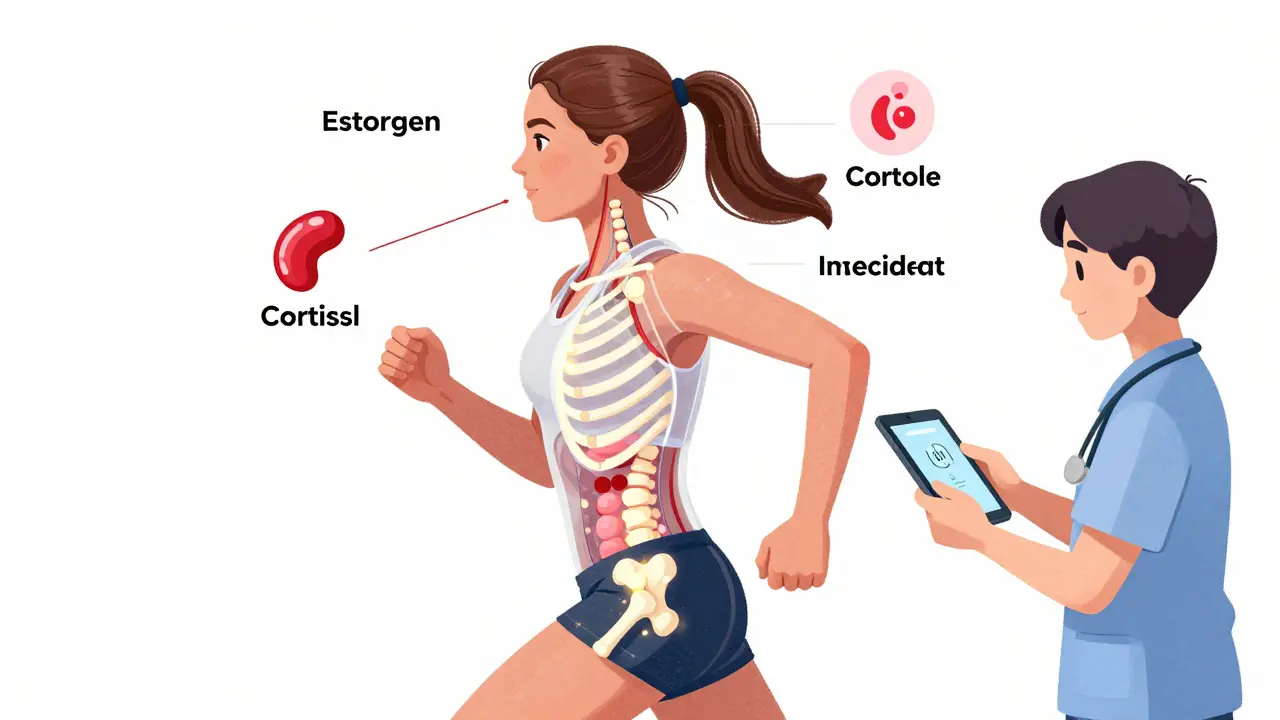
Studies show that 13.6% to 20% of all running injuries are MTSS, while stress fractures make up 2% to 16%. But here’s the kicker: women are up to three times more likely to get stress fractures than men. Why? Often, it’s not just training volume - it’s energy availability. The 2023 IOC consensus statement found that 31% of female athletes with recurring stress fractures had undiagnosed Relative Energy Deficiency in Sport (RED-S). That means not enough calories to support training, hormones, and bone repair. Fix the bone, but ignore the fuel, and it’ll happen again.
Why the 10% Rule Doesn’t Work Anymore
You’ve heard it a thousand times: “Don’t increase your mileage by more than 10% per week.” Sounds smart. But a 2024 review in Sports Medicine found that this rule fails for 68% of runners with stress fractures. Why? Because bone doesn’t adapt on a calendar. It adapts on biological time. Bone remodeling takes 90 to 120 days. If you’re pushing too hard too fast, your bone can’t keep up - no matter how careful you think you are.
What works better? A pain-guided, phase-based system. No arbitrary percentages. No rigid timelines. Just progress based on how your body responds.
The 6-Phase Return-to-Run Protocol (Evidence-Based)
There’s no one-size-fits-all plan, but research from OrthoPT, Kinetics MP, and Lever Movement shows a clear pattern across successful rehab programs. Here’s what actually works.
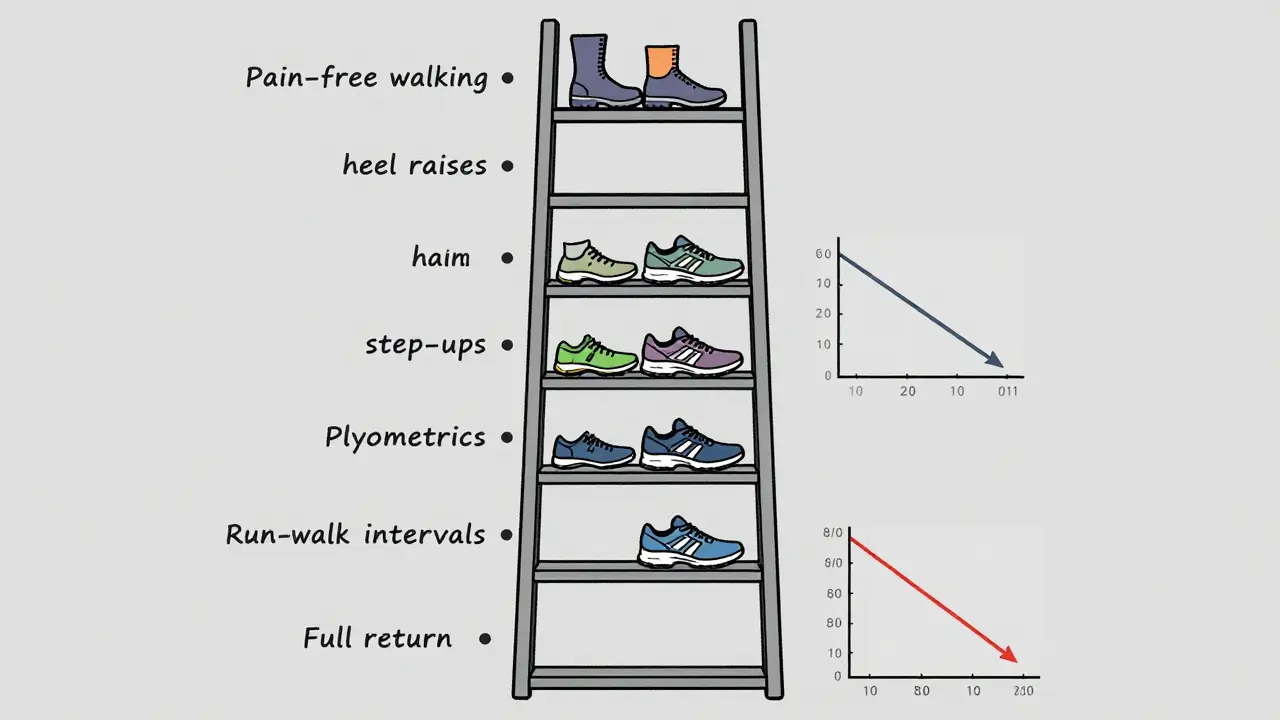
Phase 1: Pain-Free Walking First
You’re not ready to run. Not even close. First goal? Walk without pain for at least 7 straight days. This isn’t optional. If you can’t walk pain-free, you’re still in the healing phase. No running. No cycling. No elliptical if it causes discomfort.
For MTSS, this phase lasts 3-10 days. For stress fractures? 4-6 weeks. Yes, weeks. If you rush this, you risk turning a stress reaction into a full fracture.
Phase 2: Gentle Loading - Heel Raises
Once walking is pain-free, you start loading the bone - slowly. Double-leg heel raises are the gold standard. Do 3 sets of 15-20 reps daily, on flat ground. No jumping. No bouncing. Just slow, controlled lifts. Keep the pain under 2/10 during and after. If it spikes higher, back off.
For MTSS, this starts around day 7-10. For stress fractures, wait until week 4-6. This is where most people fail - they start too early because they’re bored or frustrated.
Phase 3: Full Range Strength - Step-Ups
Now you add height. Stand on a step or low box. Do heel raises going up and lowering down slowly. 3 sets of 10-15 reps. Focus on control, not speed. This builds strength through the full range of motion your ankle and calf need for running.
Don’t skip this. Weak calves = more stress on the tibia. And if your glutes are weak? That’s another problem. 57% of runners who skipped hip strengthening had a recurrence within 3 months. Do clamshells, side leg raises, and banded walks 3 times a week.
Phase 4: Explosive Strength - Plyometrics
Once heel raises are easy, you introduce controlled bouncing. Start with double-leg hops - 2 sets of 10-15 reps. Do them on a soft surface, like grass or a mat. No single-leg hops yet. Wait until you can do double-leg hops pain-free for 2 weeks before moving to single-leg.
This phase trains your tendons and bones to handle impact again. But if you rush it? You’ll feel that familiar ache return. And this time, it’ll be worse.
Phase 5: Run-Walk Progression - The Real Test
Now you get back to running. But not how you think.
For low-risk stress fractures (posterior medial tibia), the Lever Movement protocol is clear:
- Week 1-2: 1 minute run, 4 minutes walk. Total 20 minutes. 2-3 times per week.
- Week 3: 1:3 ratio. 25 minutes total.
- Week 4: 1:2 ratio. 30 minutes total.
- Week 5: 1:1 ratio. 35 minutes total.
- Week 6: 3:1 ratio. 40 minutes total.
High-risk sites - like the front of the shin, femoral neck, or navicular bone - need 8-12 weeks. No shortcuts.
And here’s the rule: if pain goes above 2/10 during or after, go back one step. Not one day. One full phase.
Phase 6: Full Return - But Not Back to Normal
Once you’re running 40 minutes at a 3:1 ratio without pain, you’re ready to slowly increase distance. But don’t jump to your old mileage. Add no more than 5% per week. And keep your rest days. Protocols that require at least one full rest day between runs cut recurrence by 34%.
Also, ditch the heel lifts. Research from Dr. Casey Kerrigan shows they only reduce tibial strain by 12-15%. Gait retraining - changing how you land - cuts it by 38%. Work with a physical therapist to fix overstriding or heel striking. It’s not about being “light on your feet.” It’s about letting your body absorb impact properly.
What Happens When People Skip the Steps?
Reddit’s r/running has over 1,200 posts on this. The pattern is clear.
Users who followed a structured plan had a 63% success rate. Those who went back too soon? Only 29% stayed injury-free.
One runner wrote: “I jumped to 1:1 after just two pain-free days. Three weeks later, I was back in the boot.”
Another said: “The 1:4 ratio made me feel like I was still running, not just walking.” That’s the psychological win - you’re not losing your identity as a runner. You’re healing smart.
What Else Should You Be Doing?
Running isn’t just about your legs. It’s about your whole system.
- Calories matter. If you’re restricting food to lose weight, you’re starving your bones. Eat enough. Period.
- Calcium and vitamin D. 1,200 mg calcium and 1,000 IU D3 daily if you’re not getting enough from food or sun.
- DXA scans. If you’ve had more than one stress fracture, get a bone density scan. 27% of recurrent cases show low bone mineral density.
- Cross-train. Pool running, cycling, swimming - keep your heart strong while your bone heals. Anti-gravity treadmills (like AlterG) can reduce recovery time by 27 days if available.
- Monitor with tech. Devices like the WHOOP strap now track bone strain. If it’s spiking, back off. It’s not magic - it’s data.
When to See a Pro
If you’ve had pain for more than 2 weeks, get an MRI. X-rays won’t show early stress fractures. An MRI will. And if you’re a woman with recurring injuries? Get screened for RED-S. It’s not just “not eating enough.” It’s hormonal disruption that stops bone repair.
And if you’re in a rural area? Telehealth PT is now a thing. Mayo Clinic is piloting remote rehab programs. You don’t need to live near a sports clinic to get expert guidance.
The Bottom Line
Shin splints and stress fractures aren’t the same. One is a warning. The other is a red flag. You can’t rush bone healing. But you can heal smart.
Follow the phases. Listen to your pain. Eat enough. Strengthen your hips. Relearn your stride. And don’t go back to running until your body says yes - not your ego.
It’s not about getting back fast. It’s about staying out of the clinic for good.
Sue Stone
January 22, 2026 AT 19:20Been there. Thought it was just shin splints. Turned out to be a stress fracture. Took me 11 weeks to get back. Don't rush it.
Susannah Green
January 23, 2026 AT 13:14I love how this breaks it down-no fluff, just the facts. Phase 2 with heel raises? That’s where I blew it last time. Did them too fast, too hard. Pain hit like a truck. Now I do them slow, like I’m lifting a baby bird. 3 sets, no rush. Game changer.
Janet King
January 24, 2026 AT 03:19The 10% rule is outdated. Bone remodeling requires 90 to 120 days. This is supported by multiple peer-reviewed studies. Adherence to pain-guided progression reduces recurrence by 50% or more. Evidence-based protocols are not optional.
dana torgersen
January 24, 2026 AT 08:03why do we always think our bodies are machines?? you can't just 'program' healing like a software update... bone isn't code, it's living tissue that needs rest, food, and patience... and yet we keep trying to hack it... i'm guilty too... i tried to 'run through' my last one... big mistake... now i just sit and breathe and wait... it's weirdly peaceful...
Stacy Thomes
January 25, 2026 AT 11:50YOU GOT THIS. I was out for 6 months. Now I’m running 50 miles a week. Phase 4 saved me. Don’t skip the hops. Your tendons remember. Your bones forgive if you’re patient. You’re not losing time-you’re investing in forever.
Vanessa Barber
January 25, 2026 AT 12:09Actually, most of this is overblown. I had shin pain for 3 weeks, kept running, and it went away. No MRI needed. Probably just tight calves. All this phase stuff feels like overkill.
Laura Rice
January 27, 2026 AT 11:01Vanessa, I hear you. But hear me too-your body doesn't lie. I did what you did. Thought I was tough. Two months later, I was in a boot. And then I found out I had RED-S. It wasn't just about running. It was about fuel. About sleep. About letting myself rest without guilt. You’re not weak for slowing down. You’re wise.
Oladeji Omobolaji
January 29, 2026 AT 06:20Back home in Nigeria, we don't have MRI machines everywhere. But we know pain. If you can't walk without limping, you rest. No fancy phases. Just stop. Eat yam. Sleep. Come back slow. Same result. Science or not, the body speaks the same language.
Kerry Moore
January 29, 2026 AT 16:57The correlation between energy availability and bone injury in female athletes is statistically significant. The 2023 IOC consensus statement is a critical reference point. It is recommended that clinicians screen for RED-S in any patient with recurrent stress fractures, regardless of BMI or reported dietary intake.
Sallie Jane Barnes
January 31, 2026 AT 08:32When I started Phase 5, I cried. Not from pain-from relief. I’d spent months feeling like a failure because I couldn’t run. But this plan made me feel like an athlete again, not a patient. And the 3:1 ratio? That was the moment I realized I wasn’t losing my identity. I was reclaiming it.
Dawson Taylor
January 31, 2026 AT 23:12Healing is not linear. Progress is not measured in miles. It is measured in stillness, in listening, in the quiet refusal to rush what time requires. The body does not negotiate. It only responds.
Anna Pryde-Smith
February 1, 2026 AT 07:54THIS IS WHY PEOPLE GET HURT. You think you’re being smart by following a ‘protocol’? You’re just being passive. The real answer? Run less. Eat more. Sleep more. Stop overthinking. Stop reading blogs. Just listen to your body. If it hurts, stop. If it doesn’t, go. No phases. No charts. Just you and your bones.