
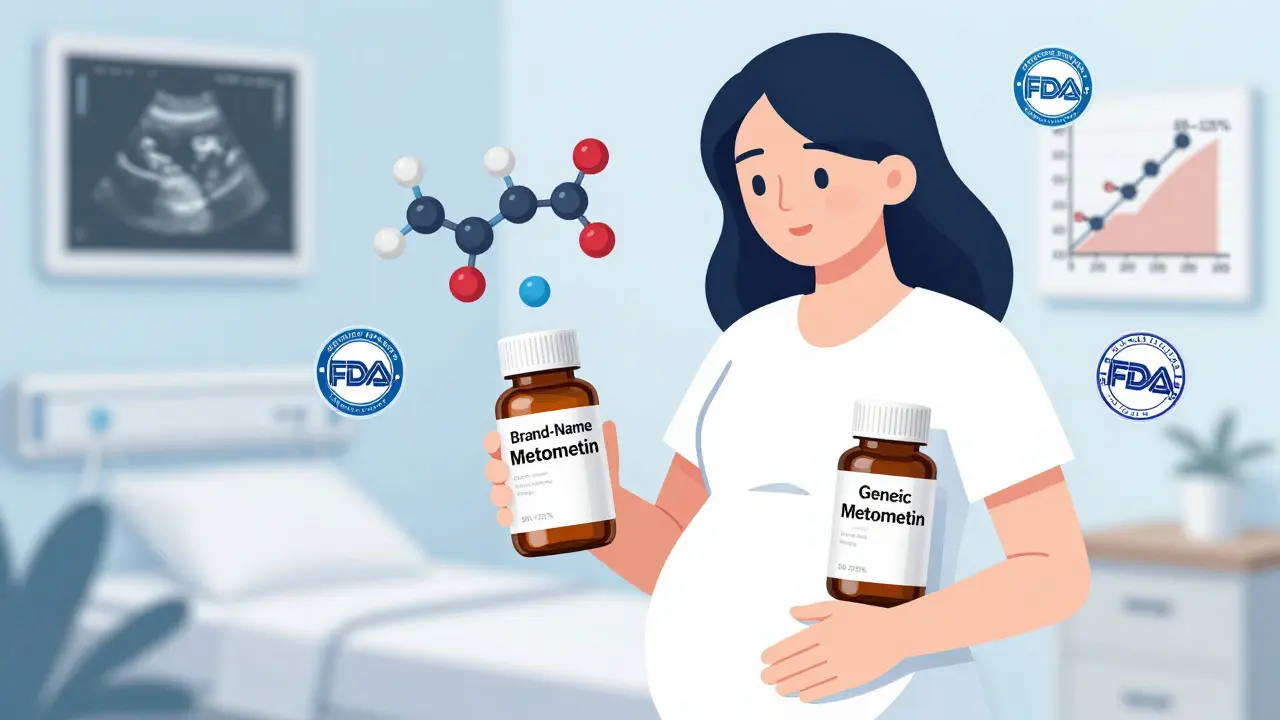
When you're pregnant, every pill you take feels like a decision with two lives on the line. You want to manage your health-whether it's high blood pressure, nausea, thyroid issues, or depression-but you also need to know if what you're taking is truly safe for your baby. That’s why so many expectant mothers ask: Are generic medications safe during pregnancy? The answer isn't as complicated as the fear around it suggests.
Generics aren't 'cheap versions'-they're identical in active ingredients
Generic medications aren’t knockoffs or lower-quality substitutes. They’re exact copies of brand-name drugs in terms of active ingredient, dosage, strength, and how they work in your body. The U.S. Food and Drug Administration (FDA) requires that generics meet the same strict standards as brand-name drugs. That means if your doctor prescribes metformin for gestational diabetes, the generic version has the same chemical structure, same dose, and same effect as the brand. The only differences are in the inactive ingredients-like fillers, dyes, or coatings-which don’t affect how the medicine works in your system.The FDA’s bioequivalence rules are strict: generics must deliver the same amount of active ingredient into your bloodstream within a narrow range (80-125%) of the brand-name drug. For high-risk drugs like levothyroxine, used to treat hypothyroidism during pregnancy, the FDA tightened that range to 90-112% in 2012 because even small changes in absorption can affect fetal brain development. Untreated hypothyroidism increases miscarriage risk by 61% and preterm birth risk by 39%. So if your doctor switches you from a brand to a generic levothyroxine, they’re doing it with extra care.
Pregnancy safety data applies equally to generics
Before 2015, drugs were labeled with letter categories (A, B, C, D, X) to show pregnancy risk. Those categories applied to both brand and generic versions. Today, the FDA uses the Pregnancy and Lactation Labeling Rule (PLLR), which gives detailed summaries of risks, clinical considerations, and data-not just a letter. And here’s the key point: the safety data from brand-name drug studies applies directly to generics.The American College of Obstetricians and Gynecologists (ACOG) says it plainly: generic medications approved by the FDA are therapeutically equivalent to their brand-name counterparts. If a brand-name prenatal vitamin is considered safe in pregnancy, so is its generic version. Same with acetaminophen for headaches, famotidine for heartburn, or doxylamine for nausea. The FDA mandates that any safety update to a brand-name drug must be reflected in all generic versions within 30 days. That’s not a suggestion-it’s a legal requirement.
What about those stories of side effects?
You’ve probably heard someone say, “I switched to generic prenatal vitamins and got worse nausea,” or “My migraine got worse after switching to generic sumatriptan.” These anecdotes are real-and they matter. But they’re not proof that generics are unsafe.A 2019 study in the Journal of Obstetrics and Gynaecology Canada looked at 127 cases of generic substitutions during pregnancy and found no significant difference in outcomes like preterm birth or low birth weight. Yet, 4.7% of doctors reported patients expressing concern after the switch. On Reddit’s r/BabyBumps, 29% of 287 respondents said generics caused more nausea than brand-name prenatal vitamins. But 63% reported no difference at all.
Why the variation? It’s likely due to inactive ingredients. Some people are sensitive to dyes, gluten, or fillers in certain formulations. If you’ve had nausea with one generic prenatal, try another brand. Not all generics are made the same way. The active ingredient-folic acid, iron, DHA-is identical, but the coating or binder might be different. That’s why pharmacists often recommend trying a different manufacturer if you have a reaction.
High-risk drugs: generics follow the same strict rules
Some medications carry serious risks during pregnancy-like isotretinoin, used for severe acne. Brand-name Accutane was infamous for causing birth defects. But the generic versions, available since 2002, are just as dangerous if misused. That’s why they’re all covered under the same iPLEDGE program. Every patient-whether taking brand or generic-must have monthly pregnancy tests, use two forms of birth control, and register with the program. The FDA’s adverse event database from 2018-2022 showed no difference in pregnancy rates between brand and generic isotretinoin: 0.21% vs. 0.23%. The risk isn’t in the generic-it’s in the drug itself.The same applies to methotrexate, thalidomide, and other high-risk drugs. The FDA’s Risk Evaluation and Mitigation Strategies (REMS) program ensures that safety protocols are identical for both brand and generic versions. No shortcuts. No exceptions.
What the data says about common pregnancy meds
Here’s what real-world evidence shows for widely used generics during pregnancy:- Metformin (for gestational diabetes): A 2021 study of 157 women using generic metformin found no difference in birth outcomes compared to brand-name use.
- Ondansetron (for nausea): A 2020 study found that 32.7% of pharmacists reported varying patient experiences across different generic manufacturers. Some women felt better; others felt worse. This isn’t about safety-it’s about individual tolerance to inactive ingredients.
- Diphenhydramine (Benadryl): Generics are just as safe as the brand for allergies or sleep. The FDA considers it Pregnancy Category B.
- Calcium carbonate (Tums): Generics are identical in active ingredient and safe for heartburn. No evidence of harm.
- Progesterone (for preventing preterm birth): Generic versions approved in 2022 are held to the same bioequivalence standards as the brand. No new safety signals reported.
The University of North Carolina’s pregnancy medication guide lists dozens of generics as safe alternatives. If a brand-name drug is approved for pregnancy, its generic is too-unless there’s a specific, documented reason not to.
What about compounded medications?
Don’t confuse generics with compounded drugs. Compounded medications are custom-mixed by pharmacies, often without FDA approval. They’re not tested for bioequivalence or safety in pregnancy. If your doctor prescribes a compounded version of a drug-like a custom thyroid dose or a flavored prenatal-you should ask: Is this FDA-approved? If not, it’s not a generic. It’s a different category entirely. Avoid them unless absolutely necessary and under close supervision.
Why do so many women still hesitate?
Despite all the data, a 2022 survey in the American Journal of Obstetrics and Gynecology found that 41.3% of obstetric providers still hear patient hesitation about generics. Why? Because fear spreads faster than facts. You see ads for brand-name drugs. You hear stories online. You worry that “cheaper” means “less effective.”But here’s the reality: 90% of all prescriptions filled in the U.S. are generics. And 66% of pregnant women take at least one prescription drug. If generics weren’t safe, we’d see a spike in birth defects or complications. We don’t. The CDC, ACOG, FDA, and MotherToBaby-all track outcomes. Their data shows no increased risk.
Dr. Siobhan Dolan, a leading expert in maternal pharmacology, puts it simply: “The molecular structure is identical. Pregnancy safety data applies equally.”
What you should do
If you’re pregnant and prescribed a medication:- Ask if a generic version is available. It’s almost always an option.
- Ask your pharmacist: “Is this generic equivalent to the brand?” They’re trained to answer this.
- If you notice a change in how you feel after switching-like more nausea, dizziness, or headaches-tell your provider. It’s not necessarily the drug. It might be the filler.
- Don’t switch back to brand-name unless your doctor recommends it. Generics save money without sacrificing safety.
- Use MotherToBaby or your OB’s resources to check the safety of any medication, brand or generic.
There’s no need to pay extra for a brand-name prenatal vitamin if the generic has the same folic acid, iron, and DHA. There’s no reason to fear a generic version of metformin if your doctor says it’s safe. The science is clear: generics are safe during pregnancy. The fear? That’s what needs to be addressed-not the medicine.
Are generic medications as safe as brand-name drugs during pregnancy?
Yes. The FDA requires generic medications to contain the exact same active ingredient, strength, dosage form, and route of administration as the brand-name version. They must also meet strict bioequivalence standards. Pregnancy safety data from brand-name drugs applies directly to their generic equivalents. ACOG, the CDC, and the FDA all confirm that generics approved in the U.S. are therapeutically equivalent and safe for use during pregnancy.
Can inactive ingredients in generics affect pregnancy?
Inactive ingredients like dyes, fillers, or coatings don’t affect how the drug works, but some people may be sensitive to them. For example, a woman might experience more nausea with one generic prenatal vitamin because of a specific dye or binder, but not with another. If you notice a change after switching generics, try a different manufacturer. The active ingredient remains the same-only the non-medicinal components differ. Compounded medications, however, are not FDA-approved and should be avoided unless medically necessary.
Do generics have the same pregnancy warnings as brand-name drugs?
Yes. The FDA requires that all generic medications carry the same pregnancy warnings, precautions, and contraindications as their brand-name counterparts. If a brand-name drug is updated with new safety information, all generic versions must be updated within 30 days. This includes high-risk drugs like isotretinoin, which are subject to the same iPLEDGE program regardless of brand or generic.
Are there any generics that shouldn’t be used during pregnancy?
No generic medication should be avoided simply because it’s generic. The safety of a drug during pregnancy depends on its active ingredient, not whether it’s branded or generic. For example, generic metformin, acetaminophen, and prenatal vitamins are all safe. The real issue is the drug itself-like isotretinoin or thalidomide-which are dangerous regardless of brand. Always consult your provider before starting or stopping any medication during pregnancy.
Why do some doctors still recommend brand-name drugs during pregnancy?
Some doctors recommend brand-name drugs out of habit, patient preference, or because they’re unfamiliar with generic alternatives. In rare cases, they may have seen an individual patient react differently to a specific generic formulation. But this doesn’t mean generics are unsafe. ACOG explicitly advises providers not to hesitate to prescribe generics when indicated. The science supports their use, and cost savings can improve adherence-especially for long-term medications like thyroid hormone or antidepressants.
How can I check if a generic medication is safe during pregnancy?
Use trusted resources like MotherToBaby (a service of the Organization of Teratology Information Specialists), the FDA’s Pregnancy and Lactation Labeling Rule database, or your OB’s recommended guides. You can also ask your pharmacist-they’re required to counsel pregnant patients on medication safety. Never rely on social media or anecdotal stories. Look for evidence-based sources that cite clinical studies or regulatory agencies.
Cassie Widders
January 12, 2026 AT 14:00I switched to generic prenatal vitamins last trimester and didn’t notice a thing. My OB said it was fine, and my baby came out healthy. Sometimes the fear is worse than the medicine.
Also, I saved like $40 a month. That’s a whole grocery run.
Konika Choudhury
January 12, 2026 AT 20:18USA thinks generics are safe but in India we know the truth. Cheap meds = cheap results. Why trust a pill made in a factory with no quality control? My cousin’s baby had jaundice after her generic folic acid. Coincidence? I think not.
Brand name is the only way. Money saved is baby’s health lost.
Darryl Perry
January 13, 2026 AT 03:51The FDA’s bioequivalence standards are not rigorous enough for pregnancy. The 80-125% range is absurd. A 25% variation in absorption for a drug crossing the placenta is reckless.
This article reads like an industry pamphlet. Where’s the independent data?
Windie Wilson
January 15, 2026 AT 03:07Oh so now we’re supposed to trust the same FDA that approved thalidomide in the 50s? And now they’re telling us generics are fine? Sweetheart, I’ve seen the ads for brand-name prenatal vitamins. They show glowing moms with golden hair and zero nausea.
Meanwhile, my generic made me feel like I swallowed a brick wrapped in regret. But hey, at least it’s cheaper.
Also, why does every article on this topic sound like it was written by a pharmacist on a caffeine high?
Amanda Eichstaedt
January 17, 2026 AT 00:13I spent months researching this before I got pregnant. I read the FDA’s full PLLR documents, ACOG guidelines, and even dug into the clinical trial data from the 2021 metformin study. The truth is, the active ingredient doesn’t change. What changes is your body’s reaction to the filler-like gluten or dyes. That’s why some people swear their generic made them sick.
But here’s the thing: if you switch from one generic to another and feel better, it’s not magic. It’s chemistry. The same folic acid. Different binder. Try a different brand. Don’t panic. Don’t go back to the expensive one unless your doctor says so.
Also, please stop calling them ‘cheap versions.’ That’s not just wrong-it’s insulting to the pharmacists who test these things daily.
And yes, I’m a pharmacist. And yes, I took generics during my pregnancy. My daughter is now 3 and she runs like a cheetah. No birth defects. No issues. Just a smart mom who did her homework.
Jose Mecanico
January 18, 2026 AT 00:19My wife took generic levothyroxine. We monitored her TSH every 4 weeks. Numbers stayed perfect. Baby was fine. No drama.
Just saying.
Alex Fortwengler
January 18, 2026 AT 02:25They’re lying to you. The FDA doesn’t test generics. They just look at the paperwork. Big Pharma owns the FDA. The real active ingredient? It’s in the packaging. The pills are different. They use different chemicals. You think your body can’t tell the difference? You’re wrong.
My neighbor’s kid had autism after her mom took generic Zofran. Coincidence? Nah. It’s the fillers. They’re full of neurotoxins.
And don’t even get me started on the iPLEDGE program. That’s a trap. They want you to think you’re safe. You’re not.
Go brand. Always. Even if it costs your rent.
jordan shiyangeni
January 18, 2026 AT 10:21It is a moral failure of modern medicine that we have allowed the commodification of pharmaceuticals to such a degree that pregnant women are being told to accept statistically insignificant variations in bioavailability as ‘safe.’ The FDA’s 80-125% bioequivalence window is not a scientific standard-it is a corporate compromise. When you are administering a substance across the placental barrier, where fetal neurodevelopment occurs in a window measured in nanomoles, even a 20% fluctuation in plasma concentration constitutes an unacceptable risk. The fact that this is normalized under the banner of ‘cost savings’ reveals the profound ethical bankruptcy of our healthcare system. And yet, we are told to trust the same institutions that permitted thalidomide, DES, and Vioxx. Where is the accountability? Where is the precautionary principle? This article is not informative-it is an act of medical gaslighting disguised as advocacy.
And for the record, if your child has a developmental delay, don’t blame the filler. Blame the system that told you it was fine.
Abner San Diego
January 19, 2026 AT 07:32Generics are fine unless you’re in a state that lets any pharmacy fill your script. I got a generic that had a different coating. Made me nauseous for weeks. Switched back to brand. Problem gone.
So yeah, maybe the science says they’re the same. But the body doesn’t read FDA guidelines. It reacts to what’s in the pill.
Also, why do all these articles sound like they were written by a Walmart pharmacist trying to hit a KPI?
Eileen Reilly
January 20, 2026 AT 11:10ok but like… i took generic metformin and it made me feel like my insides were being scrubbed with steel wool. i switched to brand and it was like a warm hug. so no, not all generics are the same. also why is everyone so chill about this? like… you’re literally growing a human. maybe don’t gamble on the cheapest pill.
also who wrote this? it sounds like a drug rep wrote it while on a 3pm coffee run.
Monica Puglia
January 21, 2026 AT 13:30My OB told me to get the generic prenatal and I did. Best decision ever. Saved me $50 a month and my baby is thriving 😊
Also, if you’re scared, talk to your pharmacist. They’re the real MVPs. And yes, the active ingredients are the same. You got this 💪
Cecelia Alta
January 21, 2026 AT 16:31Let me tell you what really happened. I took a generic prenatal. The next day I felt like I’d been hit by a truck. Nausea so bad I couldn’t even look at water. I went to the pharmacy and asked if they had another brand. They gave me a different generic. Same active ingredients, different filler. I took it. No nausea. Zero.
So here’s the truth: it’s not about brand vs generic. It’s about which generic. There are 17 different manufacturers of prenatal vitamins. One of them might have a dye that makes you want to vomit your soul out. Another might have a coating that’s like swallowing a marshmallow.
But nobody tells you this. The article just says ‘it’s all the same.’ No. It’s not. And if you’re one of the 4.7% who has a reaction, you’re just supposed to suck it up? That’s not science. That’s corporate negligence wrapped in a pretty infographic.
And don’t get me started on the ‘mother to baby’ hotline. I called them. They read me a script. No empathy. Just facts. Like I’m a robot. I’m a pregnant woman. I’m scared. I need to know if this pill is going to kill my baby. Not a chart.
So yeah. Generics? Maybe. But don’t pretend it’s simple.
steve ker
January 23, 2026 AT 02:24Generics are fine. Why overthink. People in Africa take generics. Babies born fine. USA overmedicalizes everything. Stop worrying. Take pill. Live life.
George Bridges
January 24, 2026 AT 07:53I just want to say thank you for writing this. I’ve been so scared about switching from brand to generic levothyroxine. I read all the studies. I talked to my OB. I even called MotherToBaby. And you’re right-it’s the same molecule. The fear is real, but the data is clearer than I thought.
My baby is due in 6 weeks. I’m taking the generic. And I’m not afraid anymore.
Thank you.