
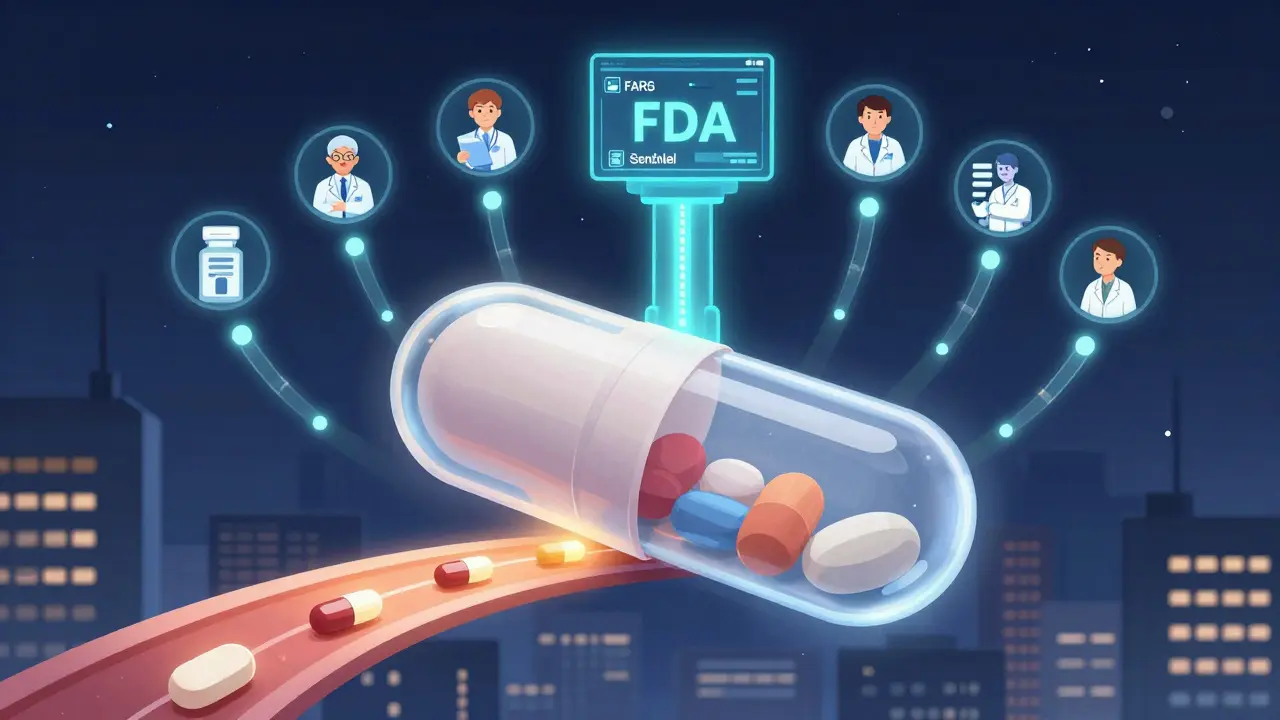
When you pick up a generic pill at the pharmacy, you expect it to work just like the brand-name version. But how does the FDA make sure it actually does-especially after it’s already on the shelf? Unlike new drugs, generics don’t go through years of clinical trials. Instead, they’re approved based on proving they’re bioequivalent to the original. That means the same active ingredient, in the same dose, absorbed the same way. But bioequivalence doesn’t catch everything. That’s where post-market surveillance comes in.
Why Generic Drugs Need Extra Monitoring
Generics make up about 90% of all prescriptions filled in the U.S. That’s over 4 billion prescriptions a year. They save billions in healthcare costs. But because they’re approved faster and with less testing, the FDA has to watch them closely after they hit the market. A drug that works perfectly in a trial of 500 people might cause unexpected problems in millions. A patient with a rare genetic condition might react badly. A different inactive ingredient-like a dye or filler-might trigger an allergy. Or a manufacturing flaw might creep in during mass production.
The FDA doesn’t assume everything’s fine just because the drug passed initial tests. It knows the real world is messier. That’s why they’ve built a system to catch problems after approval-not before.
The Tools the FDA Uses to Watch Generics
The FDA doesn’t rely on one tool. It uses a network of systems that work together:
- FAERS (FDA Adverse Event Reporting System): This is the main database where doctors, pharmacists, patients, and drug companies report side effects, allergic reactions, or when a drug didn’t work as expected. Anyone can file a report through MedWatch. In 2023 alone, over 2 million reports came in-about 30% involving generics.
- Sentinel Initiative: This system scans real-world data from health insurance claims and electronic health records of over 200 million Americans. It looks for patterns-like a spike in kidney injuries among people taking a specific generic blood pressure pill. Unlike FAERS, which collects individual reports, Sentinel finds trends automatically.
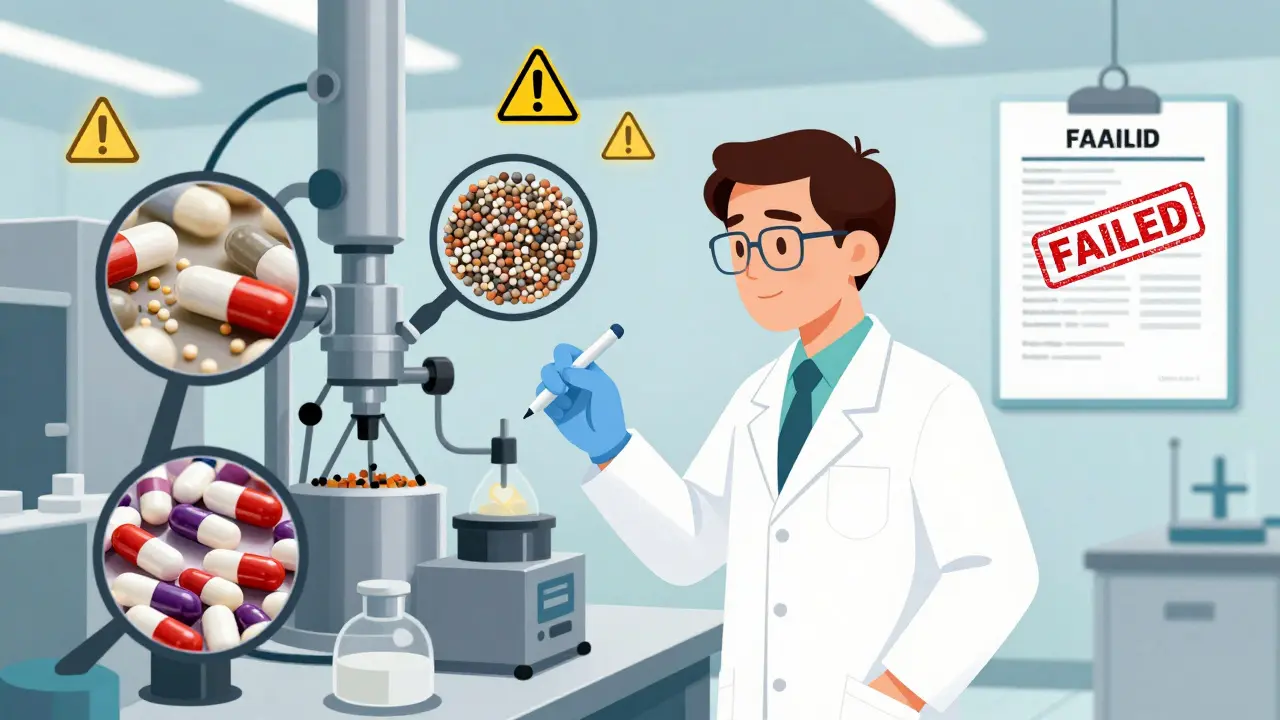
- Unannounced Inspections: The FDA sends inspectors to generic drug factories without warning. They check if the manufacturing process still matches what was approved. A single change in the mixing machine or raw material source could affect quality. In 2022, FDA inspectors shut down three overseas generic drug plants for failing to meet standards.
- Proactive Screening by the Office of Generic Drugs: The FDA doesn’t wait for reports to pile up. They actively mine MedWatch data for early warning signs. If a certain generic version of a diabetes drug starts showing more reports of low blood sugar than others, they dig in-fast.
Where It Gets Tricky: Complex Generics
Not all generics are created equal. Simple pills-like metformin or lisinopril-are easy to copy. But what about an inhaler? Or a topical cream? Or a slow-release capsule? These are called complex generics. They’re harder to match exactly because their effectiveness depends on how the drug is delivered, not just how much is in it.
A 2021 report from the National Academies found that for complex generics, bioequivalence doesn’t always mean therapeutic equivalence. Two inhalers might have the same active ingredient, but if one delivers the drug deeper into the lungs, a patient could get better control-or worse, have more side effects.
The FDA has been working on this for years. In 2020, they funded a research center at the University of Maryland to study these complex products. In 2023, they spent $5.2 million on AI and machine learning projects to spot safety signals faster. The goal? To predict problems before patients get hurt.
What Happens When Something Goes Wrong?
When a pattern emerges-say, multiple reports of a generic seizure drug causing confusion in elderly patients-the FDA doesn’t wait. They investigate. They might:
- Ask the manufacturer to change the label to warn about the risk
- Issue a public alert to doctors and pharmacists
- Require the company to conduct a new study
- Order a voluntary recall if the risk is serious
In 2021, the FDA updated the label for a generic version of a blood thinner after reports linked it to higher bleeding rates in older adults. The manufacturer didn’t change the formula-they just added a stronger warning. That’s surveillance working as intended.
The Human Factor: Perception vs. Reality
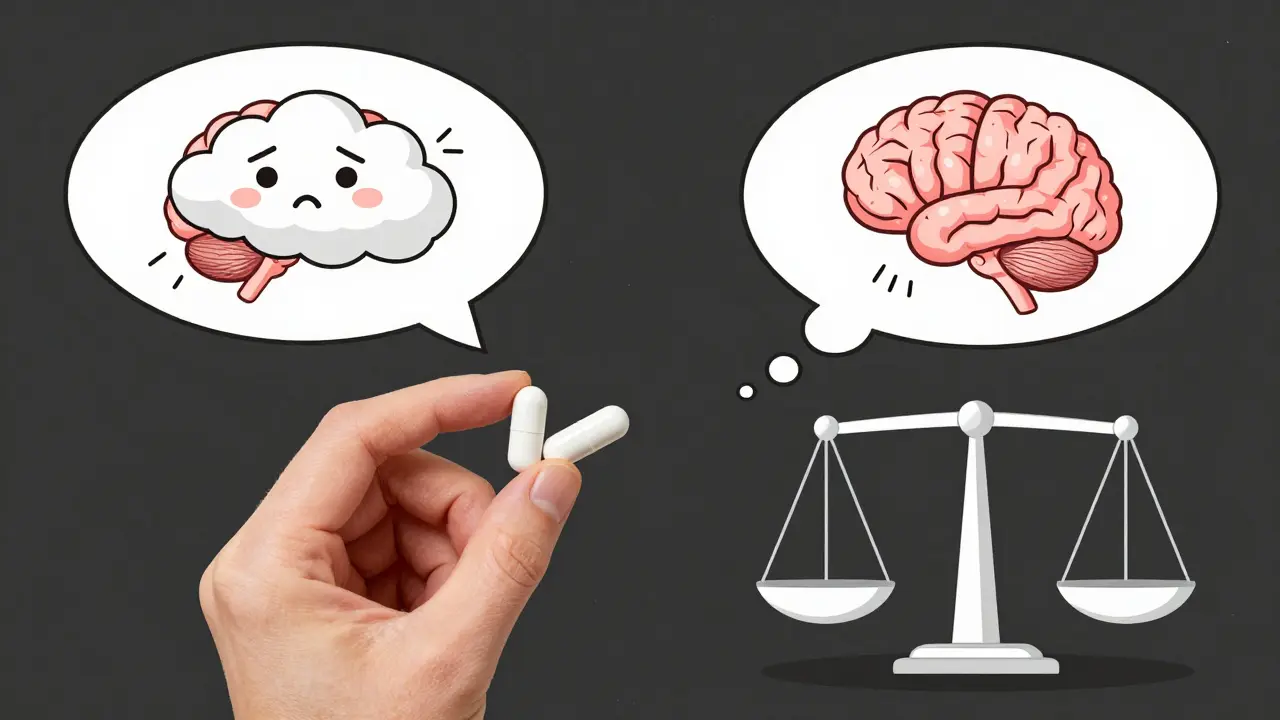
Here’s one of the toughest parts: sometimes, the problem isn’t the drug-it’s the patient’s belief about it.
Studies show that when people switch from a brand-name drug to a generic, some report side effects they never had before-even if the generic is chemically identical. This is called the “nocebo effect.” If someone believes generics are inferior, their brain can actually create symptoms.
But that doesn’t mean the concern is imaginary. A 2019 JAMA study found that 15% of adverse event reports for generics involved complaints about reduced effectiveness. In many cases, no biological difference was found. But the FDA still investigates each one. Why? Because if patients stop taking their meds because they think the generic doesn’t work, that’s a public health risk.
What’s Next for Generic Drug Safety?
The FDA is moving fast. By 2027, they plan to use AI to analyze real-world data and flag safety issues in weeks-not months. They’re also pushing for better data sharing between pharmacies, hospitals, and insurers. And they’re working on creating specific surveillance rules for each type of complex generic-like inhalers, patches, and injectables.
But challenges remain. Critics say the system is underfunded. Public Citizen, a consumer advocacy group, argues that the FDA doesn’t have enough staff to properly review all the reports. And with over 15,000 generic drugs approved since 1984, the workload keeps growing.
Still, the system works. Most generics are safe. Most work just fine. But the FDA’s job isn’t to assume safety-it’s to prove it, every day, for billions of pills.
What You Can Do
You don’t have to wait for the FDA to find a problem. If you notice something unusual after switching to a generic-new side effects, no improvement, or a strange reaction-report it. Go to MedWatch and file a report. Your input helps. So does talking to your doctor. If you’re worried about a generic, ask: "Is there a reason this one was chosen?" Sometimes, the answer is cost. But sometimes, it’s safety.
Generic drugs are essential. They keep healthcare affordable. But affordability shouldn’t mean lower safety. The FDA’s surveillance system is the quiet backstop that keeps that promise alive.
Are generic drugs as safe as brand-name drugs?
Yes, in most cases. Generic drugs must meet the same strict standards as brand-name drugs for quality, strength, purity, and performance. The FDA requires them to be bioequivalent, meaning they work the same way in the body. But because generics don’t go through the same long-term clinical trials, the FDA relies on post-market surveillance to catch rare or delayed side effects that might not show up during approval.
How does the FDA know if a generic drug is causing problems after it’s on the market?
The FDA uses multiple systems. The main one is FAERS, where patients, doctors, and manufacturers report side effects. They also use the Sentinel Initiative, which analyzes health data from over 200 million people to spot unusual patterns. Unannounced inspections of manufacturing plants check for quality issues. And the Office of Generic Drugs actively scans reports to find early warning signs.
Can a generic drug be different from the brand-name version?
The active ingredient must be identical. But the inactive ingredients-like fillers, dyes, or coatings-can be different. For simple pills, this rarely matters. But for complex generics like inhalers, patches, or slow-release capsules, these differences can affect how the drug is absorbed or delivered. That’s why the FDA has special rules and extra monitoring for these types of drugs.
What should I do if I think my generic medication isn’t working?
Don’t stop taking it without talking to your doctor. But do report your experience. Use MedWatch to file a report with the FDA. Keep track of symptoms, when they started, and whether they happened after switching to the generic. Your doctor can help determine if it’s a real issue or a perception effect-and may switch you to another generic or the brand-name version if needed.
Is the FDA doing enough to monitor generics?
The FDA has one of the most advanced post-market surveillance systems in the world. But experts agree it’s under strain. With over 15,000 approved generics and rising use of complex formulations, resources are stretched thin. The agency is investing in AI and machine learning to improve detection speed, but more funding and staffing would help. Consumer advocates argue for stronger rules on complex generics, and the FDA is working on it.
Kristina Felixita
January 9, 2026 AT 08:25Okay but like… I switched to a generic blood pressure med last year and suddenly I felt like a zombie? Like, not even exaggerating-I napped during my Zoom meeting. My doctor said it’s ‘all in my head’ but… what if it’s not??
Ken Porter
January 10, 2026 AT 04:23USA makes the best drugs. If a generic works, it’s because American science made it possible. Stop trusting foreign factories.
Dave Old-Wolf
January 10, 2026 AT 10:36I’m just wondering-how do they even test a cream or inhaler to make sure it’s the same? Like, you can’t just swallow it and see if it works the same. It’s gotta be way harder than pills. Do they use robots or something?
Prakash Sharma
January 11, 2026 AT 22:38India makes 40% of the world’s generics. If you’re worried about safety, stop buying Indian drugs. We don’t cut corners. Our labs are world-class. You just don’t know because you don’t care.
Donny Airlangga
January 12, 2026 AT 08:59I had a cousin who stopped her antidepressant after switching to generic. Said she felt ‘empty.’ She went back to brand and cried happy tears. That’s not placebo. That’s real.
Molly Silvernale
January 13, 2026 AT 19:12Generics are the silent heroes of modern medicine-unseen, unthanked, and quietly holding up the entire system while the rest of us scream about brand-name prices… and then panic when our body doesn’t instantly obey the new pill like it’s a magic spell. It’s not magic. It’s chemistry. And chemistry? It’s messy. Beautiful. Unforgiving. And somehow, still working.
Joanna Brancewicz
January 14, 2026 AT 15:29FAERS data is noisy. Sentinel is better. But both need better normalization. We’re drowning in signals, starving for insights.
swati Thounaojam
January 16, 2026 AT 12:54my mom took generic metformin and got rash… we changed back to brand. no more rash. simple.
Luke Crump
January 16, 2026 AT 14:11So the FDA is basically playing whack-a-mole with pills? You mean to tell me we’re trusting algorithms and random reports from people who think their coffee is making them dizzy? This isn’t science-it’s a TikTok trend with a government badge.
Manish Kumar
January 17, 2026 AT 13:41Let me tell you something, my friend. In India, we don’t just make generics-we make them with heart. We understand that medicine is not just chemistry, it is compassion. When a man in Bihar takes a generic insulin because he can’t afford the brand, he doesn’t care about bioequivalence-he cares that he can breathe. The FDA has machines. We have meaning. And that’s why our generics are not just safe-they are sacred.
Aubrey Mallory
January 18, 2026 AT 06:20Everyone’s talking about safety, but what about access? If we don’t have generics, millions can’t afford treatment. So yes, the system’s imperfect-but it’s the only thing standing between poverty and death for a lot of people. Don’t tear it down. Fix it.
Evan Smith
January 19, 2026 AT 18:36So… if I report my weird headache after switching generics, does the FDA send me a thank-you card? Or just add it to the 2 million other reports and forget about it? 😅
christy lianto
January 20, 2026 AT 13:23You know what’s wild? The FDA doesn’t just wait for problems-they hunt them. Like digital detectives with lab coats. And you? You can be part of it. Just report it. Seriously. One report might save someone’s life. Don’t be quiet.