
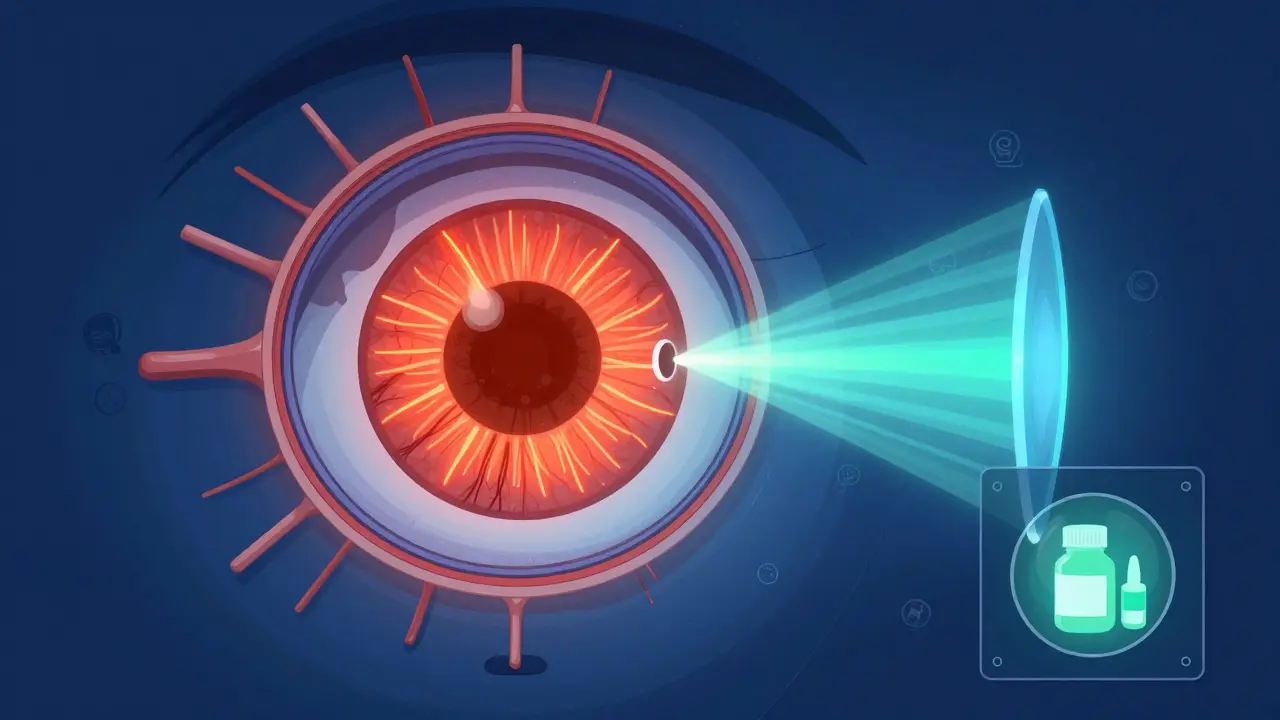
Light hurts your eyes. Not just when you step outside on a sunny day, but even under office fluorescent lights, or when you turn on the bathroom light in the morning. If this sounds familiar, you’re not alone. About photophobia affects 35% of people at some point in their lives, and for many, it’s not just discomfort-it’s a disabling symptom that stops them from working, driving, or even watching TV.
Here’s the thing: photophobia isn’t a disease. It’s a warning sign. Your eyes are telling you something’s wrong inside, and ignoring it can delay treatment for serious conditions like uveitis, meningitis, or chronic migraines. The good news? Most cases improve dramatically once you know what’s causing it-and how to manage it.
What’s Really Going On When Light Hurts?
Photophobia happens when your brain and eyes overreact to light. Normal eyes adjust quickly: pupils shrink, brain filters out glare. But in photophobia, the pupillary reflex is broken. Instead of shutting down at 5-10 lux (a dimly lit room), your eyes react painfully at just 0.5-2.0 lux-like a flashlight turned on in a dark theater.
Studies using fMRI show that photophobic brains light up 3.2 times more in the thalamus under normal office lighting (500 lux) than healthy brains. This isn’t just about brightness-it’s about how certain wavelengths trigger nerve pathways. Blue-green light between 500-550nm is the worst offender. That’s why regular sunglasses don’t always help-they block UV and reduce overall brightness, but they don’t filter the specific wavelengths that trigger pain.
Three Main Causes (And What They Mean for You)
Photophobia doesn’t come out of nowhere. It’s tied to one of three root causes:
- Eye conditions (45% of cases): Uveitis, corneal abrasions, albinism, or dry eye syndrome. If you’ve had recent eye pain, redness, or blurred vision along with light sensitivity, this is likely the culprit. Uveitis, in particular, shows photophobia in 92% of cases before any other symptoms appear.
- Neurological issues (40% of cases): Migraines are the biggest player here. Between 76% and 80% of migraine sufferers experience photophobia during attacks. But it’s not just migraines-concussions, traumatic brain injuries, and even Parkinson’s can trigger it. The difference? Migraine-related photophobia comes from cone-driven retinal pathways, while meningitis or encephalitis triggers rod-driven pathways.
- Medications (15% of cases): Certain antibiotics, antihistamines, antidepressants, and even some acne treatments can make your eyes hypersensitive. If you started a new drug and light suddenly became unbearable, talk to your doctor before stopping anything.
Women between 25 and 55 are most affected-65% of cases. That’s partly hormonal, partly because autoimmune disorders like lupus (which accounts for 46% of non-eye-related photophobia) are more common in this group. If you’re a woman with unexplained light sensitivity, don’t brush it off as “just stress.”
How Bad Is Your Photophobia? The Three Levels
Not all light sensitivity is the same. It falls into three clear tiers:
- Mild (48%): Only painful in direct sunlight. You can handle indoor lighting fine.
- Moderate (37%): You need sunglasses indoors under fluorescent or LED lights. Office work becomes a struggle.
- Severe (15%): Even 50-lux lighting-like a dimly lit living room-causes pain. You avoid windows, turn off lights, and may miss work or school.
The Photophobia Severity Scale (PSS-10) is the standard tool doctors use. A score above 25 means your daily life is significantly impacted. In severe cases, visual acuity drops to 20/40 or worse in bright light. That’s the difference between reading a menu clearly and squinting at it.
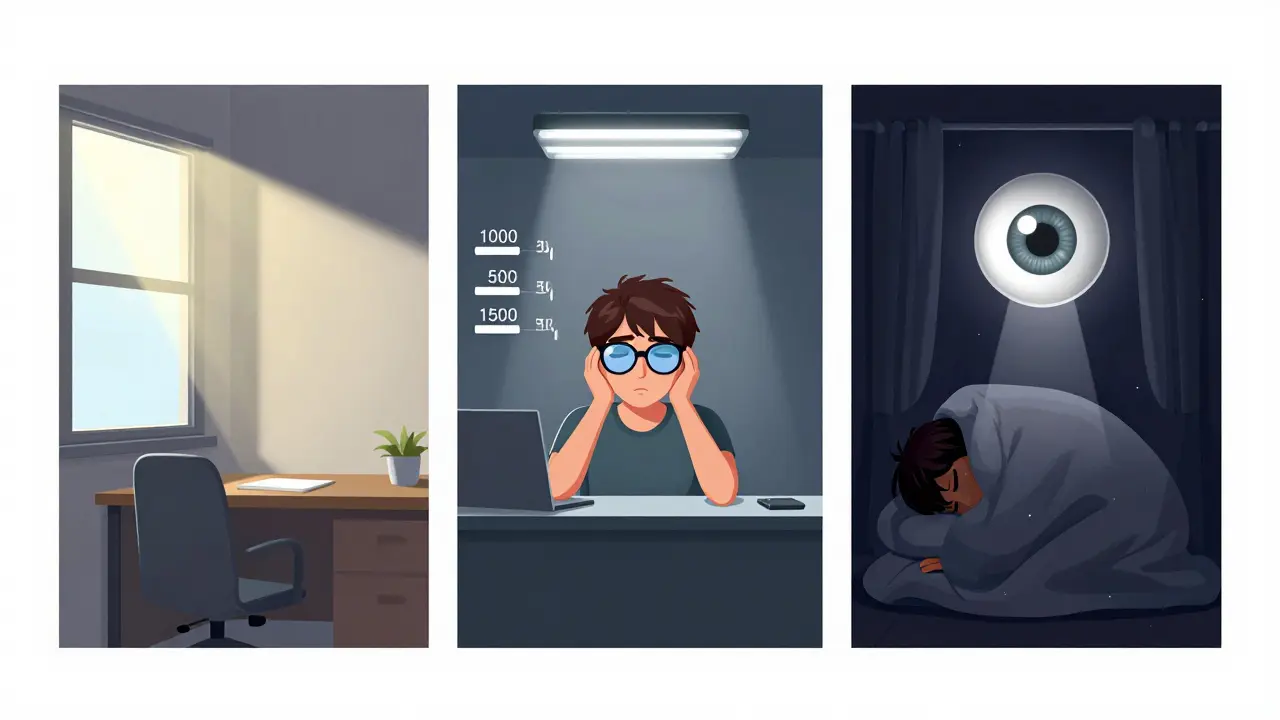
The FL-41 Lens Solution: More Than Just Tinted Glasses
Here’s where things get practical. The most effective, research-backed solution for photophobia isn’t prescription medication-it’s a specific lens tint: FL-41.
Unlike blue-light blocking glasses (which target 415-455nm), FL-41 filters the exact range that triggers pain: 500-550nm. It blocks 70% of that problematic green-blue light while letting through enough visible light to see clearly. In clinical trials, users reported a 43% reduction in symptoms. For migraine sufferers, it even reduces cortical spreading depression-the brain wave pattern behind migraines-by 31%.
Brands like TheraSpecs dominate the market with 63% share, priced around $149 per pair. Amazon reviews average 4.2/5. Users report: “Reduced my migraines from 18 to 5 per month in three weeks.”
But here’s the catch: not all “photophobia glasses” are FL-41. Many cheap ones on Amazon are just dark lenses or wrong wavelengths. One Reddit user wrote: “Wore blue-light glasses for months-made it worse. Didn’t block the right light.” Always check the product specs. Look for “FL-41,” “500-550nm,” or “migraine-specific.”
What Doctors Won’t Always Tell You
Many patients spend months-or years-misdiagnosed. A 2022 Good Eyes survey found 82% of people initially told they had “just migraines” actually had uveitis. Another 63% had delayed treatment because doctors dismissed their symptoms as “normal sensitivity.”
The American Academy of Neurology warns that over-relying on tinted lenses without diagnosis misses treatable conditions in 22% of cases. Lupus, Lyme disease, and even brain tumors can present as photophobia. If your symptoms are new, worsening, or accompanied by headaches, nausea, fever, or vision changes-get a full eye exam and neurological workup.
Specialists in neuro-ophthalmology have a 4.7/5 average rating on Healthgrades. General practitioners? 3.9/5. If you’re struggling, see an eye doctor who specializes in light sensitivity.
Managing Photophobia: A Practical 3-Step Plan
You don’t need to live in the dark. Here’s how to take control:
- Phase 1: Immediate Relief - Wear 100% UV-blocking sunglasses outdoors. Indoors, use FL-41 tinted glasses. Dim lights to 100-200 lux. Use warm, low-glare bulbs. Avoid fluorescents and LEDs with high blue content.
- Phase 2: Diagnosis - See an ophthalmologist. Get a full eye exam. If no eye issue is found, ask for a neurological referral. Tests may include pupillary light reflex measurement, MRI, or blood work for autoimmune markers.
- Phase 3: Treatment - Treat the root cause. For migraines: CGRP inhibitors like Aimovig (monthly injection, $690/month). For uveitis: steroid eye drops. For dry eye: artificial tears and punctal plugs. For medication-induced: switch drugs under supervision.
Costs vary: sunglasses ($25-$200), specialist visits ($300-$1,200), medications ($50-$800/month). But the real cost is what you lose-productivity. Untreated photophobia reduces workplace output by 52%, according to Good Eyes. Many Fortune 500 companies now install adjustable lighting to cut sick days by 17%.
What Doesn’t Work (And Why)
Don’t waste time or money on these:
- Blue-light blocking glasses: They target the wrong wavelength. You need FL-41, not blue-light filters.
- Digital screen filters: Only help 38% of cases. Ambient lighting is the main trigger in 62% of workplace cases.
- Just wearing darker shades: Dark lenses make pupils dilate, letting in more harmful light. FL-41 is selective-it blocks pain triggers without dimming everything.
- Ignoring it: 31% of meningitis and encephalitis cases were initially dismissed as “just photophobia.” Delayed diagnosis can be dangerous.
What’s Next? The Future of Photophobia Care
The FDA approved the first diagnostic tool for photophobia in May 2023: the Photosensitivity Assessment Device (PAD-2000). It measures pupillary response with 94% accuracy-no guesswork.
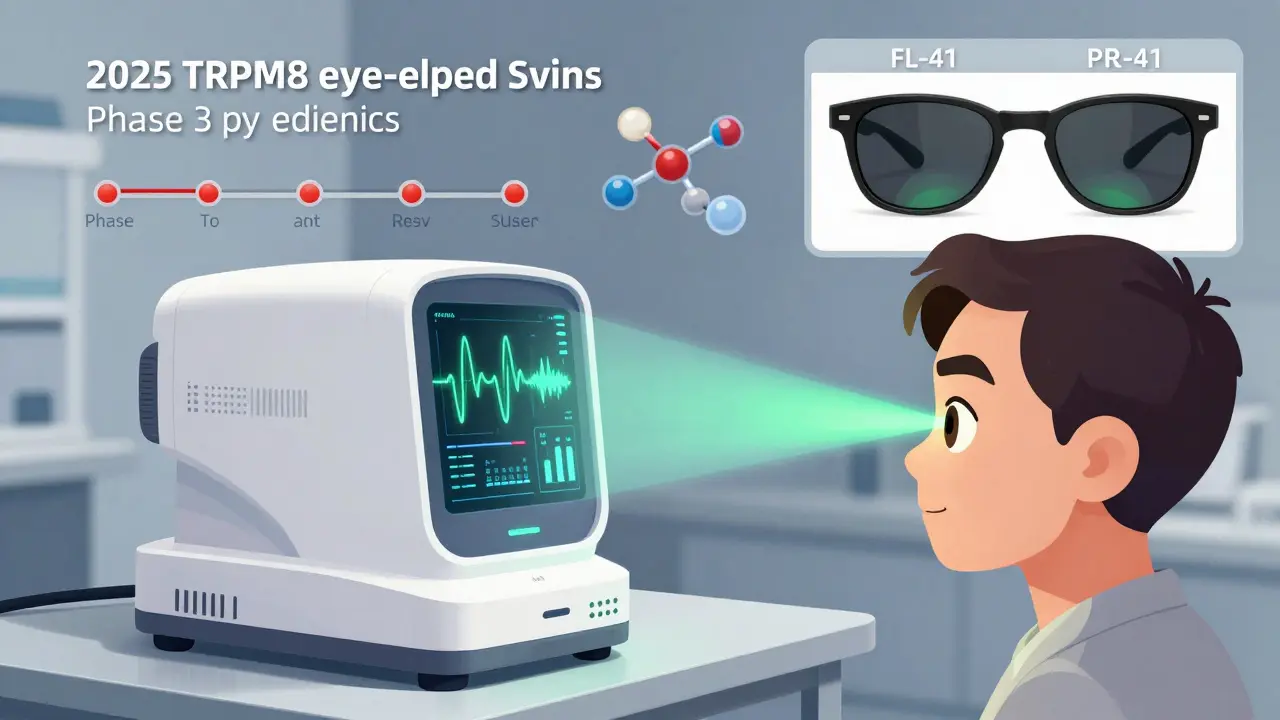
By 2025, a new topical eye drop targeting TRPM8 receptors (a key pain pathway) will enter Phase 3 trials. Early results show 60% reduction in sensitivity. If approved, it could replace or reduce the need for oral meds or tinted lenses.
Long-term, 78% of people see major improvement within six months of proper diagnosis. Autoimmune cases need lifelong management-but they’re manageable. With the right tools, you can work, drive, and enjoy sunlight again.
Is photophobia the same as being sensitive to bright light?
No. Everyone’s eyes adjust to bright light. Photophobia is an abnormal, painful reaction that happens at much lower light levels-sometimes even in dim rooms. It’s not just discomfort; it’s a neurological response tied to specific conditions like migraines, eye inflammation, or medication side effects.
Can FL-41 glasses cure photophobia?
No, they don’t cure it. They manage the symptom. FL-41 lenses filter the specific wavelengths that trigger pain, reducing discomfort by up to 43%. But if the root cause-like uveitis or a migraine disorder-isn’t treated, symptoms will return. Glasses are a tool, not a solution.
Why do my eyes hurt under LED lights?
Many LEDs emit a spike in blue-green light around 500-550nm-the exact range that triggers photophobia. Regular LEDs aren’t designed for sensitive eyes. Switching to warm-white, low-glare bulbs or using FL-41 glasses can make a big difference. Avoid cool-white LEDs in your home workspace.
Can photophobia cause permanent vision loss?
Photophobia itself doesn’t damage vision. But the conditions causing it can. Untreated uveitis, for example, can lead to glaucoma, cataracts, or retinal detachment. That’s why photophobia is a red flag-it’s your body’s way of saying, “Look deeper.”
Should I avoid sunlight completely?
No. Avoiding sunlight increases your risk of vitamin D deficiency-27% higher in chronic photophobia patients. Wear FL-41 sunglasses outdoors, and get short, protected exposure (10-15 minutes) early or late in the day. Talk to your doctor about vitamin D supplements if you’re avoiding sun.
Are there any new treatments on the horizon?
Yes. A new topical eye drop targeting TRPM8 receptors is in Phase 3 trials and expected to be submitted to the FDA in mid-2025. Early results show a 60% reduction in light sensitivity. This could be a game-changer for people who can’t tolerate oral meds or find glasses inconvenient.
Robert Way
January 15, 2026 AT 01:59fl-41 glasses saved my life no cap
Jason Yan
January 16, 2026 AT 05:33Man, this post hit me right in the soul. I used to think I was just weak for hating office lights, but turns out my brain was screaming for help. The part about blue-green light hitting 500-550nm? That’s the exact wavelength that made me feel like my eyeballs were melting under LED strips. I bought a pair of TheraSpecs after reading this, and honestly? I cried the first time I walked into a grocery store without squinting. It’s not just about comfort-it’s about reclaiming your life from something so invisible, so dismissed. And yeah, the cost is steep, but compared to missing work, missing birthdays, missing sunlight? Worth every penny. I wish doctors would screen for this before prescribing more migraine pills.
Sarah Triphahn
January 17, 2026 AT 07:28So you’re telling me all this time I thought I was just ‘overly sensitive’ I actually had a neurological thing? Wow. I guess I’m just one of those women who’s too dramatic to be taken seriously. Classic. Also, FL-41 glasses are expensive. I’m sure the people who wrote this paper don’t have to choose between rent and glasses. Some of us can’t afford to ‘manage’ our pain-we just have to endure it. Thanks for the textbook chapter, though.
Vicky Zhang
January 17, 2026 AT 08:36OH MY GOD I’M NOT ALONE. I’ve been wearing sunglasses indoors since college and everyone thought I was weird. My mom said I was ‘just being dramatic.’ But when I got my FL-41s, I finally felt like my eyes weren’t screaming. I cried in the optometrist’s office. I didn’t even know I could look at a lamp without wanting to vomit. If you’re reading this and you’re suffering-please, just try the glasses. Don’t wait. Don’t get told it’s ‘all in your head.’ It’s not. Your eyes are real. Your pain is real. And there’s help.
Allison Deming
January 17, 2026 AT 19:15While I appreciate the anecdotal enthusiasm surrounding FL-41 lenses, I must emphasize that the article’s reliance on commercial product endorsements-specifically TheraSpecs with a 63% market share-raises legitimate concerns about conflict of interest and evidence-based medicine. The FDA’s approval of the PAD-2000 device is a step forward, but substituting diagnostic rigor with retail solutions risks medicalization of normal variation in sensory perception. One must question whether this is clinical guidance or a marketing funnel disguised as patient advocacy. Without longitudinal studies controlling for placebo effect, we risk creating a generation of patients who believe glasses are cures, not tools.
Susie Deer
January 17, 2026 AT 23:30Why do we even need glasses for this I mean why cant we just turn off the lights like in the old days
Andrew Freeman
January 19, 2026 AT 10:00FL-41 is just a gimmick. I had photophobia for 8 years and it went away when I stopped drinking coffee. Also the whole 500-550nm thing is made up. I read it on a blog. Also why is everyone on here buying expensive glasses instead of just wearing a hat
says haze
January 21, 2026 AT 03:03It’s fascinating how this post weaponizes scientific jargon to sell a $150 product while pathologizing normal human variation. The fMRI data cited? Correlation without causation. The 43% symptom reduction? No control group mentioned. The author conveniently ignores that photophobia often resolves with stress reduction, sleep hygiene, or even just reducing screen time. This isn’t medicine-it’s wellness capitalism. You don’t need FL-41 lenses. You need to stop treating your nervous system like a broken circuit board that requires a proprietary filter. The real diagnosis? Capitalism has made us believe every discomfort has a product solution.
Alvin Bregman
January 22, 2026 AT 23:06im glad this got out there i used to think i was the only one who had to turn off every light in the house just to read. i tried the glasses after reading a reddit thread and honestly it was like someone turned down the volume on the world. no more headaches after work. no more avoiding windows. i dont know if its the science or just luck but it worked for me. i still dont trust big pharma but i trust my eyes now
Sarah -Jane Vincent
January 24, 2026 AT 14:54FL-41 is a distraction. The real cause is 5G radiation from smart streetlights and LED bulbs designed by the Illuminati to control our brainwaves. You think this is about migraines? No. It’s about population control. The FDA approved the PAD-2000 because they want you to think you’re being helped while they track your pupil response. They know who’s sensitive. They know who’s vulnerable. Don’t buy the glasses. Buy a Faraday cage for your eyes. And stop trusting doctors who work for Big Optics
Henry Sy
January 24, 2026 AT 23:59Bro I had photophobia for 12 years and I thought I was cursed. Then I found out I was allergic to the fucking fluorescent ballasts in my apartment. No glasses. No meds. Just replaced the damn bulbs with incandescent ones and my life changed. Why the hell is everyone buying $150 sunglasses when the solution is $8 at Home Depot? This whole post feels like a sponsored ad for rich people who can’t fix their own lighting. Also I’m pretty sure the ‘43% reduction’ is just placebo because everyone’s too stressed to notice their eyes aren’t on fire anymore