
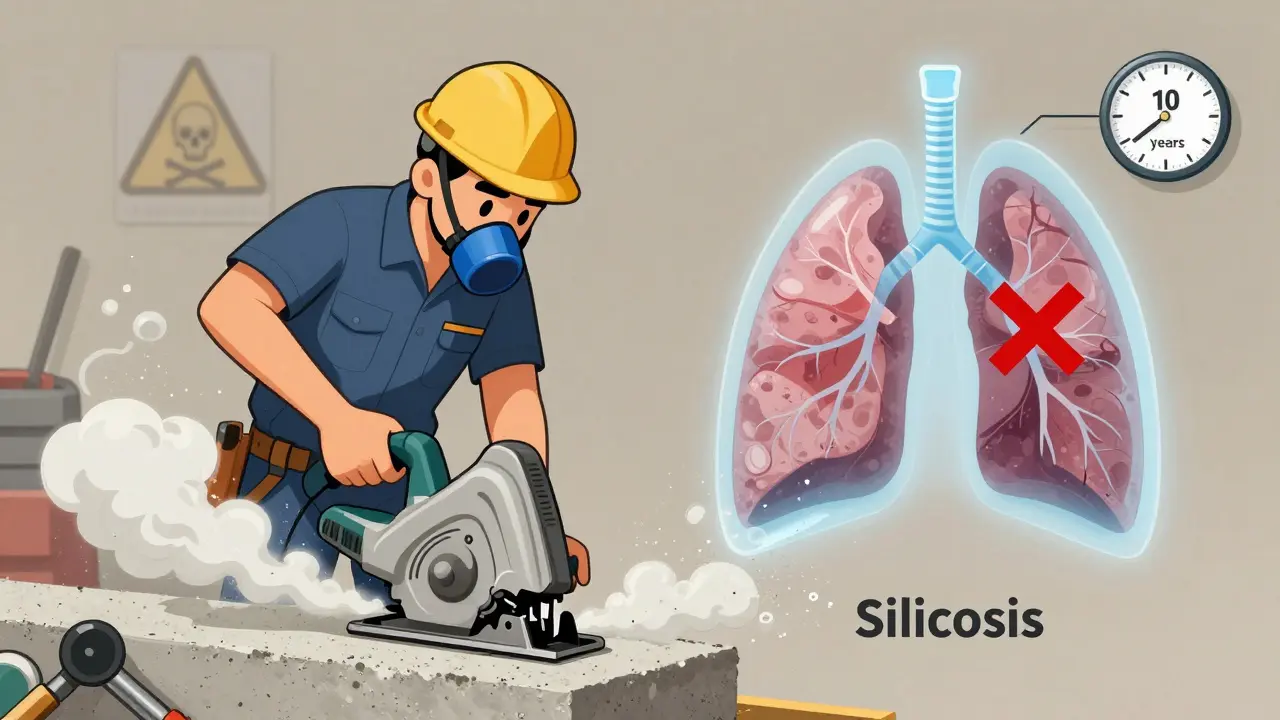
Every year, thousands of workers breathe in dust and fibers they can’t see - and pay with their lungs. Silicosis and asbestosis aren’t rare diseases from the past. They’re happening right now, in quarries, construction sites, and factories across the country. And here’s the hard truth: both are 100% preventable. If you work in construction, mining, demolition, or manufacturing, this isn’t just about safety rules - it’s about staying alive.
What Silicosis and Asbestosis Actually Do to Your Lungs
Silicosis comes from breathing in crystalline silica dust. It’s in sand, stone, concrete, and even some paints. When you cut, drill, or grind these materials, invisible particles fly into the air. Once inhaled, they cut into lung tissue like tiny glass shards. Your body tries to fight them off, but instead of clearing them, it builds scar tissue around them. Over time, your lungs turn stiff and rubbery. Breathing becomes harder. Coughing won’t stop. And once the damage is done, it’s permanent.
Asbestosis is similar, but worse. Asbestos fibers are thin, needle-like, and stick to lung tissue like Velcro. They don’t break down. Over 10, 20, even 30 years, they slowly scar the lungs. People often don’t feel sick until decades later. By then, the scarring is severe. Many don’t realize they’ve been exposed until they’re diagnosed with advanced disease. The CDC says between 2004 and 2014, over 1,100 U.S. workers died from asbestosis alone. Silicosis kills about 1,200 people each year.
Why These Diseases Keep Happening
You’d think we’d have this figured out by now. But here’s what’s really going on:
- Workers skip respirators because they’re hot, heavy, or fog up their glasses.
- Supervisors push for speed over safety - “Just get it done quick.”
- Small businesses don’t have the money for ventilation systems.
- Old buildings still have asbestos hidden in insulation, tiles, and pipes.
- Many workers don’t know they’re at risk until it’s too late.
One construction worker on Reddit said, “My company finally got wet cutting saws last year - silica dust is way down. But the foreman still yells at us for taking too long with water.” That’s the problem. Safety isn’t a priority - it’s an inconvenience.
The Hierarchy of Control: What Actually Works
Not all protection is created equal. The best way to stop these diseases isn’t by giving people masks - it’s by removing the danger at the source.
Here’s the real order of effectiveness, from best to last resort:
- Elimination - Don’t use silica or asbestos at all. Substitute with safer materials. For example, some concrete mixes now use recycled glass instead of quartz sand.
- Substitution - Replace dry cutting with wet methods. Wetting down stone or concrete cuts silica dust by 90%.
- Engineering Controls - This is where real change happens. Local exhaust ventilation systems pull dust away at 100-150 feet per minute. Sealed cutting enclosures trap 95% of particles. These systems cost $2,000-$5,000 per station but pay for themselves in under two years by cutting workers’ comp claims.
- Administrative Controls - Limit exposure time. Rotate workers. Schedule dusty tasks for low-traffic hours.
- PPE (Personal Protective Equipment) - Masks are the last line of defense. N-95s filter 95% of particles. P-100s? 99.97%. But here’s the catch: if they don’t fit, they’re useless. OSHA requires annual fit tests. Yet, CDC data shows 68% of complaints are about discomfort - and 32% of workers modify their masks to make them easier to wear. That’s like wearing a seatbelt with the buckle undone.
Engineering controls reduce exposure by 80-90%. PPE? Only 40-60% - if worn right. Too many companies treat masks like a checkbox instead of a lifesaver.

What Workers Need to Know
If you’re in a high-risk job - demolition, tile cutting, sandblasting, pipe insulation removal - here’s what you need to do:
- Ask if your job has a written exposure control plan. If not, demand one.
- Insist on wet methods. If you’re dry-cutting concrete or stone, you’re putting yourself at risk.
- Get fit-tested for your respirator - every year. If your employer hasn’t scheduled it, ask why.
- Don’t clean dust with a regular vacuum. Use a HEPA-filtered vacuum. Regular vacuums just blow dust back into the air.
- Report unsafe conditions. OSHA protects whistleblowers. You have rights.
And here’s something no one talks about: smoking. If you smoke and work around silica or asbestos, your risk of lung disease jumps 50-70%. Quitting isn’t just about your heart - it’s about your lungs.
Testing and Early Detection
Most people with silicosis or asbestosis feel fine for years. By the time they cough or get winded, it’s too late. That’s why spirometry - a simple breathing test - matters.
The American Thoracic Society recommends baseline testing when you start a high-risk job, then every five years. If you already have asthma or COPD, get tested annually. Early detection can slow progression by 30-50%. That’s not a guarantee of a cure - but it’s a chance to stop it from getting worse.
NIOSH’s new “Prevent eTool” platform gives free, sector-specific guidance for 15 high-risk industries. It’s live, free, and updated in 2023. Use it.

The Bigger Picture
These aren’t just worker problems. They’re business problems. In 2021, OSHA fined construction companies over $3.2 million for silica violations. That’s not just a penalty - it’s a warning. Companies that cut corners on safety pay more in lawsuits, lost productivity, and insurance than they save by skipping ventilation.
The European Respiratory Society says 60-70% of these diseases could be eliminated with current technology. The U.S. has the tools. The question is: do we have the will?
There’s hope. In Germany, mandatory health checks and exposure monitoring cut new cases by 55%. In Australia, where I live, strict controls on asbestos since the 1980s have brought new cases down by over 90%. It’s possible. It’s been done.
But it takes more than rules. It takes culture. It takes supervisors wearing their masks. It takes workers speaking up. It takes companies that see safety as part of their bottom line - not a cost.
What’s Next?
The future of prevention is in real-time monitoring. Wearable sensors are now being tested to track dust levels as workers move through a site. If a worker hits a dangerous threshold, the device alerts them - and their supervisor - instantly. This isn’t sci-fi. It’s already in pilot programs.
And yet, the biggest challenge remains human behavior. No matter how good the tech gets, if workers don’t trust the system, if they’re afraid to speak up, if they’re pressured to skip safety steps - these diseases will keep happening.
So ask yourself: Are you part of the problem? Or part of the solution?
Can you get silicosis from one exposure?
No, silicosis develops over years of repeated exposure. But even short, intense bursts - like sandblasting without protection - can cause acute silicosis, which can develop in weeks or months. It’s rare, but deadly. There’s no safe level of exposure.
Is asbestos still used today?
In the U.S., asbestos isn’t banned, but its use is heavily restricted. It’s still found in older buildings, brake pads, gaskets, and some imported products. The real danger isn’t new asbestos - it’s disturbing old asbestos during renovation or demolition. That’s when fibers become airborne.
Do N-95 masks protect against asbestos?
N-95 masks filter 95% of particles 0.3 microns or larger. Asbestos fibers are often smaller than that, and they’re sticky and sharp. For asbestos work, OSHA requires P-100 or R-100 respirators - they filter 99.97% and are oil-resistant. N-95s are not enough.
How long does it take for symptoms to appear?
Typically 10-30 years. That’s why people don’t connect their breathing problems to their job. By the time they see a doctor, the damage is advanced. That’s why regular spirometry tests are critical - they catch changes before you feel them.
Can you sue your employer if you get silicosis or asbestosis?
Yes - but it’s complicated. Workers’ compensation usually covers medical costs and lost wages. But if your employer knowingly ignored safety rules, you may have grounds for a lawsuit. Document everything: exposure history, medical records, witness statements. Legal help is available through occupational injury attorneys.
Are there any cures for silicosis or asbestosis?
No. Once the lung tissue is scarred, it can’t heal. Treatment focuses on slowing progression - quitting smoking, avoiding further exposure, oxygen therapy, and pulmonary rehab. In severe cases, a lung transplant may be the only option - but it’s risky and not always possible.
Dylan Patrick
March 11, 2026 AT 20:27Leah Dobbin
March 12, 2026 AT 02:52Ali Hughey
March 13, 2026 AT 22:14Aaron Leib
March 14, 2026 AT 02:09rakesh sabharwal
March 14, 2026 AT 10:10Elsa Rodriguez
March 15, 2026 AT 17:15Serena Petrie
March 16, 2026 AT 04:53Kathy Leslie
March 16, 2026 AT 07:57Jimmy V
March 16, 2026 AT 08:12tynece roberts
March 16, 2026 AT 23:16Amisha Patel
March 18, 2026 AT 07:19Alex MC
March 18, 2026 AT 20:42