
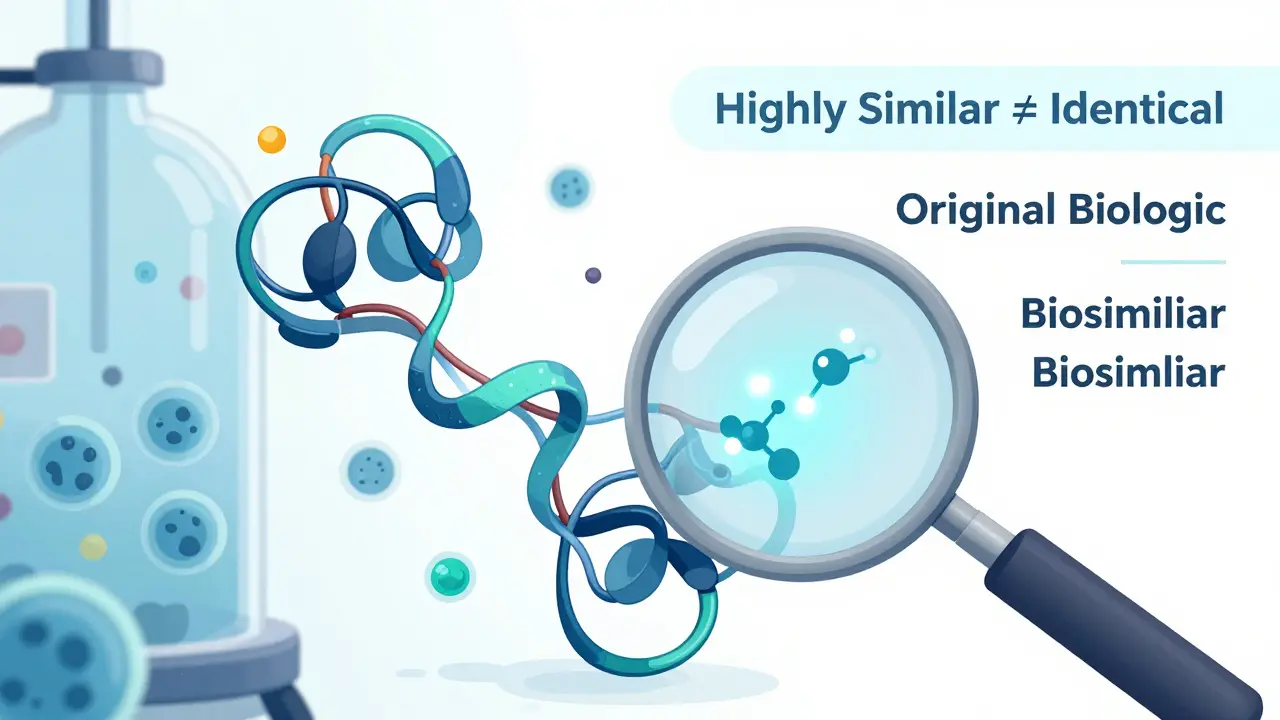
When you hear the word biosimilar, you might think it’s just another generic drug. But that’s not true. Monoclonal antibody biosimilars aren’t like the little pills you’ve taken for years-they’re complex, living medicines made from living cells. And they’re changing how we treat cancer, autoimmune diseases, and other serious conditions.
What Makes Monoclonal Antibody Biosimilars Different?
Generics are copies of small-molecule drugs, like ibuprofen or metformin. They’re chemically identical to the original. Biosimilars? They’re not identical. They’re highly similar. That’s because monoclonal antibodies are huge proteins-about 150,000 daltons in size-made by living cells in bioreactors. Even tiny changes in how they’re grown, purified, or stored can affect how they behave in your body.
The FDA and EMA both require biosimilar makers to prove there are no clinically meaningful differences in safety, purity, or effectiveness compared to the original. That means more than just matching a chemical formula. It means running dozens of lab tests, animal studies, and clinical trials in real patients. One of the biggest challenges? Glycosylation-the sugar molecules attached to the antibody. A small change there can trigger immune reactions. That’s why some patients developed allergies to certain versions of cetuximab years ago.
Approved Monoclonal Antibody Biosimilars and What They Treat
As of 2023, the FDA has approved over 20 monoclonal antibody biosimilars. Here are the most common ones and the conditions they’re used for:
- Bevacizumab biosimilars (like Mvasi, Zirabev, Vegzelma): Used for colorectal, lung, and brain cancers. Six versions are approved in the U.S. alone.
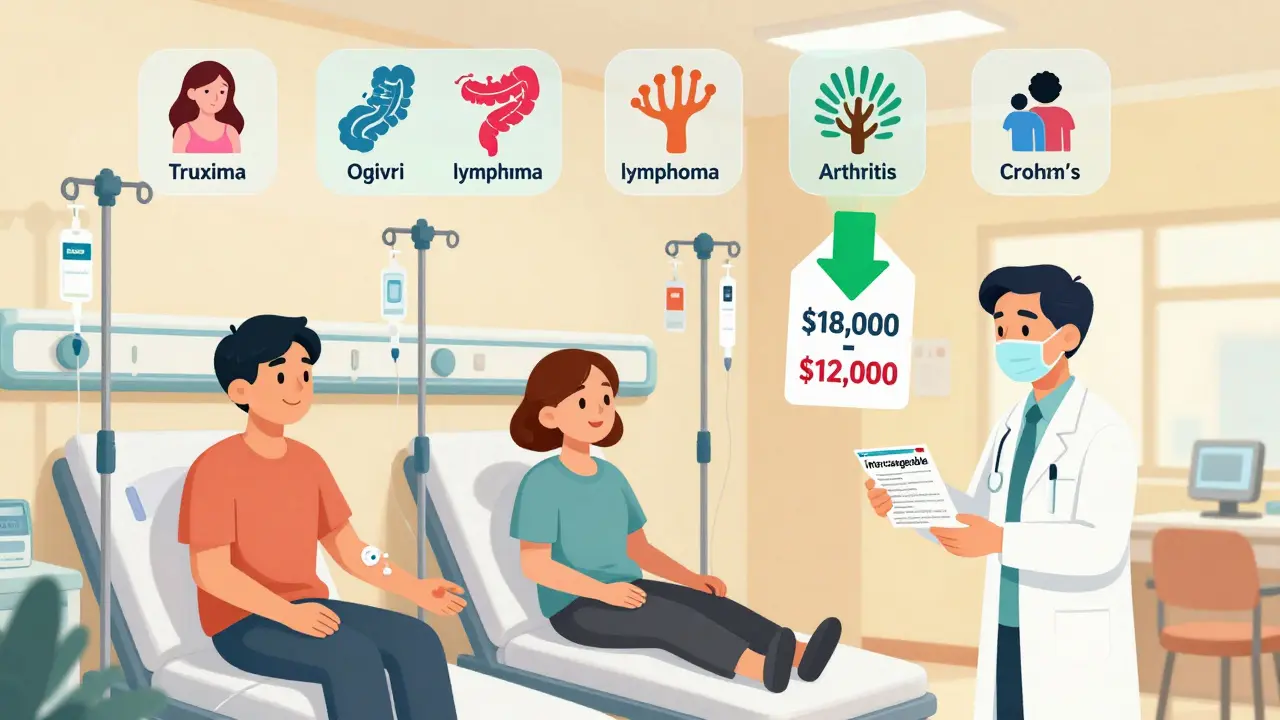
- Rituximab biosimilars (Truxima, Ruxience, Riabni): Treat non-Hodgkin’s lymphoma, chronic lymphocytic leukemia, and rheumatoid arthritis.
- Trastuzumab biosimilars (Ogivri, Herzuma, Kanjinti, Hercessi): Target HER2-positive breast and stomach cancers. Six approved versions.
- Infliximab biosimilars (Remsima, Inflectra): Used for Crohn’s disease, ulcerative colitis, and psoriasis. Remsima became the first interchangeable monoclonal antibody biosimilar in the U.S. in July 2023.
- Adalimumab biosimilars (Hyrimoz, Amjevita, Cyltezo): Treat rheumatoid arthritis, psoriatic arthritis, and ankylosing spondylitis. Over a dozen are in development or approved.
These aren’t experimental. They’re in use every day in hospitals and infusion centers across the country. In fact, a 2022 study in JAMA Oncology tracked over 1,200 patients switching from original rituximab to Truxima. No drop in effectiveness. No rise in side effects. Just lower costs.
How Much Do They Save?
Cost is the biggest driver behind their adoption. The original versions of these drugs can cost $10,000 to $20,000 per infusion. Biosimilars typically launch at 15% to 30% lower prices. In some cases, prices have dropped even further after competition kicks in.
According to Evaluate Pharma, biosimilar versions of bevacizumab, trastuzumab, and rituximab alone could save the U.S. healthcare system $250 billion between 2023 and 2028. That’s not just a number-it means more patients can get treatment. It means fewer people skip doses because they can’t afford them. It means insurance companies can cover more therapies without hiking premiums.
Interchangeable Biosimilars: The Next Step
Not all biosimilars are created equal when it comes to switching. Most require a doctor’s approval to switch from the original drug. But some are now labeled “interchangeable.” That means pharmacists can swap them out without asking the doctor-just like with generics.
Remsima (infliximab) was the first monoclonal antibody biosimilar to get this status from the FDA in July 2023. To earn it, the manufacturer had to prove that switching back and forth between the biosimilar and the original doesn’t increase risks. That’s a big deal. It removes a major barrier for adoption, especially in community pharmacies.
Why Aren’t They Used More?
Despite the savings and solid data, uptake is still slower than it should be. Why?
- Patent battles: Drugmakers sue to delay biosimilar entry. On average, each monoclonal antibody biosimilar faces 14.7 patent challenges before launch.
- Provider hesitation: A 2022 ASCO survey found only 58% of oncologists felt “very confident” prescribing biosimilars. Many still think they’re less effective-even though the data says otherwise.
- Formulary restrictions: Pharmacy benefit managers sometimes block biosimilars unless the original drug fails first. That’s outdated thinking. It delays access and drives up costs.
There’s also a lack of education. Nurses, pharmacists, and even some doctors still confuse biosimilars with generics. They don’t realize biosimilars require more rigorous testing than generics ever did.
What’s Coming Next?
The pipeline is packed. As of September 2023, the FDA was reviewing 37 new monoclonal antibody biosimilars. The biggest focus? Pembrolizumab (Keytruda) biosimilars. Keytruda is one of the most widely used cancer drugs in the world. Its biosimilars could save billions.
Also on the horizon: biosimilars for newer drugs like antibody-drug conjugates (ADCs) and bispecific antibodies. These are even more complex than today’s monoclonal antibodies. The EMA plans to release new guidelines for them in early 2024.
Market analysts at IQVIA predict that by 2027, monoclonal antibody biosimilars will make up 35% of all biologic prescriptions in the U.S.-up from 18% in 2022. Cancer treatments will account for 62% of that volume.
Are They Safe?
Safety is the number one concern for patients. The data says they’re just as safe as the originals.
The EMA reviewed over 1.2 million patient-years of exposure to monoclonal antibody biosimilars. They found 12 cases of unexpected immune reactions. That’s a rate of 0.001%. The same rate was seen with the original drugs. No difference.
Long-term studies are still ongoing, but so far, no red flags. Patients who switch from the original to a biosimilar don’t have more flare-ups, infections, or hospitalizations. In fact, some studies show better adherence because patients can afford to keep taking them.
Final Thoughts
Monoclonal antibody biosimilars aren’t a future idea. They’re here. They’re working. And they’re saving lives-not just by being effective, but by being affordable.
If you or someone you know is on a biologic for cancer, rheumatoid arthritis, or another chronic condition, ask your doctor: Is there a biosimilar option? You might be surprised by the answer-and by how much it could lower your costs without lowering your care.
Are monoclonal antibody biosimilars the same as generics?
No. Generics are chemically identical copies of small-molecule drugs. Biosimilars are highly similar but not identical to complex biological drugs like monoclonal antibodies. They’re made from living cells, so small variations are normal-but they must show no clinically meaningful differences in safety or effectiveness.
Can biosimilars be substituted for the original drug without a doctor’s approval?
Only if they’re labeled "interchangeable" by the FDA. As of 2023, only one monoclonal antibody biosimilar-Remsima (infliximab)-has this status. For others, a doctor must specifically prescribe the biosimilar. Pharmacists cannot automatically switch them without authorization.
Do biosimilars cause more side effects than the original drugs?
No. Multiple large studies, including those reviewed by the FDA and EMA, show biosimilars have the same safety profile as their reference products. In fact, the rate of immune reactions and adverse events is statistically identical. The only difference is cost.
Which cancers are treated with monoclonal antibody biosimilars?
Biosimilars for bevacizumab, trastuzumab, and rituximab are used to treat colorectal cancer, non-small cell lung cancer, HER2-positive breast cancer, gastric cancer, non-Hodgkin’s lymphoma, and chronic lymphocytic leukemia. These are among the most common cancer types treated with biologics.
How long have monoclonal antibody biosimilars been available?
The first monoclonal antibody biosimilar-infliximab (Remsima)-was approved in the European Union in 2013. The U.S. followed with its first biosimilar (filgrastim) in 2015, but the first monoclonal antibody biosimilar in the U.S. was bevacizumab (Mvasi), approved in September 2017.
Why are biosimilars cheaper than the original biologics?
They don’t require the same expensive clinical trials as the original drug. Biosimilar makers don’t need to prove safety and effectiveness from scratch-they only need to show similarity to the already-approved reference product. This reduces development costs by 50-70%, allowing lower prices without sacrificing quality.
Joie Cregin
January 18, 2026 AT 00:14This is the kind of post that makes me believe medicine can actually be humane. Biosimilars aren’t just about cutting costs-they’re about giving people a fighting chance without forcing them to choose between rent and remission. I’ve seen friends cry because they couldn’t afford their meds. This? This is progress with a heartbeat.
Rob Deneke
January 18, 2026 AT 15:32So many docs still act like biosimilars are some kind of scam but the data is crystal clear. Same efficacy same safety lower price. Why are we still having this conversation
john Mccoskey
January 19, 2026 AT 05:45Let’s be real here. The pharmaceutical industry doesn’t want biosimilars because they expose the fact that these drugs were never worth $20k per infusion in the first place. They spent billions on marketing and lobbying to keep prices inflated. The science behind biosimilars is more rigorous than generics-yet they’re still treated like second-class citizens. It’s not about science. It’s about profit. The FDA’s standards are ironclad. The hesitation among providers? That’s institutional inertia wrapped in fear and legacy brand worship. And don’t get me started on PBMs who force step therapy like it’s 1998. You want to talk about systemic failure? This is it. The patient pays the price while CEOs cash in on the illusion of innovation. Biosimilars are the quiet revolution nobody wanted but everyone needs.
brooke wright
January 19, 2026 AT 21:33My aunt switched to a trastuzumab biosimilar last year and her insurance dropped her copay from $1200 to $80. She’s been in remission for 18 months. No new rashes no new infections no weird lab results. Why is this still controversial
Christina Bilotti
January 21, 2026 AT 13:41Oh wow a whole article about how biosimilars are ‘just as good’ as the originals. Shocking. I bet next they’ll tell us generic insulin is fine too. Maybe we should just let Big Pharma write the textbooks since they clearly know what’s best for our bodies. /s
Melodie Lesesne
January 22, 2026 AT 01:44I work in an infusion center and I’ve watched patients breathe easier when they realize they can actually keep up with treatment. No one’s ever had a bad reaction switching to a biosimilar. The real tragedy is how long it took for this to become common knowledge. We need better education-not more lawsuits.
Corey Chrisinger
January 22, 2026 AT 09:35It’s funny how we fear what we don’t understand. We’ll take a pill made in a lab with 17 synthetic ingredients but get nervous about a protein grown in a bioreactor? We’ve outsourced our trust to corporations and now we’re mad when the system tries to fix itself. Biosimilars aren’t a compromise-they’re a correction.
Ryan Hutchison
January 22, 2026 AT 20:27USA is falling behind Canada and Europe on this. We’ve got the science but we’ve got the bureaucracy. Why are we letting patent trolls delay life-saving treatments for years? This isn’t innovation. This is greed dressed up as intellectual property.
Travis Craw
January 23, 2026 AT 19:21my brother got on a biosimilar for crohns last year and he’s finally sleeping through the night. no drama no drama just lower bills. why is this so hard to celebrate
Bianca Leonhardt
January 23, 2026 AT 21:43Don’t let the hype fool you. These are still expensive. The savings are real but they’re not miracle discounts. And don’t pretend the manufacturers aren’t still milking the system. You think they didn’t design their biosimilars to avoid patent cliffs? They did. And they’re still charging $15k. That’s not affordable. That’s just less gouging.
Samyak Shertok
January 25, 2026 AT 16:46So let me get this straight-you’re celebrating a drug that’s *almost* the same as the original? That’s not progress. That’s compromise. India makes better generics than this. At least with generics you know what you’re getting. Biosimilars? It’s like asking a clone to recite Shakespeare and then calling it Shakespeare.
evelyn wellding
January 26, 2026 AT 09:06YES. YES. YES. My mom’s on adalimumab biosimilar and she’s dancing again 😊 Thank you for sharing this. We need more people to know this is possible!
Chelsea Harton
January 27, 2026 AT 22:57biosimilars arent generics but theyre close enough and cheaper so why not
Nick Cole
January 29, 2026 AT 09:35One of the most important things no one talks about: when patients can afford to stay on treatment, their outcomes improve across the board. It’s not just about the drug-it’s about dignity. Biosimilars give people back control. That’s not a side effect. That’s the point.