
How Much Melatonin Should You Really Take?
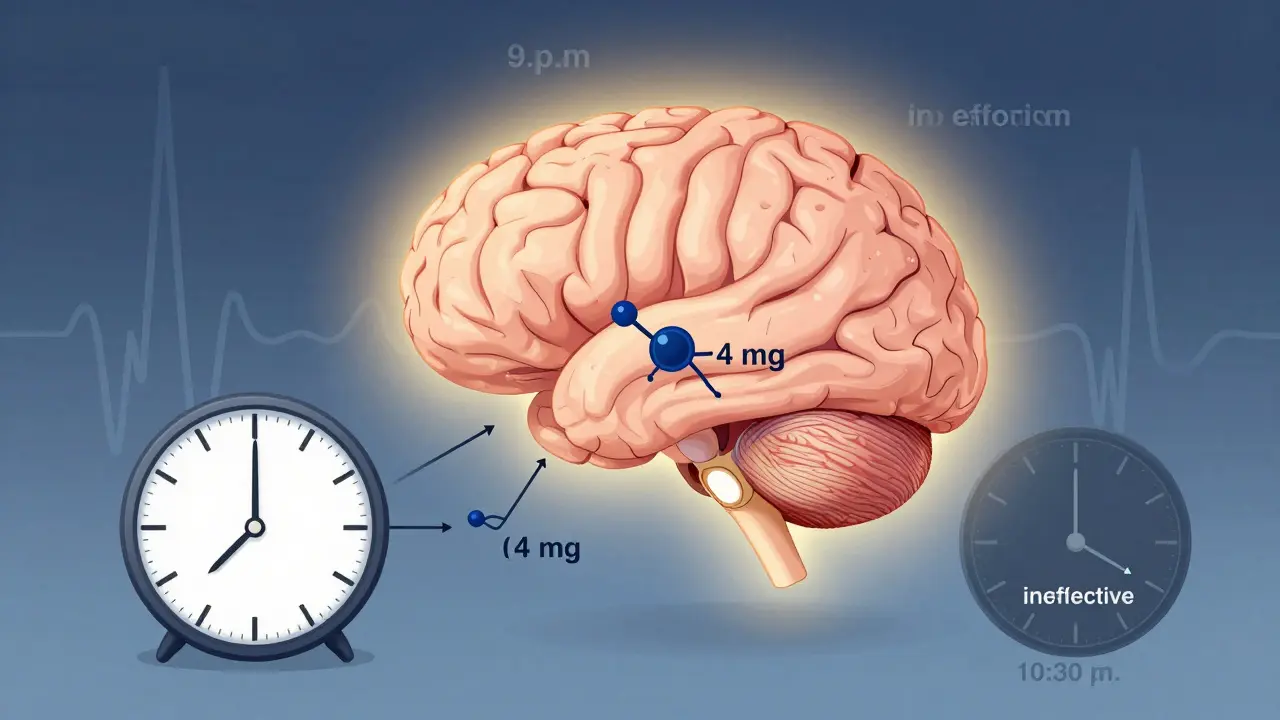
Most people start with 1 mg of melatonin because it’s the lowest dose available in stores. But if you’ve tried that and still can’t fall asleep, you’re not alone. The truth is, the dose you need isn’t about how tired you feel-it’s about when you take it and what kind you’re using. A 2024 meta-analysis of 2,412 people showed that 4 mg taken 3 hours before bed worked far better than the common 1 mg taken 30 minutes before sleep. That’s not a typo. The science is shifting, and most advice you’ve heard is outdated.
Why Timing Matters More Than the Dose
Taking melatonin at 10:30 p.m. for an 11 p.m. bedtime might feel logical, but it’s often too late. Your body’s internal clock doesn’t respond to a quick spike of melatonin-it needs a gentle signal hours ahead. Research from the Journal of Sleep Research found that taking melatonin 3 hours before your target sleep time improved sleep onset by 16% compared to taking it just before bed. That means if you want to sleep at midnight, take it at 9 p.m. That’s especially true if you’re trying to reset your rhythm after traveling or working night shifts.
Here’s why: melatonin doesn’t act like a sleeping pill. It doesn’t knock you out. It tells your brain, “It’s time to start winding down.” If you take it too late, your body’s natural melatonin is already dropping, and the supplement just adds noise. Take it too early, and it fades before sleep hits. The sweet spot? 3 to 4 hours before your desired bedtime. For most people, that’s between 7 p.m. and 9 p.m.
Fast-Release vs. Slow-Release: Which One Do You Need?
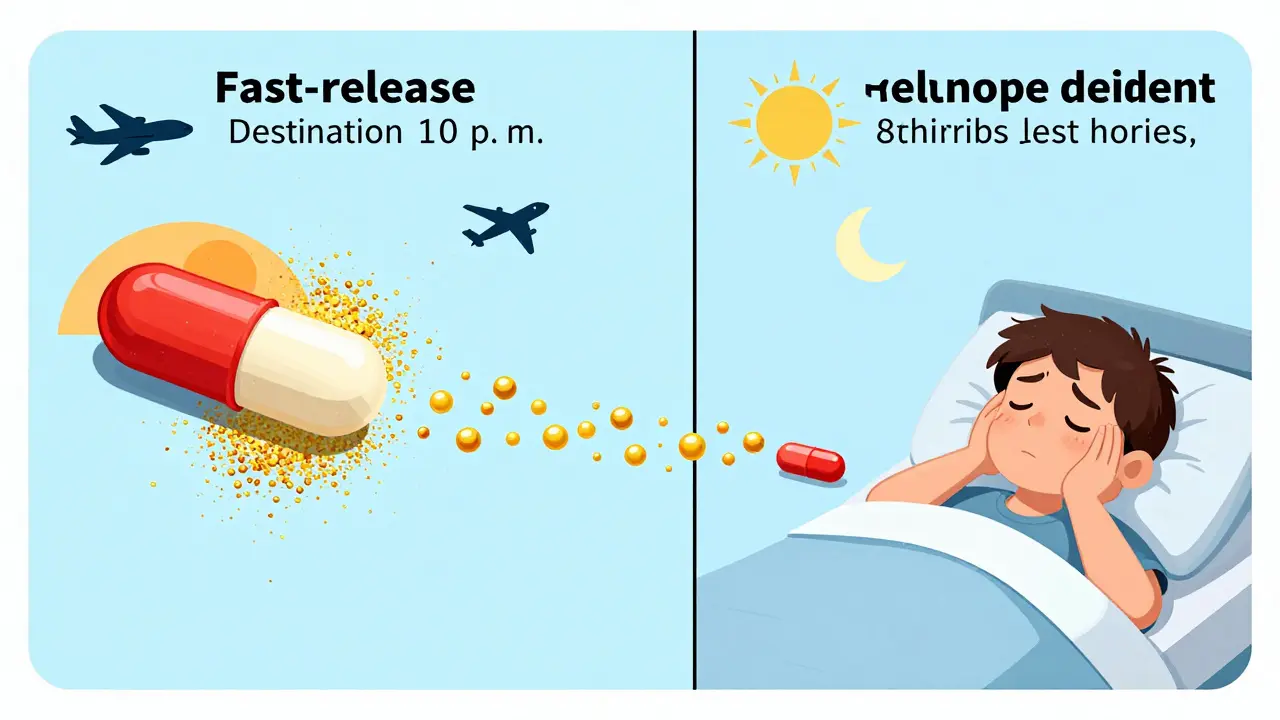
Not all melatonin supplements are made the same. You’ll see two types on the shelf: fast-release and slow-release. Fast-release dissolves quickly and gives you a quick spike in blood levels-ideal for jet lag or when you need to fall asleep fast. Slow-release (also called extended-release) trickles melatonin into your system over several hours, mimicking your body’s natural overnight release.
For jet lag, stick with fast-release. The Timeshifter protocol, based on 2024 circadian research, recommends 1-3 mg of fast-release melatonin taken at your destination’s bedtime. Slow-release can linger too long and confuse your internal clock, especially if you’re flying east. If you struggle with staying asleep all night-waking up at 2 a.m. and can’t go back-then slow-release (like the 2 mg NHS-recommended tablet) might help. But for falling asleep faster, fast-release wins.
Jet Lag Protocols That Actually Work
Jet lag isn’t just about being tired. It’s your body stuck in the wrong time zone. The key is shifting your internal clock, not just forcing sleep.
For eastward travel (e.g., Sydney to London): Your body wants to sleep earlier than it can. Take 1-3 mg of fast-release melatonin at your destination’s bedtime. If you land at 7 a.m. local time and want to sleep at 10 p.m. that night, take melatonin at 10 p.m. Do this for 2-4 days. Avoid sunlight in the morning-wear sunglasses if needed. Get bright light in the late afternoon to help reset your clock.
For westward travel (e.g., London to Sydney): Your body wants to stay up later. Here, melatonin isn’t always the answer. Instead, take 1 mg of fast-release melatonin in the morning (7-9 a.m. local time) to delay your rhythm. Light exposure in the evening helps too. Don’t take melatonin at night-it’ll fight your body’s natural adjustment.
Don’t take melatonin for more than 5 days straight for jet lag. The NHS recommends no more than 16 courses per year. Overuse can blunt your body’s own melatonin production.
How Much Is Too Much?
You’ll find bottles labeled 5 mg, 10 mg, even 20 mg. But more isn’t better. The 2024 meta-analysis showed that 4 mg is the peak dose for effectiveness. Above 5 mg, you’re not getting more sleep-you’re just increasing side effects.
People taking doses over 5 mg report:
- Morning grogginess (37% of users in a 2023 Sleep Foundation survey)
- Vivid dreams or nightmares
- Headaches (12.4% vs. 5.2% at lower doses)
- Dizziness and nausea
The Cleveland Clinic warns that doses above 10 mg can interfere with your body’s natural melatonin cycle. That’s not a myth-it’s biology. Your pineal gland doesn’t like being told what to do every night. Use the lowest dose that works. Start with 0.5 mg. If nothing happens after 3 days, go to 1 mg. Then 2 mg. Most people don’t need more than 3 mg.
What About Kids and Special Conditions?
Children don’t need adult doses. UC Davis Health recommends starting at 1 mg for kids under 88 pounds. Increase by 0.5 mg weekly if needed, but never exceed 3 mg without a doctor’s guidance. Melatonin is often used for kids with ADHD, autism, or sleep disorders-but only under medical supervision.
For adults with chronic conditions like cerebral palsy, chronic fatigue, or severe insomnia, the NHS allows up to 10 mg daily under specialist care. But that’s not for casual use. If you’re taking melatonin for more than 13 weeks, talk to a doctor. Long-term use without oversight can mask underlying issues like sleep apnea or anxiety.

What the Experts Agree On (And What They Don’t)
There’s a mess of conflicting advice out there. The NHS says 2 mg slow-release 1-2 hours before bed. The Sleep Foundation says 1-3 mg 30 minutes before bed. The Timeshifter protocol says 1-3 mg fast-release at destination bedtime. The science says 4 mg 3 hours before bed.
Why the confusion? Melatonin is sold as a supplement, not a drug. That means manufacturers don’t have to prove effectiveness like pharmaceuticals do. Studies vary in quality. Some use low doses. Others use high. Some test timing. Others don’t.
The clearest takeaway? For most people, start low, take it early, and use fast-release for jet lag. The goal isn’t to feel drugged-it’s to gently nudge your rhythm back into sync.
How to Use Melatonin Without Losing Your Natural Rhythm
Here’s a simple 5-step plan to use melatonin wisely:
- Start at 0.5 mg-even if you think you need more. Your body is sensitive.
- Take it 3-4 hours before your target bedtime-not 30 minutes before.
- Use fast-release for jet lag, slow-release only if you wake up in the night.
- Never exceed 3 mg unless under medical care.
- Use it for 3-7 days max-then stop. Let your body reset naturally.
Combine melatonin with good sleep hygiene: dim lights an hour before bed, avoid screens, keep your room cool. Melatonin isn’t magic. It’s a signal. Use it right, and your body will thank you.
When Melatonin Doesn’t Work
If you’ve tried the right dose, at the right time, for 7 days, and still can’t sleep, melatonin isn’t the problem-it’s the symptom. Chronic insomnia, anxiety, sleep apnea, or even caffeine late in the day could be the real cause. Don’t keep increasing the dose. Talk to a sleep specialist. There are better long-term solutions.
Marian Gilan
January 27, 2026 AT 18:46Conor Murphy
January 28, 2026 AT 13:21Conor Flannelly
January 29, 2026 AT 20:26Patrick Merrell
January 31, 2026 AT 09:43Henry Jenkins
January 31, 2026 AT 10:49TONY ADAMS
January 31, 2026 AT 12:46George Rahn
January 31, 2026 AT 17:53Karen Droege
February 1, 2026 AT 10:53