
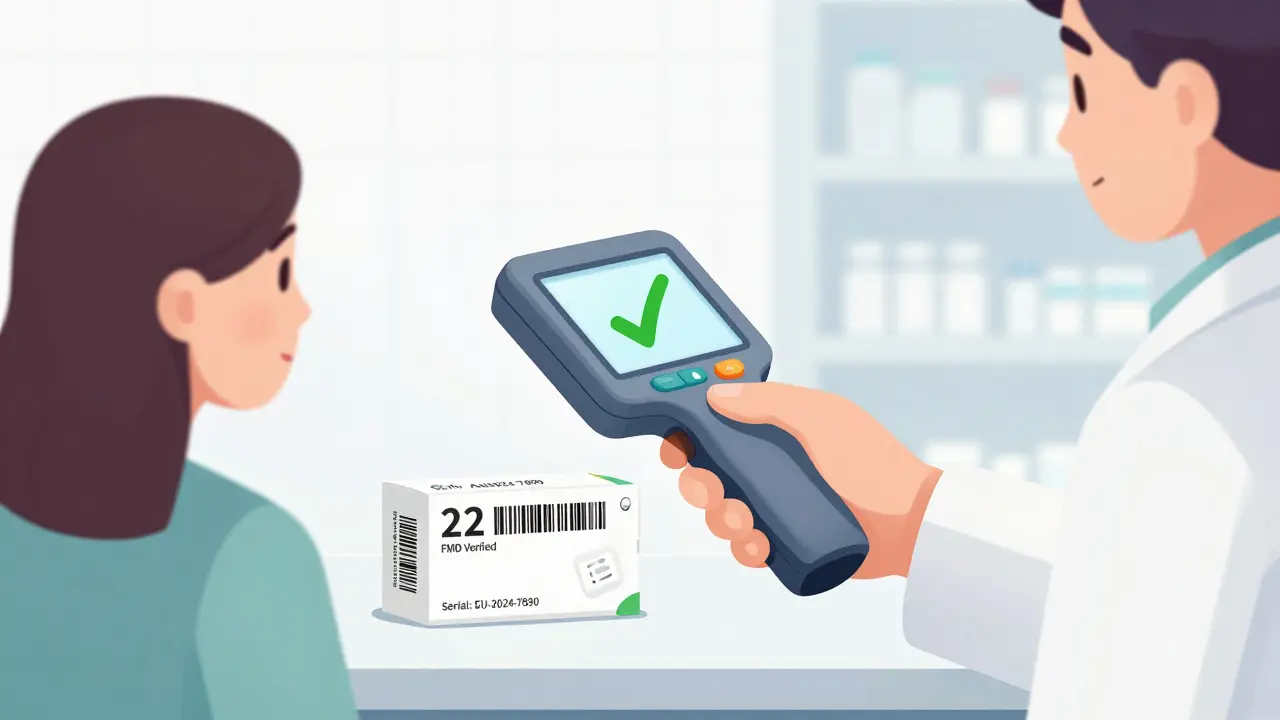
Every year, millions of people around the world take medications that aren’t what they claim to be. Fake pills, diluted powders, or wrong ingredients - these aren’t scenes from a movie. They’re real risks in the global drug supply chain. The World Health Organization estimates that 1 in 10 medical products in low- and middle-income countries is fake or substandard. Even in high-income nations, counterfeit drugs slip through. Knowing how to verify drug authenticity isn’t just a safety tip - it’s a necessity.
Why Drug Authenticity Matters
A counterfeit drug might look identical to the real thing. It could have the same color, shape, and branding. But inside? It might contain no active ingredient, too little, or worse - toxic substances like rat poison, chalk, or industrial dyes. The FDA warns that fake medicines can cause organ failure, antibiotic resistance, or even death. And because they often mimic real prescriptions, patients assume they’re safe. The problem isn’t just about fraud. It’s about trust. When people can’t be sure their medicine works, they stop taking it. That leads to worsening conditions, hospitalizations, and higher long-term costs. Verifying drug authenticity protects not just individuals, but entire public health systems.How Countries Are Fighting Counterfeit Drugs
Different regions have built different systems to catch fake drugs before they reach patients. The two biggest frameworks are the European Union’s Falsified Medicines Directive (FMD) and the U.S. Drug Supply Chain Security Act (DSCSA). The EU’s FMD, which took full effect in 2019, requires every prescription medicine package to have a unique 12-digit serial number, a 2D barcode, and a tamper-evident seal. At the pharmacy, pharmacists scan the barcode before giving the medicine to the patient. The system checks the code against a centralized European database. If it’s not registered, or if the package has been opened, the system blocks the sale. This is the only system in the world that requires verification at the point of patient care. In the U.S., the DSCSA focuses on tracking drugs as they move through the supply chain - from manufacturer to distributor to pharmacy. But here’s the catch: there’s no requirement to scan or verify the drug when it’s handed to the patient. That gap is being addressed. In September 2023, the FDA proposed new rules that will require pharmacies to verify drugs at the point of dispensing by 2027, bringing the U.S. closer to the EU model.Official Tools for Verifying Drug Authenticity
If you’re a patient, you might think you need lab equipment to check your medicine. You don’t. Here are the official tools you can use right now.1. EU FMD Verification System
If you’re in Europe, your pharmacist is already using this system. But you can also check your medicine yourself. Look for a 2D barcode on the box. Some pharmacies now offer QR code scanners at the counter - scan it, and the system tells you if the product is legitimate. You can also visit your country’s national medicines verification portal. For example, in the UK, you can use the UK Medicines Verification System (UKMVS) to enter the serial number manually if you’re unsure.2. FDA’s Drug Supply Chain Security Tools
The FDA doesn’t give patients direct access to its verification database - yet. But you can use the Drug Supply Chain Security Act (DSCSA) to ask your pharmacy questions. By law, every drug package now has a unique identifier. Ask your pharmacist: “Can you confirm this was verified through the DSCSA system?” Legitimate pharmacies will be able to show you the verification log.3. Mobile Apps and Consumer Scanning Tools
Several mobile apps now let you scan barcodes on medicine packaging. The International Barcode Association found these apps achieve 92% accuracy in field tests. Apps like MediCheck (available in over 40 countries) and VeriDrug (used in parts of Africa and Southeast Asia) connect to official databases. Just scan the code - if the app says “authentic,” it’s likely safe. If it says “not found” or “tampered,” don’t take it.4. Spectral Analysis Devices
These aren’t for home use - yet. But if you’re a pharmacist, nurse, or community health worker, handheld spectrometers are becoming more common. Devices from Thermo Fisher Scientific and Agilent use near-infrared or Raman spectroscopy to analyze the chemical makeup of a pill. They compare it to a known reference library. Accuracy in labs is over 98%, and field accuracy has improved from 78% in 2018 to 92% in 2022. The U.S. Pharmacopeia and FDA are building a public library of 1,200 essential medicines’ spectral signatures - available for free to authorized users by 2025.5. Molecular Taggants and DNA Barcodes
Some manufacturers are now embedding invisible molecular tags into pills - tiny chemical markers or even synthetic DNA strands that can’t be copied. These are used by Pfizer and other top companies in high-risk markets. You won’t see them, but if you’re prescribed a drug from a company using this tech, you can ask if it’s protected by molecular authentication. It’s the most secure method - 99.9% accurate - but it’s only available on select brands.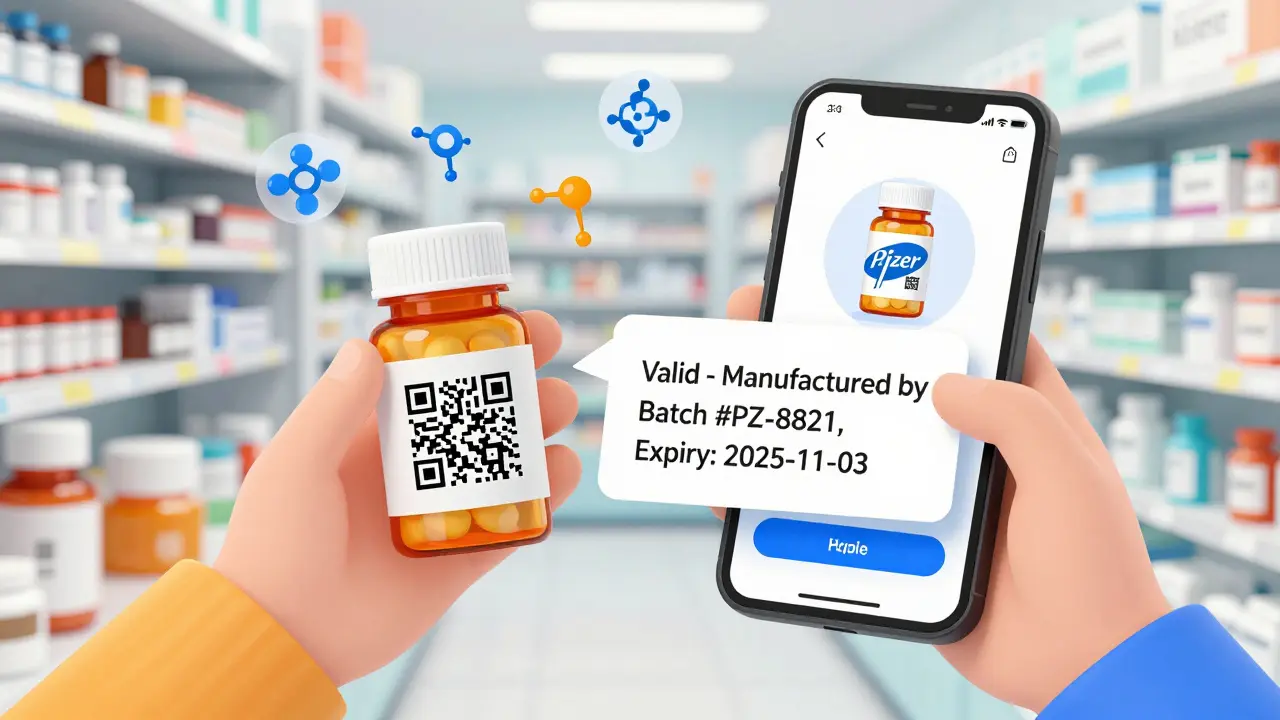
What You Can Do as a Patient
You don’t need to be a scientist to protect yourself. Here’s what works:- Always buy from licensed pharmacies. Avoid online sellers without a physical address or a verifiable license. In the U.S., look for the VIPPS seal (Verified Internet Pharmacy Practice Sites).
- Check the packaging. Look for misspellings, blurry logos, or mismatched colors. Fake drugs often have slight imperfections.
- Ask your pharmacist to verify. Say: “Can you scan this to make sure it’s real?” Most pharmacies in the EU and many in the U.S. now do this routinely.
- Compare the pill to past prescriptions. If your new pills look different - different color, size, or markings - ask why. It could be a generic switch, but it could also be a fake.
- Report suspicious drugs. In the U.S., report to the FDA’s MedWatch program. In the EU, contact your national medicines agency. Your report could stop a batch from reaching others.
Common Mistakes and Pitfalls
Even with good tools, mistakes happen. Here are the most common errors:- Confusing “already dispensed” alerts. In the EU, early FMD systems showed pop-ups saying “already dispensed” - but many pharmacists thought it meant “verified.” That led to 43% of counterfeit alerts being missed in the first year. Now, most systems use color-coded alerts (red for fake, green for safe).
- Ignoring audio alerts. Pharmacists report that visual-only alerts are easy to miss during busy hours. A 2023 pilot in 14 NHS hospitals added a beep when a fake drug was detected. Staff caught 30% more counterfeits.
- Assuming price = authenticity. A fake drug might be cheaper - but so can a legitimate generic. Don’t assume low price means fake. Always verify through official channels.
- Trusting SMS-based systems. In Africa and parts of Asia, people text a code to verify a drug. But poor network coverage means 32% of messages fail to send. These systems are unreliable.
What’s Coming Next
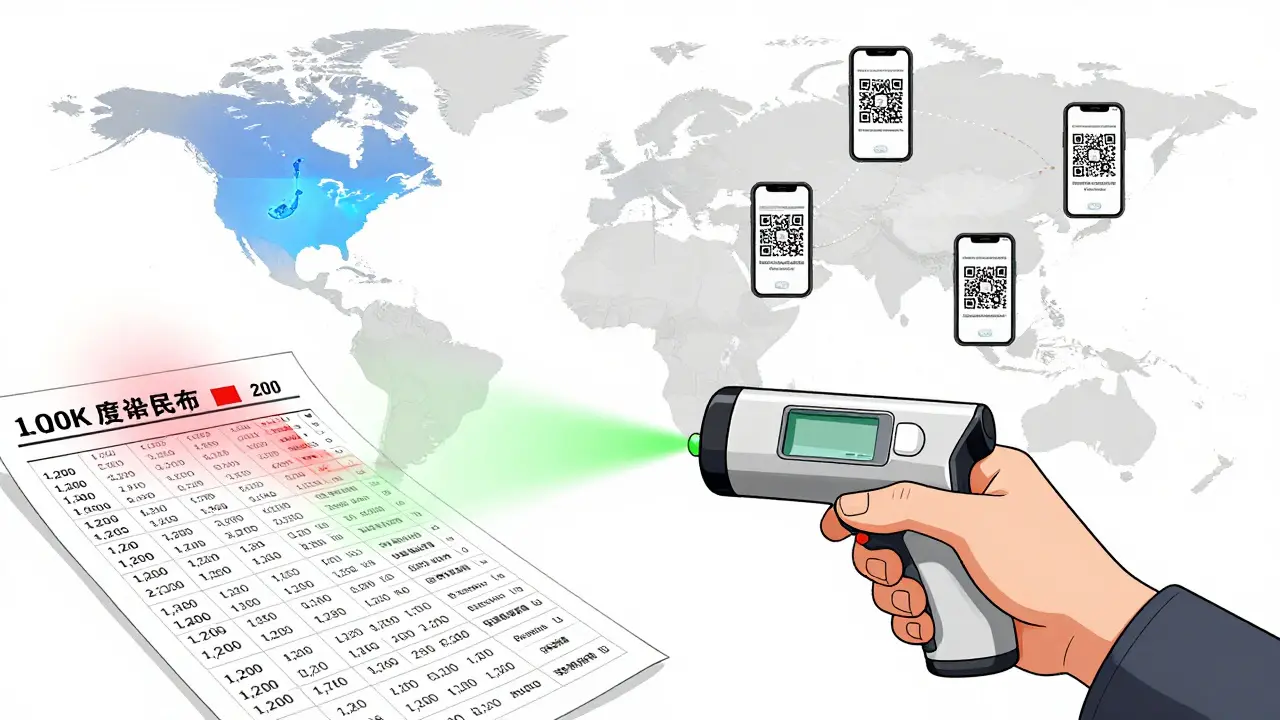
The fight against fake drugs is accelerating. By 2027, the U.S. will require patient-level verification, closing its biggest loophole. AI is being tested to spot anomalies in verification data - for example, if a drug is scanned too many times in one day, the system flags it. Blockchain is being used by Pfizer and others to create tamper-proof records across borders. The big win? Cost. Molecular tags add just $0.03 to $0.15 per pill. That’s less than a penny. As adoption grows, these tools will become standard - not luxury.Final Thoughts
You can’t see a fake pill with your eyes. But you can protect yourself with simple, official tools. Whether you’re in London, Lagos, or Los Angeles, the same rule applies: verify before you take. Ask questions. Demand scans. Report suspicions. Technology is on your side - if you know how to use it.How do I know if my medicine is fake?
Look for signs like poor packaging, misspelled names, or unusual pill appearance. But the most reliable way is to verify through official channels - scan the 2D barcode at your pharmacy or use a verified app like MediCheck. If the system says it’s not registered or has been tampered with, don’t take it.
Can I verify my medicine at home?
You can’t test the chemical content at home, but you can use smartphone apps that scan the barcode or QR code on the package. These apps connect to official databases and tell you if the product is registered. Accuracy is around 92%, making them reliable for initial checks. For absolute certainty, return suspicious medicine to your pharmacy for professional verification.
Is it safe to buy medicine online?
Only buy from online pharmacies that are licensed and display a VIPPS seal (in the U.S.) or equivalent certification in your country. Avoid sites that sell prescription drugs without a prescription, offer “miracle cures,” or have no physical address. The FDA estimates over 96% of online pharmacies operate illegally. When in doubt, get your medicine from your local pharmacy.
What should I do if I find a fake drug?
Do not take it. Return it to your pharmacy immediately. Then report it to your national health authority - in the U.S., use the FDA’s MedWatch program; in the EU, contact your national medicines agency. Provide the batch number, packaging details, and where you bought it. Your report helps track fake drug networks and protects others.
Why do some countries have better systems than others?
Countries with strong regulations and funding - like those in the EU - require full serialization and patient-level verification. Low-income countries often lack infrastructure, funding, or enforcement. While tools like mobile SMS verification exist, they’re unreliable in areas with poor internet. Global efforts are underway to help these regions adopt low-cost, scalable solutions like QR codes and portable spectrometers.
Are generic drugs more likely to be fake?
No. Generic drugs are subject to the same safety and quality standards as brand-name drugs. In fact, many generics are made by the same manufacturers. The risk comes from unregulated suppliers, not generics themselves. Always verify the packaging and source - whether it’s brand or generic.
How accurate are the official verification tools?
Serialization systems (like EU FMD) are 99.2% accurate because they track each package uniquely. Spectral analysis tools are 98.7% accurate in labs and 92% in the field. Mobile apps are 92% accurate. No tool is 100% perfect - but when used together, they create layers of protection. For absolute confirmation, lab testing is required, but that’s rarely needed for patients.
srishti Jain
December 30, 2025 AT 23:49My cousin in Delhi got fake insulin. He nearly died. No scanner, no app, just luck he went to the hospital. People in poor countries don’t have options.
Nadia Spira
December 31, 2025 AT 23:42Let’s be real - this whole verification infrastructure is a corporate welfare scheme disguised as public safety. The EU’s FMD? A €12 billion paper tiger that only benefits tech vendors and pharmacy conglomerates. Meanwhile, the real problem - unregulated global supply chains - remains untouched. You’re not protecting patients; you’re creating compliance theater.
And don’t get me started on those ‘mobile apps.’ They’re glorified barcode readers that pull from databases no one audits. 92% accuracy? That’s just marketing speak for ‘we’re wrong one in ten times.’ You wouldn’t trust a $5 thermometer to diagnose cancer, so why trust a phone app to verify your heart medication?
The FDA’s DSCSA is even worse. No patient-level verification until 2027? That’s not progress - that’s negligence dressed up as regulation. We’re letting people die while bureaucrats argue over API standards.
Molecular taggants? Cute. But they’re only used by Pfizer and a handful of others. The rest of the market? Still shipping pills in untraceable blister packs. This isn’t innovation. It’s a luxury feature for the wealthy.
And don’t even mention blockchain. That’s just a buzzword for ‘we’re too lazy to fix the actual supply chain.’ You don’t need distributed ledgers. You need inspectors. You need enforcement. You need consequences for counterfeiters.
Meanwhile, patients are told to ‘scan the QR code’ like it’s a TikTok filter. This isn’t safety. It’s digital mysticism.
The real solution? Ban all online pharmacies. Force every prescription to be filled in person. Require physical ID verification. Make pharmacists liable. Stop outsourcing safety to algorithms and start holding humans accountable.
Until then, this whole system is just a distraction - a way to make you feel safe while the real rot continues unchecked.
Joseph Corry
January 2, 2026 AT 19:29Interesting how the piece frames this as a technical problem when it’s fundamentally a political one. The EU’s FMD works because it’s embedded in a centralized, state-backed regulatory apparatus. The U.S. doesn’t have that - it has a fragmented, profit-driven system where liability is outsourced to pharmacists who are already overworked.
And yet, we’re told to trust ‘verified apps’ and ‘molecular taggants’ as if they’re magic bullets. But these tools are only as good as the data they reference - and that data is controlled by corporations with zero incentive to expose systemic failures.
What’s missing here is the critique of capitalism’s role in counterfeit drug proliferation. When profit margins are squeezed, corners are cut. When enforcement is underfunded, borders are porous. When patients are priced out of legitimate medicine, they turn to the dark web.
This isn’t about scanning barcodes. It’s about who gets to live - and who gets to die - in a system that treats health as a commodity.
Colin L
January 3, 2026 AT 22:49I’ve been in pharmacy for 22 years and I’ve seen everything. I remember when we first got the FMD scanners in 2019 - we were so excited. Then the system started crashing every Tuesday at 3 PM because the server couldn’t handle the load. We had to print out manual logs. One day, a woman came in with her husband’s cancer meds - the scanner said ‘tampered’ - but the package looked perfect. She cried. We called the distributor. Turned out it was a false positive because the batch had been re-shipped from a warehouse in Poland with a different temperature profile. The system didn’t know how to interpret that. So we gave her the pills anyway. She hugged me. I cried in the back room. That’s the reality. These systems are brilliant in theory, but they’re brittle in practice. People are getting caught in the gaps. And no one’s talking about that. Everyone’s just pushing the next shiny app or blockchain solution like it’s going to fix everything. It won’t. It never does. We need more staff, better training, and less bureaucracy. Not more tech. We need more humans. Not more algorithms.
Hayley Ash
January 5, 2026 AT 15:29Oh wow so we’re supposed to trust a QR code now? Next you’ll tell me to scan my insulin to check if it’s real like it’s a TikTok filter. The EU system is great until the barcode gets smudged by sweat or your pharmacist is too lazy to scan it and just hits ‘approve’ because they’re behind by 47 patients. And don’t even get me started on ‘Molecular taggants’ - sounds like something out of a sci-fi thriller where the villain implants DNA in pills to track you. What’s next? A loyalty program for your antibiotics? ‘Scan and earn 500 points toward your next Zoloft!’
Also, ‘generic drugs are safe’? Sure. If you’re lucky. I bought a generic metformin that looked like a neon green Pez dispenser. Took it. Got dizzy for three days. Called the pharmacy. They said ‘oh that’s the new formulation.’ Nope. It was fake. The batch number didn’t match. They didn’t even apologize. Just gave me a coupon for 10% off my next prescription. Thanks, capitalism.
kelly tracy
January 5, 2026 AT 16:40Everyone’s so obsessed with scanning barcodes and apps like they’re some kind of digital holy grail. But what about the people who don’t have smartphones? Or can’t afford data? Or live in rural areas where the signal drops every time you step outside? You think your fancy EU system helps an elderly woman in Appalachia who walks 3 miles to get her blood pressure meds? No. It doesn’t. And you know what? The system doesn’t care. It’s designed for urban centers with high-speed internet and pharmacists who have time to scan. It’s not for the people who need it most. This isn’t safety. It’s exclusion dressed up as innovation. And the worst part? The people who designed this will never be the ones taking the fake pills.
Shae Chapman
January 6, 2026 AT 17:46This is so important and I’m so glad someone finally laid it all out like this 💙 I’ve been terrified to take my meds since I bought some online during the pandemic. I didn’t know what to trust. Now I always ask my pharmacist to scan - and they’ve started doing it without me even asking! It’s a small thing, but it makes me feel safe. Also, I just downloaded MediCheck and scanned my blood thinner - it came back green! I cried. I didn’t even realize how much anxiety I was carrying until it was gone. Thank you for this. We need more of this info out there. 💪❤️
henry mateo
January 8, 2026 AT 15:10i read this whole thing and i think its really cool but i dont know if i got all the details right. like the part about the dna tags? is that like a tiny strand they put in the pill? and the app works by scanning the barcode? i think i get it but im not sure. also i bought some pills online once and they looked weird but i took them anyway. i hope they werent fake. maybe i should go back to my pharmacy.
Kunal Karakoti
January 9, 2026 AT 21:21It’s fascinating how we’ve outsourced trust to technology. We used to rely on the pharmacist’s word, the doctor’s recommendation, the family’s experience. Now we scan a barcode. But what does that barcode really represent? A transaction. A data point. Not safety. Not care. Not humanity. The real tragedy isn’t the counterfeit drugs - it’s that we’ve stopped believing in each other enough to demand better than a machine’s verdict. We’ve become consumers of verification, not participants in healing.
Kelly Gerrard
January 10, 2026 AT 02:12Verification is not optional. It is a moral imperative. Every pill you take is a vote for the kind of world you want to live in. If you do not demand traceability you are complicit in the suffering of others. The tools exist. The systems are proven. The cost is negligible. The only thing missing is collective will. Act now. Demand scans. Report anomalies. Protect life. This is not a suggestion. It is a responsibility.
Glendon Cone
January 11, 2026 AT 21:18Big thanks for breaking this down so clearly 🙏 I had no idea about the EU system or molecular tags - mind blown. I just started using MediCheck after reading this and it’s wild how fast it works. Scanned my asthma inhaler this morning - green light. Felt like I just unlocked a secret level of adulting 😅 Also, my pharmacist was super chill about it when I asked to scan - said they’ve been doing it for months. Maybe this stuff is becoming normal? Hope so. Keep sharing stuff like this. We need more people to know.
Henry Ward
January 12, 2026 AT 09:41You people are so naive. You think scanning a barcode makes you safe? That’s like thinking a seatbelt makes you invincible in a car crash. The real criminals aren’t the ones selling fake pills - they’re the ones who created this broken system in the first place. The FDA, the pharmaceutical giants, the lobbyists who killed stricter regulations. You’re not protecting yourself - you’re just playing along with the game they designed to make you feel safe while they keep raking in billions. Wake up. The system is rigged. Your scan is a placebo.
Cheyenne Sims
January 14, 2026 AT 08:15While the article presents a technically accurate overview, it fails to acknowledge the fundamental flaw in relying on consumer-facing verification tools in a nation with no universal healthcare. The premise that patients should ‘scan their pills’ assumes access to smartphones, literacy, time, and trust in institutions - privileges not universally available. In a country where 30 million lack health insurance and 1 in 4 adults skip medication due to cost, the notion that verification apps are a meaningful solution is not just misguided - it is dangerously elitist. Real safety requires systemic reform, not digital band-aids.