
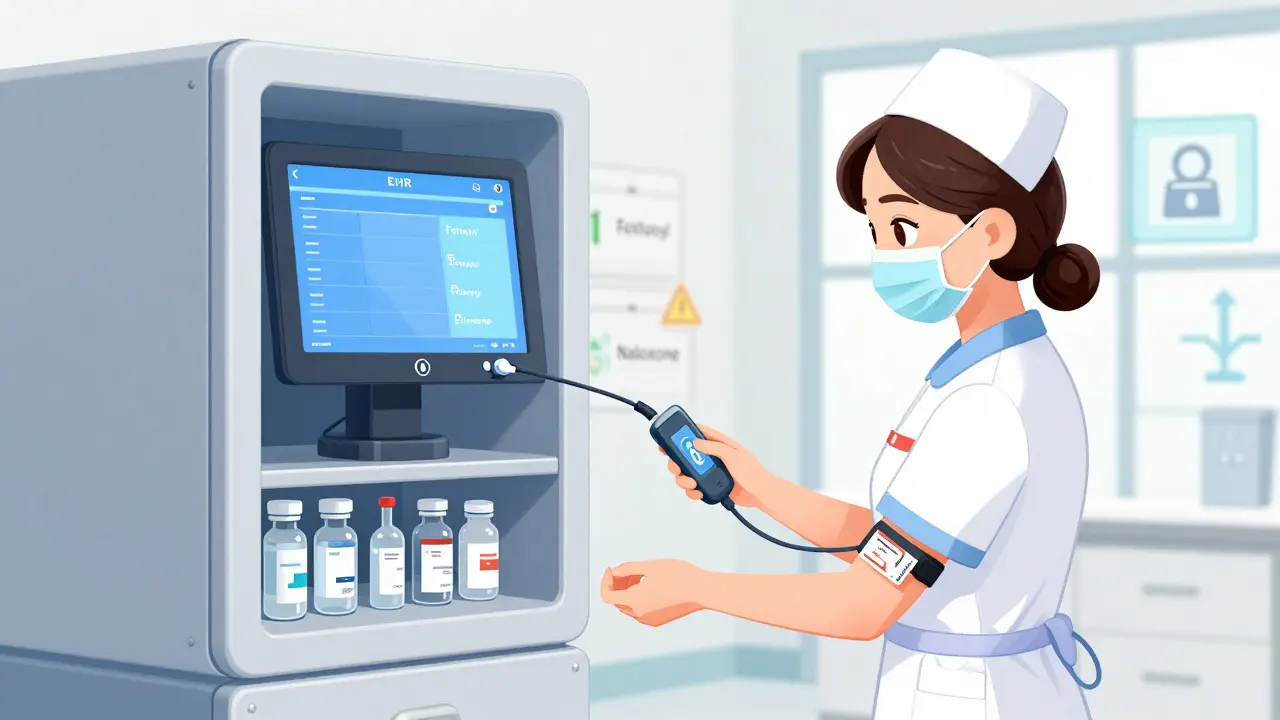
Automated Dispensing Cabinets (ADCs) are everywhere in modern clinics. They hold medications, track who takes what, and cut down on manual errors. But here’s the truth: ADCs don’t make clinics safer by themselves. If they’re set up wrong, used carelessly, or ignored by staff, they can actually cause more mistakes than they prevent.
In 2022, a study of seven nursing units found that six of them saw a 30%+ increase in medication errors after installing ADCs. Not because the machines broke. But because staff skipped steps, overrides were too easy, and the cabinets weren’t linked to patient records. This isn’t rare. Around 63% of hospitals still don’t follow all nine safety steps laid out by the Institute for Safe Medication Practices (ISMP). That’s a problem.
What an ADC Actually Does
An Automated Dispensing Cabinet is a locked, computer-controlled box that stores medications in individual doses. Think of it like a vending machine for pills - but instead of coins, you scan your badge and a barcode. Most systems, like BD Pyxis, Omnicell XT, or Capsa Nexsys, require two things: a user login and a barcode scan of both the medication and the patient’s wristband. This cuts down on giving the wrong drug or wrong dose.
Modern ADCs also have temperature-controlled zones for insulin, vaccines, or other cold-sensitive meds. They connect to your hospital’s electronic health record (EHR) so when a nurse pulls a dose, the system logs it automatically. No more handwritten logs. No more lost paperwork. And if the system detects a drug interaction, allergy, or duplicate order, it should stop the transaction - if it’s set up right.
The Biggest Mistake: Thinking ADCs Are Set-and-Forget
Too many clinics install an ADC, train staff for one day, and call it done. That’s a recipe for disaster.
Dr. Robert Weber, former president of the American Society of Health-System Pharmacists (ASHP), put it bluntly: “Proper ADC configuration reduces medication errors by 35-50%. Poor configuration can increase them by up to 30%.”
Here’s why:
- **Look-alike, sound-alike drugs** - If fentanyl and naloxone are side-by-side, and a nurse is tired, they might scan the wrong one. One nurse on Reddit reported nearly giving a patient 10x their insulin dose because the drawer labels were too similar.
- **Override abuse** - Every ADC has an override button for emergencies. But if staff can override without reason, without documentation, or without a second person watching, errors spike. Facilities with no override controls have 2.3 times more errors than those with strict rules.
- **No pharmacist review** - If the ADC isn’t tied to a pharmacy system that checks each order before it’s dispensed, nurses are flying blind. No alerts for allergies. No warnings for kidney dosing. Just a button that says “take it.”
Nine Safety Steps You Can’t Skip
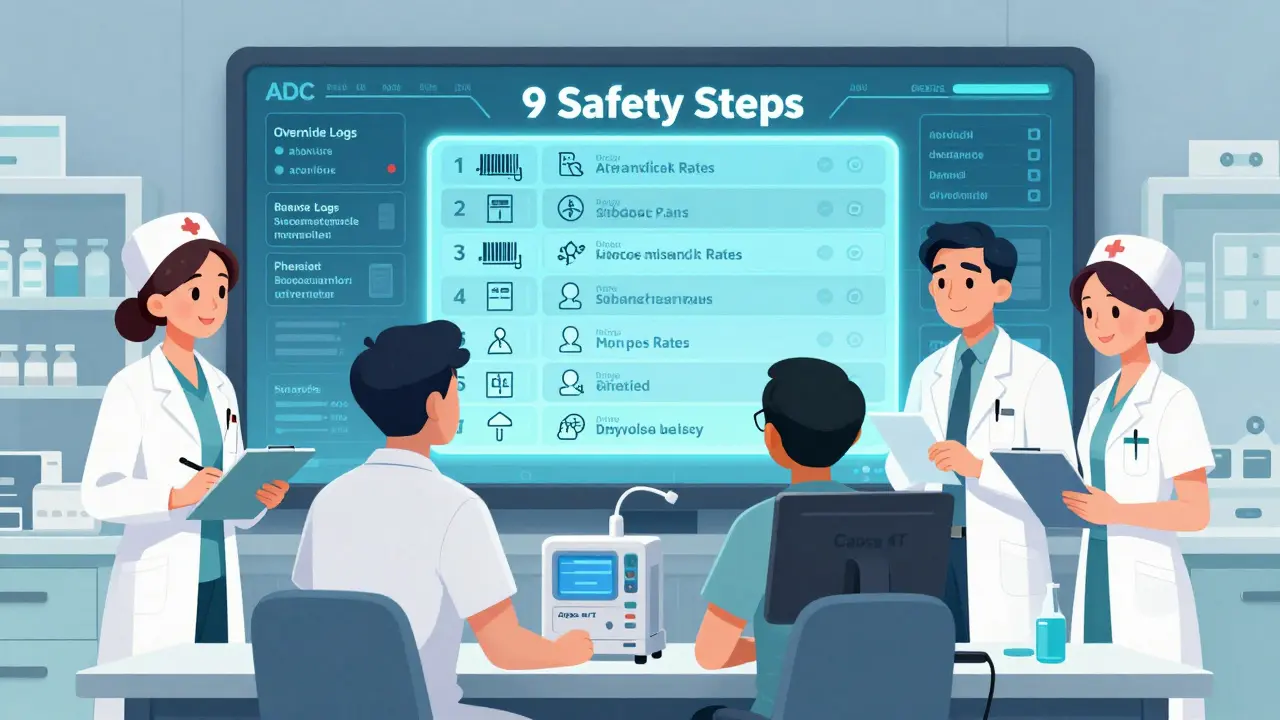
The ISMP released a full set of guidelines in 2019. These aren’t suggestions. They’re the baseline for safe use. Here are the nine core processes, simplified:
- Place ADCs where they make sense - Don’t put one in a hallway. Put it near the nurses’ station or right outside patient rooms. Distance matters.
- Control who can access it - Only licensed staff should have access. No visitors. No students without supervision.
- Use barcode scanning every time - Scan the patient. Scan the med. No exceptions. Not even for “just one pill.”
- Label everything correctly - Each dose must have a barcode with the drug name, dose, and expiration. No handwritten labels.
- Store meds properly - Refrigerated drugs need their own compartment, away from heat sources like monitors. Medications must have clear beyond-use dates.
- Limit what’s available - Don’t stock every drug in every drawer. Only what’s needed for that unit. A cardiac unit doesn’t need antivirals. A psych unit doesn’t need insulin.
- Control overrides - Override requests must be documented. A second licensed provider must witness it. And the system should limit how many overrides a person can use in a shift.
- Link to pharmacy review - Every medication pulled should trigger a pharmacy check. That’s how you catch a 500mg dose of acetaminophen when the max is 325mg.
- Train and test staff - Don’t just hand them a manual. Test them. Watch them. Do it again. The learning curve is 4-6 weeks. Treat it like a new skill, not a checkbox.
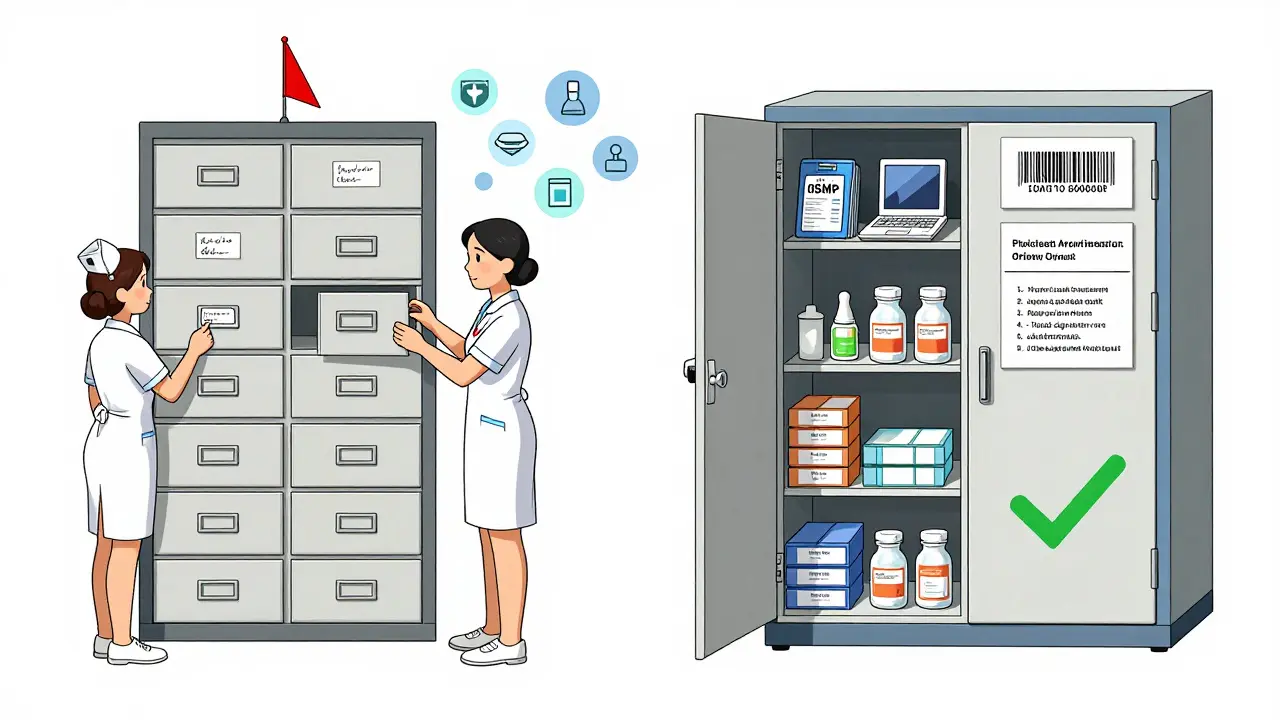
What Happens When You Skip These Rules
A 2017 ISMP report tells the story of a patient who received 10 times the correct dose of insulin. Why? The ADC was configured to allow high-dose insulin without a second check. The nurse scanned the right patient - but the system didn’t block the overdose because the pharmacy wasn’t reviewing the order.
Another case: A nurse in an ICU pulled morphine instead of hydromorphone because the drawers were next to each other and the labels were nearly identical. She caught it before giving it - but only because she paused. That pause shouldn’t be luck. It should be built into the system.
And then there’s the override problem. A 2021 audit found 58% of clinics had staff using overrides without documenting why. That’s not emergency care. That’s cutting corners.
How to Fix It - Step by Step
Improving ADC safety isn’t about buying a new machine. It’s about fixing the process.
- Form a team - Get pharmacy, nursing, IT, and clinical leadership together. No one person should decide how the ADC works.
- Map your meds - List every drug stored in each cabinet. Remove anything not used on that unit. Group similar drugs far apart. Put high-risk drugs (like insulin, opioids, sedatives) in locked drawers with extra checks.
- Lock down overrides - Require two signatures. One from the nurse, one from a pharmacist or another RN. Document the reason. Make it take 30 seconds, not 3.
- Link to pharmacy - If your ADC doesn’t send every request to the pharmacy for review, fix it. That’s the #1 safety feature.
- Train like you mean it - Run mock scenarios. “You need to give epinephrine. The system says ‘override required.’ What do you do?” Role-play it. Then test it.
- Check monthly - Pull reports. How many overrides? How many barcode mismatches? Are nurses scanning correctly? Use data, not guesses.
- Keep it clean - During the pandemic, Capsa Healthcare recommended keeping disinfectant wipes right next to the ADC. Clean hands. Clean surfaces. Clean barcode scanners. It’s not just about meds - it’s about infection control.
What the Best Clinics Do Differently
Mayo Clinic reduced override-related errors by 63% in critical care units by creating unit-specific override lists. Instead of letting anyone override anything, they only allowed overrides for drugs that were actually needed on that unit. A cardiac unit could override lidocaine. But not diazepam. That simple change cut errors dramatically.
Johns Hopkins cut medication administration timing errors by 27% by making sure ADCs were placed so nurses didn’t have to walk far. Less walking. Less rushing. Fewer mistakes.
And it’s not just big hospitals. Even small clinics can do this. You don’t need a $40,000 system. Capsa’s 4T countertop model, priced under $15,000, works for outpatient clinics - if it’s configured right.
What’s Coming Next
The future of ADCs is smarter, not just bigger.
- AI is now spotting drug diversion patterns before they become problems. Omnicell’s new algorithm cut false alarms by 37% in testing.
- BD Pyxis is adding biometric login (fingerprint or palm scan) by 2025 to replace badges that can be stolen or shared.
- By 2026, over 78% of ADCs are expected to use HL7 FHIR, a new standard that lets them talk directly to EHRs in real time - no delays, no glitches.
- Voice control is coming. Imagine saying, “Give me 5mg of morphine for patient 304,” and the system confirms the dose before dispensing.
But none of that matters if the basics are broken.
Final Reality Check
Over 95% of U.S. hospitals use ADCs. That’s progress. But only 37% of them follow all nine safety steps. That’s not progress - that’s risk.
ADCs are tools. Not magic. They don’t fix bad habits. They amplify them. If your staff rushes, skips scans, or overrides without thinking - the ADC will help them make mistakes faster.
Safe use isn’t about the machine. It’s about the people. And the rules. And the discipline to follow them - every time.
Can automated dispensing cabinets reduce medication errors?
Yes - but only if they’re set up and used correctly. Studies show well-configured ADCs can reduce dispensing errors by 15-20% compared to manual systems. However, when poorly implemented, they can increase errors by over 30%. The difference comes down to barcode scanning, pharmacist review, and controlled override policies.
What’s the biggest risk with ADCs?
The biggest risk is overuse of override functions. When staff can bypass safety checks without documentation or a second verification, errors rise sharply. Facilities with unrestricted overrides have 2.3 times more medication errors than those with strict controls. Look-alike drug placement and lack of pharmacist review are also major risks.
Do ADCs need to be connected to the pharmacy system?
Yes. Every medication dispensed should trigger a pharmacy review. This is how the system catches dangerous doses, drug interactions, allergies, and duplicate orders. Without this link, ADCs become glorified vending machines - and nurses are left guessing whether a dose is safe.
How often should staff be trained on ADC use?
Initial training should take 4-6 weeks, with hands-on testing. After that, refresher training should happen at least twice a year. New hires need full training. Any time the cabinet is reconfigured, updated, or a new drug is added, retraining is required. Competency checks should be documented.
Are ADCs safe for controlled substances like opioids?
Yes - but only with extra layers. Controlled substances should be stored in locked drawers with dual authentication (e.g., badge + PIN). Every withdrawal must be logged and tracked by DEA standards. Override access should be extremely limited, and all withdrawals reviewed by pharmacy. Many clinics also use separate, smaller cabinets just for opioids to reduce risk.
What should I do if I notice a problem with the ADC?
Report it immediately. Whether it’s a mislabeled drawer, a broken scanner, or a teammate bypassing the system, don’t ignore it. Use your facility’s incident reporting system. Also, talk to your pharmacy team - they’re responsible for configuration and safety. The ISMP offers a free ADC self-assessment tool to help teams identify hidden risks.
Can small clinics use ADCs safely?
Absolutely. Smaller systems like Capsa’s 4T countertop model are designed for outpatient clinics and cost under $15,000. The key isn’t the size - it’s the setup. Even a small cabinet needs barcode scanning, pharmacist review, and controlled overrides. Don’t skip safety steps just because you’re small. Errors don’t care about your budget.
Melissa Stansbury
March 18, 2026 AT 07:58I used to work in a hospital where the ADCs were set up like a damn buffet. Nurses were overriding everything because ‘it’s faster.’ One time, I saw a nurse pull fentanyl instead of naloxone-same drawer, same color label. She didn’t even notice until the patient started seizing. We fixed it by separating high-risk meds and adding dual authentication. Not because we were told. Because we almost lost someone.
Now every override requires a second nurse to physically stand there and verify. It’s awkward. It’s slow. But it works. Stop treating these machines like vending machines. They’re not. They’re gatekeepers.
cara s
March 18, 2026 AT 17:54Let me be clear: the notion that automated dispensing cabinets are inherently safe is not just misguided-it’s dangerously naive. The literature is replete with examples of catastrophic failures stemming from poor configuration, yet hospitals continue to prioritize cost-efficiency over clinical rigor. The ISMP guidelines are not suggestions; they are non-negotiable standards, and the fact that 63% of institutions ignore them speaks to a systemic failure of leadership, not technology.
Consider this: when override protocols are lax, you are not merely increasing error rates-you are normalizing negligence. And when pharmacy review is omitted, you are removing the final human safeguard. The machine cannot think. It cannot question. It cannot feel the weight of a life. Only we can. And if we abdicate that responsibility because ‘it’s easier,’ then we have already lost.
Amadi Kenneth
March 19, 2026 AT 20:20They say ADCs reduce errors-but what if they’re being used to cover up something else? I’ve heard whispers in nursing circles: some hospitals use these cabinets to hide drug diversion. The system logs a dose as ‘dispensed’… but what if it was never given? What if it was pocketed? And the audit trail? Easily manipulated if the software isn’t encrypted. And who’s auditing? The same people who approved the setup?
Don’t be fooled. This isn’t about safety. It’s about control. And if your hospital doesn’t use blockchain-level logging and independent third-party audits? You’re not safe. You’re just lucky.
Shameer Ahammad
March 20, 2026 AT 13:18Oh, please. You’re telling me that a $15,000 cabinet can save lives? That’s adorable. The real issue isn’t the machine-it’s the people. Nurses who skip scans because they’re tired? Pharmacists who don’t review because they’re overworked? Administrators who cut corners because ‘budgets’? This isn’t a technology problem. It’s a moral one.
You don’t need more features. You need accountability. You need consequences. You need to fire the nurses who override without reason. You need to demote the managers who let it happen. You need to make this personal. Because right now, people are dying because someone thought ‘it’s just one time.’
And if you’re not outraged by that, you’re part of the problem.
Alexander Pitt
March 21, 2026 AT 08:44Just to clarify: the 30%+ error increase after ADC implementation wasn’t caused by the cabinets. It was caused by skipping the nine ISMP steps. The machines themselves are precise. The failures are human and systemic. The key is configuration-not just installing, but validating. Barcode scanning? Mandatory. Pharmacy review? Non-negotiable. Override controls? Locked down. Training? Ongoing.
One hospital I consulted with reduced errors by 52% in six months by doing exactly that: enforcing the basics. No fancy AI. No biometrics. Just discipline. The technology is only as good as the process behind it. And if your process is lazy, the machine will amplify that. Every time.
Robin Hall
March 22, 2026 AT 00:03Here’s what no one’s saying: what if the ADCs are being used to justify cutting pharmacy staff? Think about it. Fewer pharmacists means less review. Less review means more overrides. More overrides means more errors. But now the hospital can say, ‘We have an ADC-so we’re safe.’
It’s a smokescreen. The real cost savings come from reducing pharmacy oversight, not from the machine. And when the next patient dies because a dose wasn’t checked? They’ll blame the nurse. Or the system. Never the decision to downsize the team that was supposed to catch it.
This isn’t innovation. It’s negligence with a shiny interface.
Suchi G.
March 23, 2026 AT 00:57I just want to say… I cried last week. Not because I was sad. Because I was angry.
I was working a double shift. My unit’s ADC had been down for three days because someone forgot to update the software. We were manually pulling meds. No barcode scans. No pharmacy review. Just… trust. And I held a vial of insulin in my hand and thought-this is how people die. Not because they’re sick. Because we stopped caring enough to follow the rules.
I don’t care how expensive the cabinet is. I don’t care if it has voice control. If we don’t treat this like sacred work-if we don’t pause, scan, verify, and breathe-then we’re not healers. We’re clerks with a badge.
And I’m tired.
becca roberts
March 24, 2026 AT 04:40