
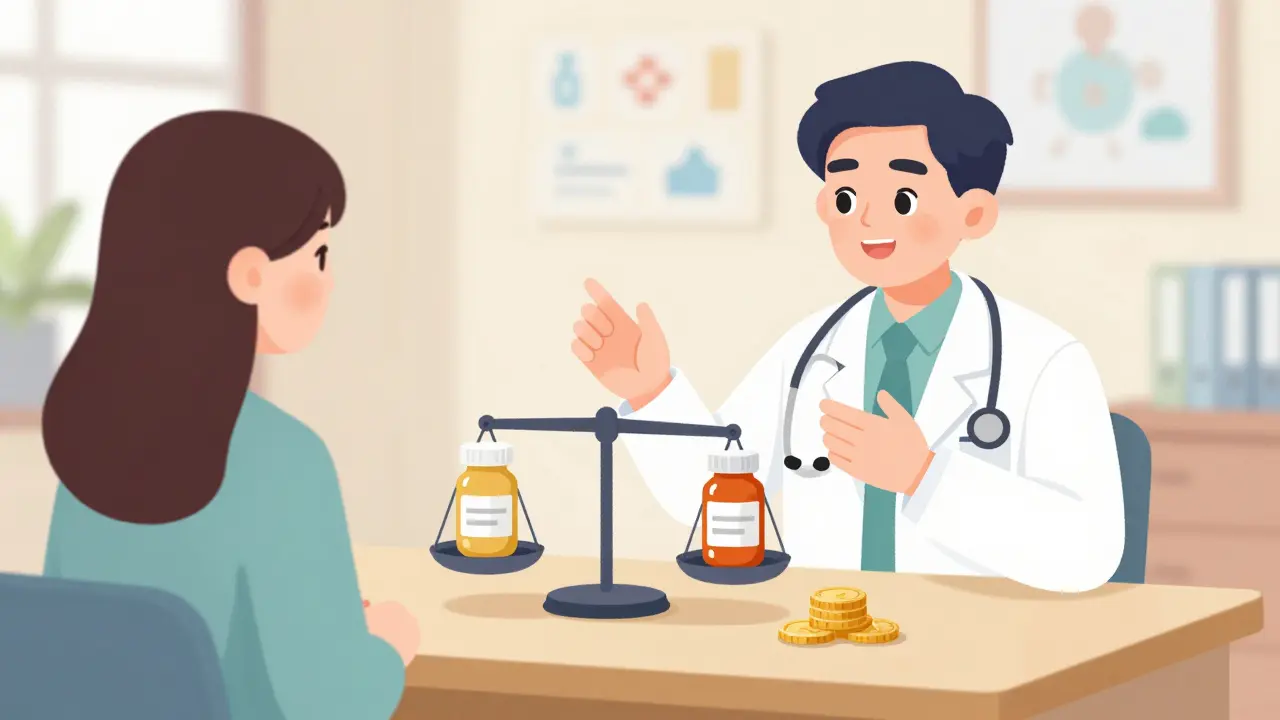
Nearly 1 in 4 adults skips doses or skips prescriptions entirely because they can't afford their meds. That's not just a statistic-it's a real problem for people trying to stay healthy. But there's a way to get the same treatment for less-without compromising health. It's called therapeutic interchange, and it's a simple process you can start today.
What Therapeutic Interchange Really Means (and why it matters)
Therapeutic interchange is a process where your doctor replaces your current medication with another drug in the same therapeutic class that works similarly but costs less. This is different from generic substitution, which uses the exact same chemical compound.
For example, switching from esomeprazole (Nexium) to omeprazole can save over $350 a year for the same stomach acid control. According to the American Academy of Family Physicians, this approach helps people stick to their treatment plans by making meds more affordable. It's not about cutting corners-it's about using clinical evidence to find the best value. A Vanderbilt University Medical Center study showed therapeutic interchange programs save $17.77 per member per year without harming health outcomes.
Step-by-Step Guide for Patients
Here's how to request a therapeutic alternative:
- Ask your doctor directly: "Do you have any lower-cost alternatives for this medication?" Don't wait for them to bring it up. A 2019 study found that 68% of patients who asked got a switch.
- Mention specific concerns: "I'm struggling to afford this $450 monthly prescription. Are there similar options?" Be honest about costs.
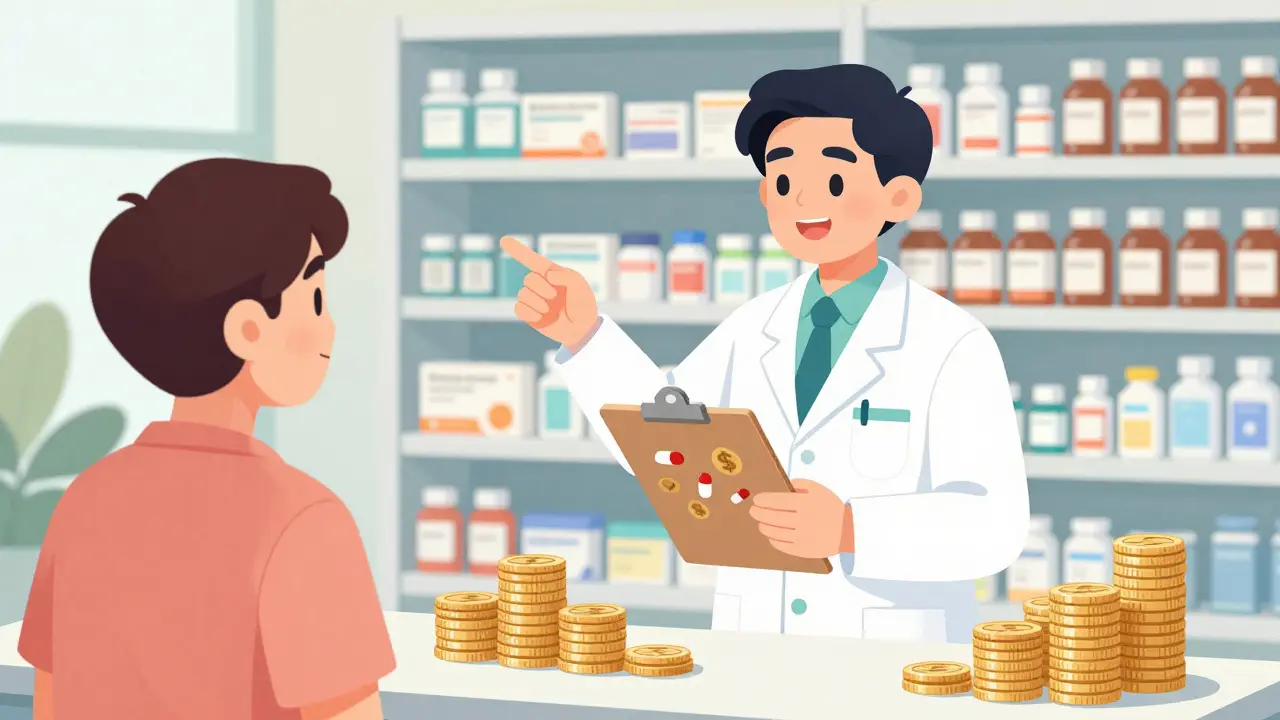
- Check with your pharmacist: Pharmacists often know about cheaper alternatives and can suggest options that match your insurance coverage.
- Use price comparison tools: In Australia, check the PBS website or MyMediCheck to see which pharmacies offer the lowest prices for generics.
- Bring research: Show your doctor data on therapeutic equivalence. For instance, gabapentin works just as well as Lyrica for nerve pain at a fraction of the cost.
What Your Doctor Needs to Know
Your doctor might not know about all therapeutic alternatives, but they're trained to make these switches safely. Key points they'll consider:
- Medication necessity: Is this drug still needed? Sometimes deprescribing is the best option.
- Clinical guidelines: Doctors check resources like the Institute for Clinical Systems Improvement for evidence-based substitution rules.
- Insurance coverage: They'll verify if the alternative is covered under your plan to avoid surprise costs.
- Patient-specific factors: Age, other health conditions, and current medications matter. For example, switching from a blood pressure med to another in the same class must consider kidney function.
- EHR Decision Support: Many clinics now have systems that flag potential cost-saving swaps when prescribing.
Real Cost-Saving Examples You Can Use Today
Real-world savings make a huge difference. Here's what people are doing:
- Switching from brand-name Lyrica (pregabalin) to generic gabapentin: $450/month to $15/month for neuropathic pain.
- Changing from Eliquis (apixaban) to warfarin: $450/month to $30/month for blood thinning (though warfarin requires regular blood tests).
- In Australia, switching from a brand-name statin like Crestor to generic atorvastatin: under PBS, the co-payment is just $6.80 per script instead of $42.50 for the brand.
- For diabetes meds, Jardiance (empagliflozin) to generic metformin: $400/month to $5/month.
A 2024 GoodRx survey found patients saved an average of $47.25 per month by asking for therapeutic alternatives. The key is knowing what to ask for and having the right conversation.
Navigating Insurance and Pharmacy Hurdles
Insurance can complicate things, but you're not powerless. Here's how to handle common issues:
- Prior authorization: If your insurance denies the switch, ask your doctor to file an appeal with clinical evidence. In Australia, PBS has streamlined processes for generic substitutions.
- Tiering exceptions: If your insurance has higher copays for certain drugs, your doctor can request a tiering exception to lower your out-of-pocket costs.
- Pharmacy choice: Prices vary wildly between pharmacies. In Australia, using the PBS website, you can find the cheapest pharmacy for your medication.
- Patient assistance programs: Many drug manufacturers offer discounts for eligible patients. For example, NeedyMeds helps find programs for low-income individuals.
A common mistake is assuming your insurance won't cover the alternative. Always check-many plans have tiered formularies where generic options are preferred.
When Therapeutic Interchange Isn't the Right Choice
Therapeutic interchange isn't a one-size-fits-all solution. It doesn't work for:
- Specialty medications: Like cancer drugs or biologics where few alternatives exist.
- High-risk situations: Where the new drug has different side effects (e.g., switching from one blood thinner to another that requires more monitoring).
- No clinical evidence: For newer drugs with no proven alternatives. A 2024 CBO report notes therapeutic interchange can't address 30% of prescription costs driven by specialty medications.
In these cases, your doctor might explore other cost-saving strategies like extended prescriptions or patient assistance programs. Always discuss risks with your healthcare team before making changes.
What's the difference between generic substitution and therapeutic interchange?
Generic substitution replaces a brand-name drug with its chemically identical generic version. Therapeutic interchange swaps a drug for another in the same class with similar effects but different chemistry. For example, switching from esomeprazole to omeprazole is therapeutic interchange, while switching from brand-name Lipitor to generic atorvastatin is generic substitution.
Can I ask my doctor to switch my medication?
Absolutely. Doctors expect these questions. Start by saying, 'I'm concerned about the cost of this medication-do you have lower-cost alternatives?' Be specific about your budget. Studies show 68% of patients who ask get a switch. Your doctor has tools to find safe, effective options.
Why would my doctor refuse a therapeutic interchange?
Doctors may hesitate if there's no clinical evidence for equivalence, if the new drug has different side effects for your specific condition, or if your insurance requires prior authorization. Always ask for the reasoning behind their decision-this helps you advocate for yourself.
How much can I save with therapeutic interchange?
Savings vary widely. Generic substitution typically saves 80-90% versus brand names, while therapeutic interchange saves 30-60% depending on the medication. For example, switching from brand-name Lyrica to gabapentin saves $435 monthly. In Australia, PBS subsidies make generic versions available for as little as $6.80 per script.
What if my insurance denies the switch?
Your doctor can file a prior authorization appeal with clinical evidence. In Australia, PBS rules require pharmacists to substitute generics unless the prescription specifies "do not substitute." Always check your PBS eligibility and ask your pharmacist for help navigating the process.
Diana Phe
February 5, 2026 AT 20:03This is all a scam by Big Pharma to keep us poor. They don't want us to know about cheaper alternatives because they make more money. The government is in on it. You think doctors care about you? They're just in it for the cash. Wake up people!
Carl Crista
February 6, 2026 AT 06:10The FDA is hiding cheaper drugs. Doctors don't tell you because they get kickbacks. I know this for sure.
Dr. Sara Harowitz
February 7, 2026 AT 05:46This is a disaster! People are dying because they don't know about therapeutic interchange! Why isn't this common knowledge? It's ridiculous! The healthcare system is broken, and this article is just a band-aid on a gaping wound! We need real change, not just lip service!
Carol Woulfe
February 9, 2026 AT 03:47The therapeutic interchange paradigm is fundamentally flawed due to pharmaceutical industry influence. The data is manipulated to serve corporate interests. One must question the veracity of the cited studies. This is a classic case of regulatory capture. The system is rigged against the public.
Kieran Griffiths
February 10, 2026 AT 02:59Hey there! It's great you're looking into this. Here's a tip: always ask your pharmacist-they know the ins and outs of insurance coverage. You've got this!
Lisa Scott
February 11, 2026 AT 09:23The article's data is cherry-picked. The Vanderbilt study? Total BS. They didn't account for long-term adverse effects.
Also, the savings are negligible when you factor in hidden costs.
Big Pharma is manipulating the system. The FDA is complicit.
They're pushing this narrative to keep you dependent on expensive drugs.
The real issue is the pharmaceutical industry's stranglehold on healthcare.
It's all about profits. They don't care about patients.
They're using therapeutic interchange as a smokescreen.
The evidence is clear-this is a dangerous practice.
You think they want you to save money? Think again.
They want you to stay sick so they can keep selling you drugs.
This is a classic case of corporate greed.
Wake up! The system is rigged against you.
Always question the source. This is a scam.
Tehya Wilson
February 11, 2026 AT 11:47This is utterly inadequate. The information provided is superficial. There are critical omissions regarding regulatory hurdles. A more rigorous analysis is required.
Kate Gile
February 13, 2026 AT 01:01Actually, the article covers a lot of important points. I've personally used therapeutic interchange and it worked well for me. It's all about communication with your healthcare team. Don't give up!
Gregory Rodriguez
February 14, 2026 AT 18:49Oh sure, because Big Pharma just loves giving away free medicine. Next you'll tell me they're handing out vaccines for free. Yeah, right. 😏
Johanna Pan
February 15, 2026 AT 13:21Hey, I know it's frustrating. But I switched to generic for my blood pressure med and saved $200 a month. It's totally possible! Just ask your doc and pharmacist. They're there to help. 😊
Jenna Elliott
February 16, 2026 AT 05:04This is a joke. The system is rigged against us. They'll never let you get cheaper meds. It's all about profits. Wake up people!
Elliot Alejo
February 17, 2026 AT 17:22Agreed. Asking directly works. I had to push my doctor a few times, but once I did, we found a cheaper option. It's worth the effort.
Samantha Beye
February 18, 2026 AT 19:58This guide is really practical. I've had success asking my pharmacist for alternatives. It's a simple step that makes a big difference.
Rene Krikhaar
February 20, 2026 AT 18:28I've been through this. Switching to generic gabapentin saved me a ton. Just talk to your doctor and pharmacist. They're there to help
one hamzah
February 22, 2026 AT 17:32Switched to generic, saved $200. Thanks!