
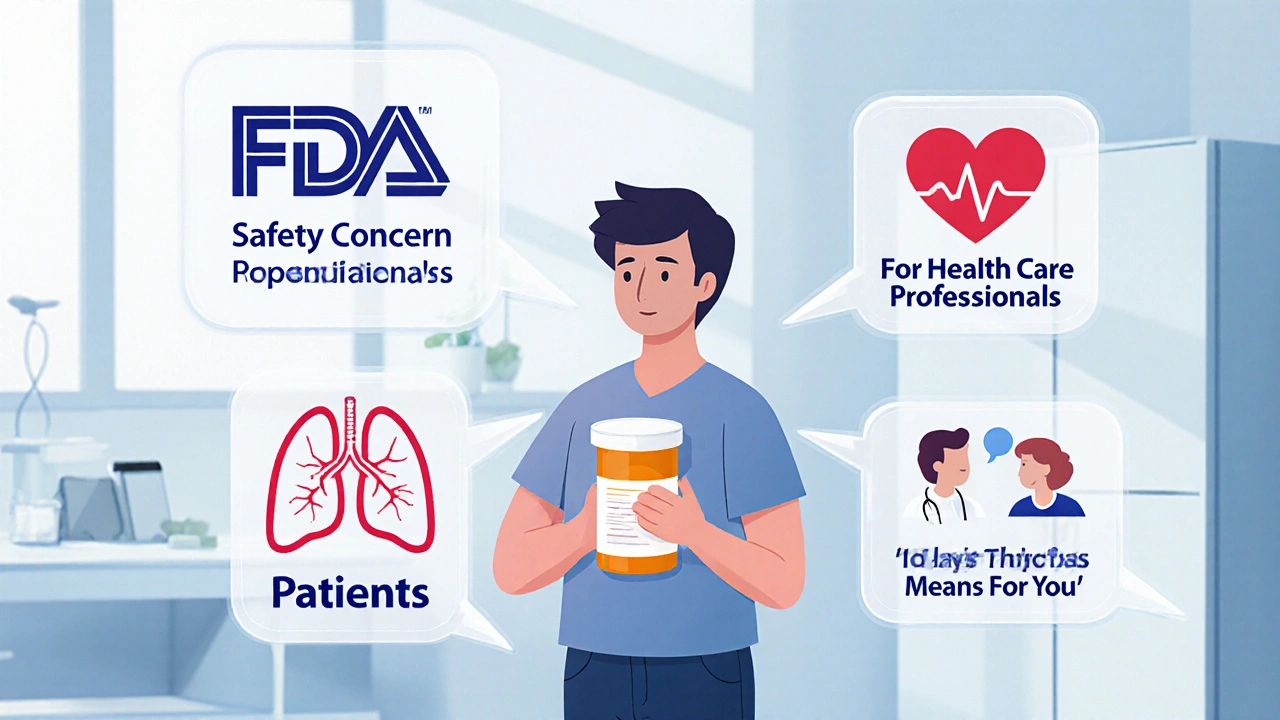
When you pick up a prescription, you trust that it’s safe. But drugs don’t stay the same after they’re approved. New risks can show up months or even years later-only after thousands of people have used them. That’s where FDA Safety Communications come in. These aren’t ads or news headlines. They’re official, science-backed updates from the U.S. Food and Drug Administration about real dangers tied to your medication. If you’re on a prescription drug, knowing how to read these notices could prevent a serious reaction-or even save your life.
What Exactly Is an FDA Safety Communication?
An FDA Safety Communication is a formal alert issued when new safety data emerges about a drug already on the market. It’s not about bad batches or manufacturing errors. It’s about hidden risks that only become clear after long-term use: liver damage from a painkiller, heart rhythm issues from an antidepressant, or dangerous interactions with other meds. Since 2007, the FDA has been required to issue these when evidence shows a significant risk, and they now publish about 50-70 major ones each year. These aren’t vague warnings. Each one includes exact changes to the drug’s official prescribing label, backed by clinical studies, patient reports, or data from national monitoring systems like the Sentinel Initiative. The FDA doesn’t issue these lightly. If a communication says your drug has a new boxed warning-the strongest type-it means the agency believes the risk is serious enough to demand immediate attention from doctors and patients alike.Where to Find Them (And How to Get Them Automatically)
You won’t find these on social media or random health blogs. The only official source is the FDA’s Drug Safety and Availability page: fda.gov/drugs/drug-safety-and-availability. But you don’t have to check it every day. Sign up for free email alerts. On that same page, scroll to the bottom and click “Subscribe to Email Alerts.” You can pick specific drug classes-like opioids, diabetes meds, or blood thinners-or choose alerts for all medications. That way, when a new communication drops, it lands in your inbox before your next refill. Pharmacies don’t always notify you. Your doctor might miss it too. But if you’re subscribed, you control the flow of critical information.How to Read One: The Four Key Sections
Every FDA Safety Communication follows the same structure. You don’t need to read every word-but you must check these four parts:- What Safety Concern Is FDA Announcing? This is the headline. It tells you the problem in plain language. Example: “FDA warns that certain opioid pain medicines can cause serious breathing problems in children.”
- For Health Care Professionals This section is technical. It lists exact changes to the drug’s prescribing label-like new contraindications, updated dosing limits, or required monitoring tests. If you’re a patient, you can skip the jargon, but pay attention if it mentions “Boxed Warning” or “Dosage and Administration.”
- For Patients This is your section. It’s written in simple language. It tells you what to do: “Don’t stop your medicine suddenly,” “Talk to your doctor before taking this with other drugs,” or “Watch for signs of liver problems like yellow skin or dark urine.”
- What This Means For You Sometimes called “Patient Guidance,” this part answers the biggest question: “Should I be worried? What do I do next?” It might say: “Continue taking your medicine unless your doctor tells you otherwise,” or “Stop immediately and call your provider if you experience chest pain.”
Understanding the Severity Levels
Not all warnings are created equal. The FDA ranks them by how urgent and serious they are:- Boxed Warning (Black Box Warning): The highest level. These drugs carry a risk of death, severe injury, or irreversible harm. Examples: certain antidepressants linked to suicidal thoughts in young adults, or blood thinners that can cause uncontrollable bleeding.
- Contraindications: You should not take this drug at all under certain conditions. For example, “Do not use if you have severe liver disease.”
- Warnings and Precautions: Use with caution. The risk is real but manageable. Might include monitoring requirements, like monthly blood tests.
- Other Updates: Changes to dosage, storage, or interactions. Important, but not immediately life-threatening.
What the Label Changes Look Like
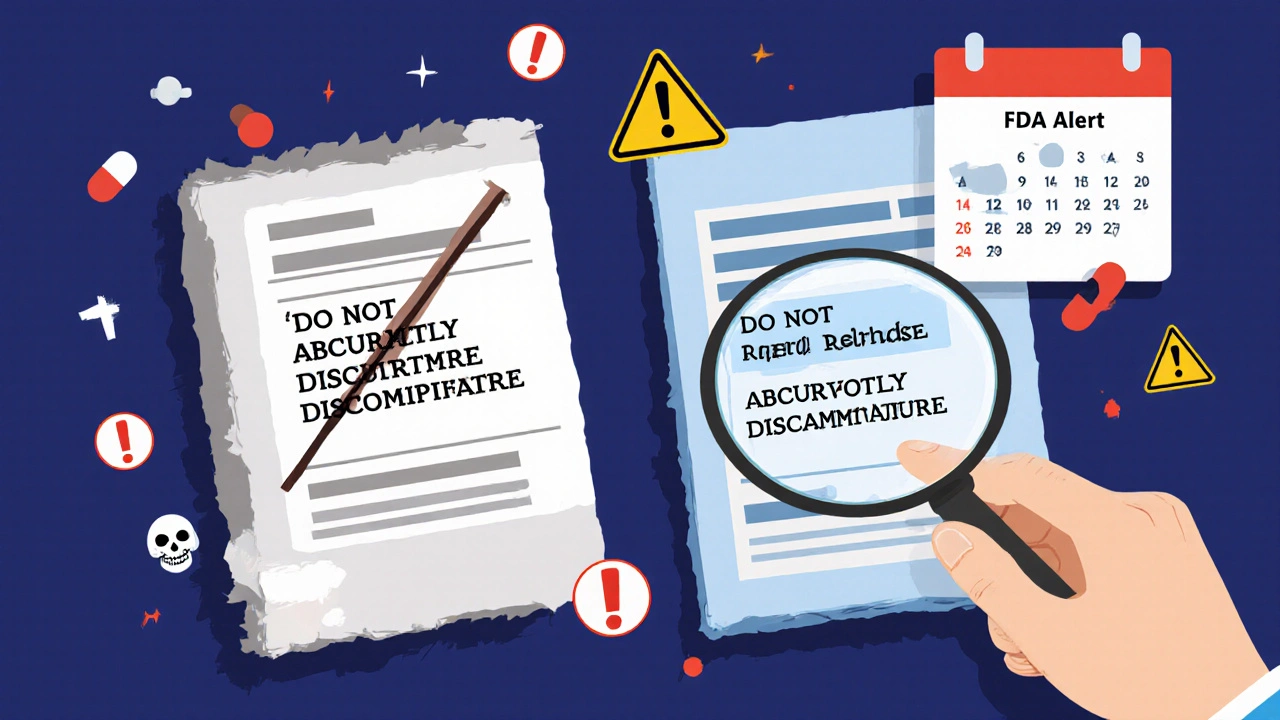
FDA communications include side-by-side comparisons of old and new labeling. They use bold text for additions and strikethrough for deletions. For example:Old wording: “Do not abruptly discontinue [Drug Name] in a physically dependent patient.”
New wording: “Do not rapidly reduce or abruptly discontinue [Drug Name] in a physically dependent patient.”
That small change matters. “Rapidly reduce” means you can’t just cut your dose in half overnight. You need a slow, controlled taper. If you didn’t know that, you could trigger withdrawal symptoms-or worse. The communication will also list the exact sections of the prescribing information that changed, like “Section 2.1, 5.3, 8.5.” If you want to dig deeper, you can look up the full prescribing info on the FDA’s Drugs@FDA database. But for most patients, the “For Patients” section gives you what you need.What to Do When You Get a Communication
Step 1: Don’t stop your medicine on your own. Unless the communication says “STOP IMMEDIATELY,” keep taking your drug. Stopping suddenly can be dangerous-especially for antidepressants, seizure meds, or heart medications. Step 2: Read the “For Patients” section. Highlight any advice that applies to you. If it says “Talk to your doctor,” make that your next step. Step 3: Bring the communication to your appointment. Print it out or show it on your phone. Say: “I got this alert about my medication. Can we talk about what this means for me?” Step 4: Check your Medication Guide. Every prescription comes with a small paper insert called a Medication Guide. The FDA requires it to be written at an 8th-grade reading level and to clearly explain risks. If you lost yours, you can download a copy from the FDA site or ask your pharmacist for a new one.
Common Mistakes Patients Make
Many people misunderstand these alerts. Here’s what not to do:- Mistake: Thinking a Drug Alert is the same as a Drug Safety Communication. Truth: Drug Alerts are short, urgent notices-like a recall or contamination issue. Safety Communications are deeper, science-based updates. Don’t confuse them.
- Mistake: Assuming “no news is good news.” Truth: Just because you haven’t seen a communication doesn’t mean your drug is risk-free. The FDA updates labels continuously. Subscribe to alerts.
- Mistake: Believing your doctor always knows. Truth: A 2021 study found only 37% of primary care doctors regularly read full FDA safety updates. Many rely on pharmacy bulletins or EHR alerts-which aren’t always accurate or timely.
- Mistake: Ignoring the Medication Guide. Truth: It’s the only document the FDA legally requires to be given to you, and it’s written for patients-not doctors.
Why This Matters More Than You Think
The FDA doesn’t approve drugs based on perfect safety data. It approves them based on the best available evidence at the time. Real-world use reveals hidden problems. That’s why post-market surveillance is critical. Take the case of Copiktra (duvelisib), a cancer drug. In 2022, the FDA issued a safety communication after reports of fatal lung infections and liver damage. The communication didn’t pull the drug off the market. Instead, it added new warnings, required patient monitoring, and updated the Medication Guide. Patients who read it and talked to their doctors could avoid complications-or switch to safer alternatives. This isn’t about fear. It’s about control. When you understand how to read these alerts, you’re no longer passive. You become an active partner in your care.What’s Changing Soon
The FDA is working to make these communications clearer. Since 2023, they’ve started testing plain-language summaries for high-risk drugs-available in both English and Spanish. They’re also piloting direct alerts through patient portals, so if you use MyChart or another health app, you might soon get a notification right in your account. By 2027, the FDA aims to raise patient understanding of these alerts from 54% to 75%. That means better visuals, simpler language, and more targeted messaging. But until then, the burden is still on you to read, understand, and act.Are FDA Safety Communications only for prescription drugs?
Yes, FDA Safety Communications focus on prescription and some over-the-counter drugs that require monitoring, like certain pain relievers or sleep aids. They don’t cover supplements, vitamins, or herbal products-those aren’t regulated the same way. If you’re taking something sold as a “dietary supplement,” the FDA won’t issue a safety communication about it.
Can I trust these alerts if my doctor didn’t mention them?
Absolutely. Doctors are busy, and many don’t read every FDA update. That’s why the FDA sends these directly to patients. If you see a communication about your drug, it’s not your doctor’s fault they didn’t tell you-it’s a system gap. Take the initiative. Bring the alert to your next visit. Your doctor will appreciate you being informed.
Do these alerts mean my drug is unsafe and I should stop it?
Not necessarily. Most safety communications don’t mean your drug is dangerous for everyone. They mean there’s a risk under certain conditions-like if you’re older, have kidney disease, or take other medications. The alert tells you when to be cautious, not when to quit. Always talk to your provider before making changes.
How often do these alerts happen?
The FDA issues 50 to 70 major Drug Safety Communications each year. Some drugs get multiple alerts over time, especially newer ones. Older, well-established drugs rarely get new ones unless a major safety issue emerges. If you’ve been on the same medication for 10 years without any alerts, it’s likely stable-but still worth checking annually.
What if I don’t understand the language in the communication?
You’re not alone. Many are written in technical terms. But every communication includes a “For Patients” section written in plain language. If that’s still unclear, ask your pharmacist. They’re trained to explain these alerts in simple terms. You can also call the FDA’s Drug Information line at 1-888-463-6332. They’ll help you understand what it means for your specific medication.
Tina Dinh
November 30, 2025 AT 21:09Andrew Keh
December 1, 2025 AT 06:04Brandy Johnson
December 3, 2025 AT 02:26Peter Axelberg
December 3, 2025 AT 03:57Monica Lindsey
December 3, 2025 AT 16:25jamie sigler
December 4, 2025 AT 20:21Jennifer Wang
December 6, 2025 AT 06:26stephen idiado
December 8, 2025 AT 05:12Subhash Singh
December 8, 2025 AT 17:45Geoff Heredia
December 10, 2025 AT 05:56Peter Lubem Ause
December 11, 2025 AT 15:37linda wood
December 12, 2025 AT 22:50LINDA PUSPITASARI
December 13, 2025 AT 05:13