
Every day, headlines scream about dangerous drugs: "New Study Links Blood Pressure Med to Heart Attacks," "FDA Warns of Deadly Side Effect in Popular Painkiller." These stories grab attention, but how many of them actually tell you what you need to know? If you’re reading a report that says a medication is risky, you’re not just looking for a headline-you’re trying to decide whether to keep taking your pill, switch prescriptions, or panic. The truth is, most media reports on medication safety get things wrong. And the consequences aren’t just confusing-they can be deadly.
Don’t Trust Relative Risk Alone
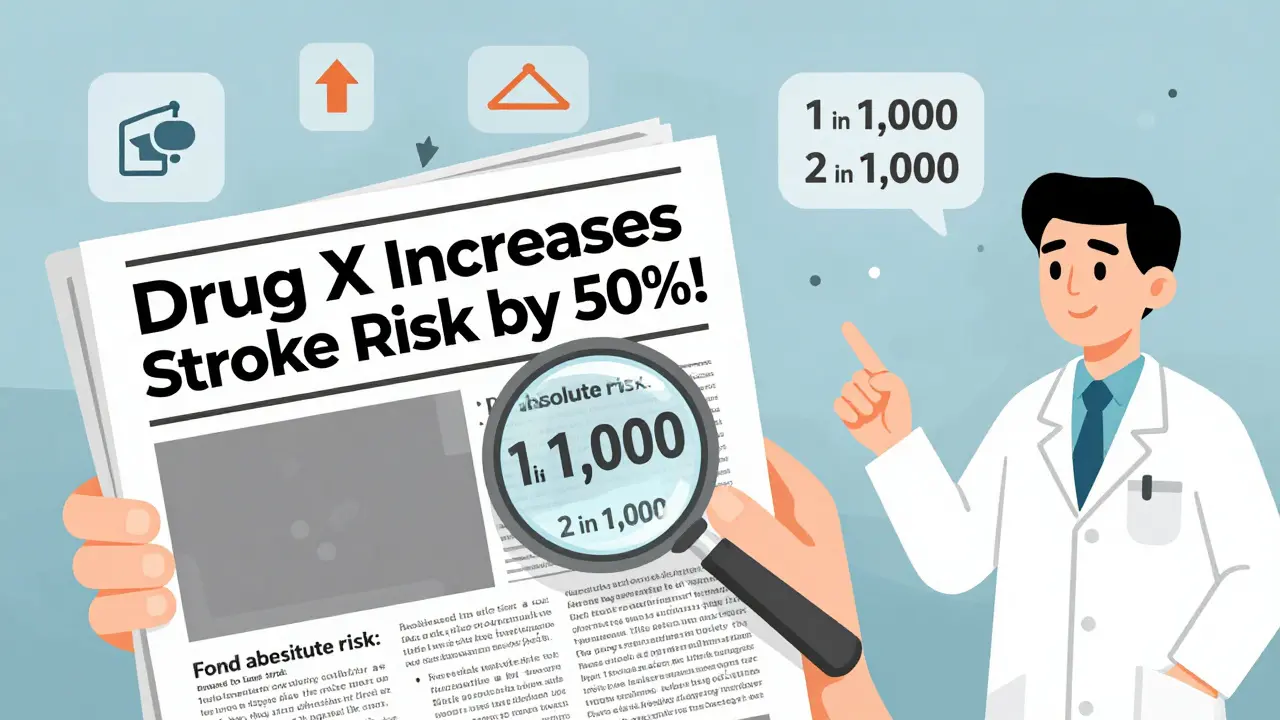
One of the most common tricks in media reporting is using relative risk to scare you. You’ll see headlines like: "Drug X increases risk of stroke by 50%." That sounds terrifying. But what if the original study found that 2 out of 1,000 people on the drug had a stroke, compared to 1 out of 1,000 on a placebo? That’s a 50% increase-but only one extra case per thousand people. That’s absolute risk: the real number that matters for your decision. A 2020 study in the BMJ found that only 38% of media reports included both relative and absolute risk. Most left out the absolute numbers, leaving readers with a distorted view of danger.Always ask: "What’s the actual chance this will happen to me?" If a report doesn’t say, look up the original study. The FDA’s 2022 guidelines say any credible safety study must report both. If it doesn’t, the report is incomplete.
Understand the Difference Between Errors and Reactions
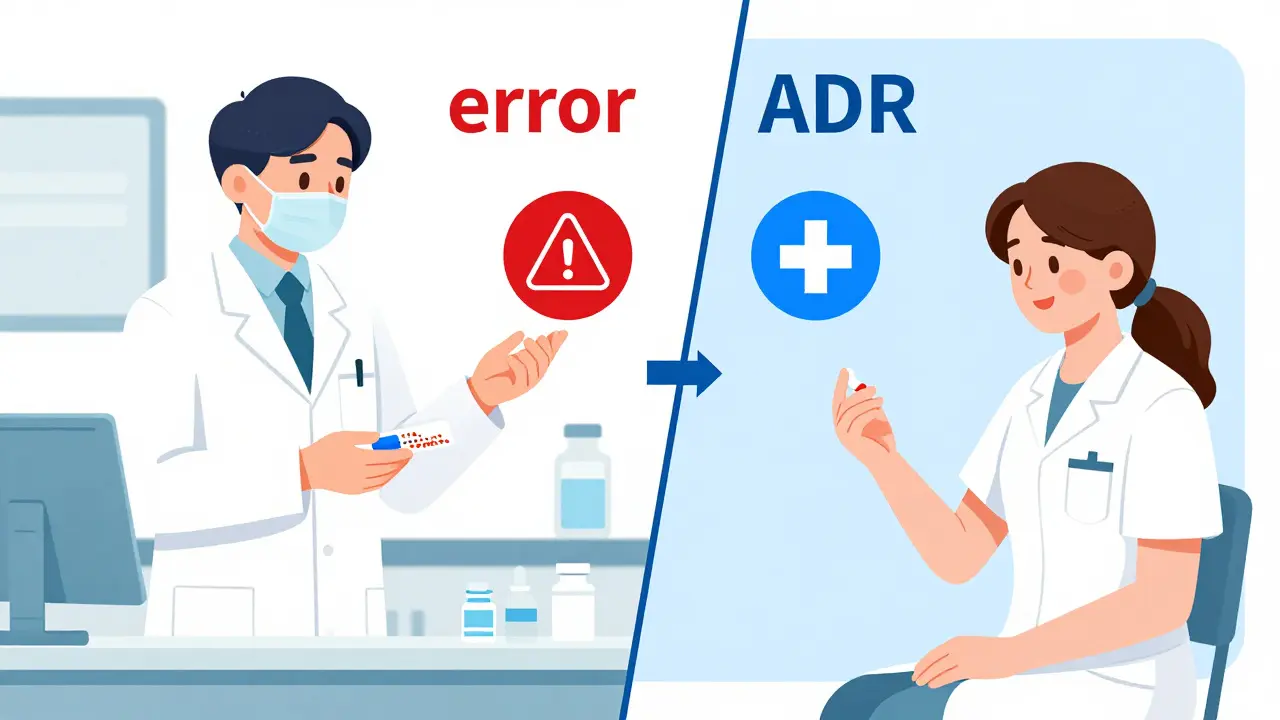
Medication errors and adverse drug reactions aren’t the same thing-and mixing them up is one of the biggest mistakes in reporting. A medication error is something that went wrong because of a human or system mistake: a pharmacist gave the wrong dose, a doctor wrote the wrong prescription, or a nurse administered it at the wrong time. These are preventable.An adverse drug reaction (ADR) is a harmful effect caused by the medicine itself, even when taken correctly. Think of it like this: if you take aspirin and get a stomach bleed, that’s an ADR. If you take the wrong dose because the label was misprinted, that’s an error.
A 2022 PLOS ONE review of 59 studies found that only 32% of research properly distinguished between the two. Media reports? Even worse. A JAMA Network Open analysis of 127 news stories showed that 68% didn’t say which category they were talking about. That’s a problem because the solutions are completely different. Fixing errors means better training and clearer labels. Managing ADRs means choosing different drugs or adjusting doses.
Check the Methodology Behind the Story
Not all studies are created equal. There are four main ways researchers find medication safety issues:- Incident reports: Hospitals and pharmacies voluntarily report mistakes. These are easy to collect but miss most events-only about 10% of errors are reported.
- Chart reviews: Researchers go through medical records to find signs of harm. They catch more than incident reports but still miss a lot. Dr. David Bates, who developed this method, says chart reviews typically capture only 5-10% of actual errors.
- Direct observation: Researchers watch nurses and pharmacists in real time. This finds the most problems, but it’s expensive and rarely used in real-world settings.
- Trigger tools: This method looks for "red flags" in patient records-like a sudden spike in potassium levels after a drug is given-and then investigates further. It’s the most efficient balance of accuracy and practicality.
A 2011 systematic review of 28 studies found trigger tools were the most reliable for finding real safety issues without wasting resources. If a media report says "a study found X drug is dangerous" but doesn’t say how they found it, you’re missing half the story. Ask: Was this based on voluntary reports? Chart reviews? Or a real-time monitoring system? Each has different reliability.
Follow the Data Back to the Source
Most media reports cite "a new study" without linking to it. That’s a red flag. You can’t verify a claim if you can’t find the original source. The FDA’s Adverse Event Reporting System (FAERS) and the WHO’s Uppsala Monitoring Centre are the two most trusted global databases for drug safety. But here’s the catch: these systems collect reports, not confirmed causes.Just because someone took Drug Y and then had a heart attack doesn’t mean the drug caused it. Maybe they had a family history of heart disease. Maybe they stopped taking their blood thinner. Spontaneous reporting systems are like smoke detectors-they alert you to something unusual, but they don’t prove a fire.
A 2021 study in Drug Safety found that only 44% of media reports explained this critical difference. If a news article says "200 people had heart attacks after taking this drug," that’s not proof-it’s a signal. Always check if the original study used statistical controls to rule out other causes. The FDA’s 2022 guidelines require this. If the media report skips it, the story is weak.
Look for Mention of Limitations
No study is perfect. Every one has limits: small sample size, short follow-up time, lack of diverse populations, or uncontrolled variables. A 2021 JAMA Network Open study found that 79% of media reports on medication safety didn’t mention any limitations. That’s not just sloppy-it’s misleading.For example, a study might look at 300 people over six months. If it finds a rare side effect that takes years to appear, the study can’t detect it. But if the headline says "New Drug Causes Liver Damage," readers assume the risk is proven, not that it’s still unknown.
Good reporting always says: "This study only looked at patients over 65," or "We didn’t track patients for more than one year," or "The sample was mostly white, so results may not apply to all groups." If those sentences aren’t there, the report is incomplete.
Use Trusted Sources to Verify Claims
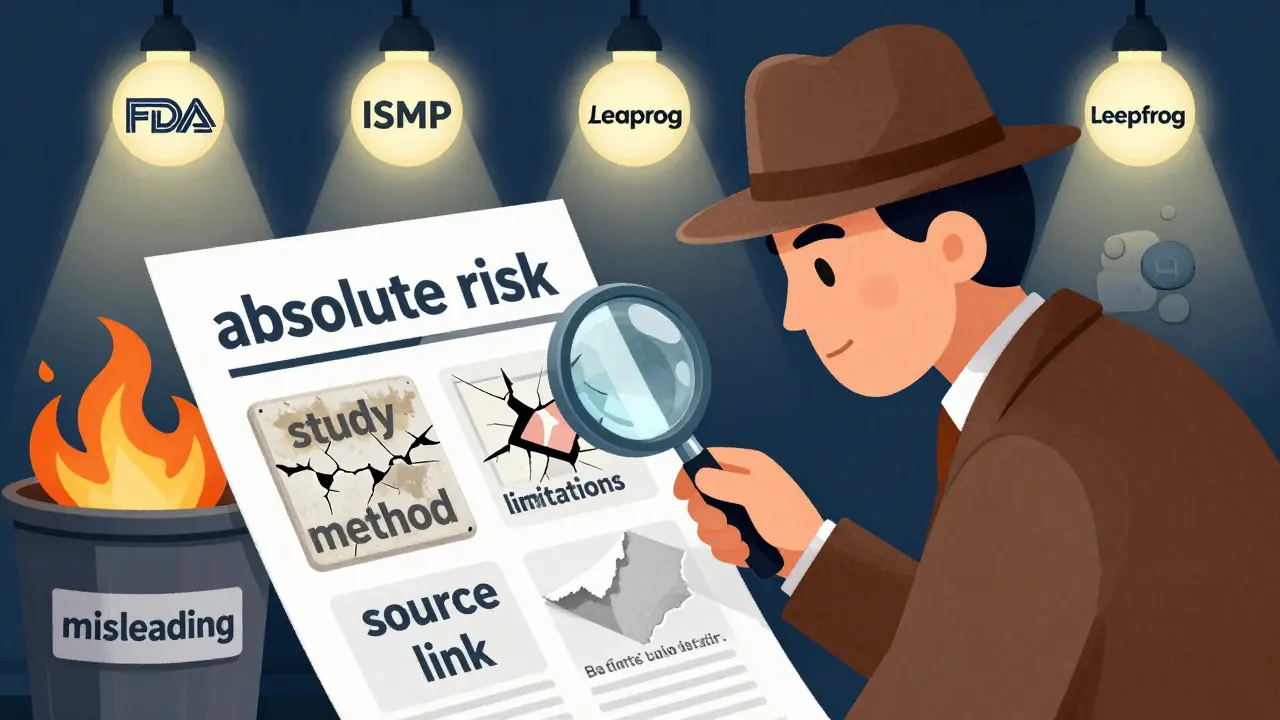
Don’t rely on headlines. Go straight to the experts. The Institute for Safe Medication Practices (ISMP) publishes an annual list of dangerous abbreviations and dosing errors that still cause harm in hospitals. If a report talks about "Lanoxin" without saying "digoxin," it’s using outdated, error-prone terminology. That’s a red flag.The FDA’s Sentinel Analytics Platform, launched in 2023, uses real-world data from millions of patients to detect safety signals. Only 18% of reporters use it-but if you’re concerned about a drug, you can check it yourself. The Leapfrog Group rates hospitals on medication safety using simulated patient scenarios. If a news story says "Hospital X has poor drug safety," does it mention whether they’ve been rated by Leapfrog? If not, the claim is unverified.
Also, check the WHO’s ATC classification system. A 2022 review found 47% of media reports misclassified drugs-calling a diabetes drug an antidepressant, for example. If the article gets the drug class wrong, it’s likely wrong on other things too.
Watch Out for Where the Story Came From
Not all media is equal. A 2020 BMJ study found that major newspapers like the New York Times and The Guardian correctly explained risk in 62% of stories. Cable news? Only 38%. Digital-only outlets? Just 22%. TV news was the worst at explaining study limitations-only 18% mentioned them. Print media did better. Social media? Even worse. A 2023 analysis by the National Patient Safety Foundation found 68% of medication safety claims on Instagram and TikTok were factually wrong.Why? Because TV and social media thrive on emotion. They don’t have time to explain confidence intervals or confounding variables. They need a quick scare. Print and academic outlets have more space and are more likely to consult experts like ISMP or ASHP.
What Should You Do When You See a Report?
Here’s your quick checklist:- Does it say whether this is an error or an adverse reaction?
- Does it give absolute risk (e.g., "1 in 1,000") not just relative risk ("50% higher")?
- Does it name the study method (trigger tool, chart review, etc.) and its known limits?
- Does it mention study limitations (sample size, duration, demographics)?
- Can you find the original source (study, FDA report, clinicaltrials.gov)?
- Does it cite trusted sources like ISMP, ASHP, or FDA guidelines?
- Is the drug correctly classified (e.g., is it really an ACE inhibitor or just "a heart drug")?
If the answer to any of these is "no," treat the report with caution. Don’t stop your medication based on it. Talk to your pharmacist or doctor. Bring them the article. Ask: "Is this something I should be worried about?"
Why This Matters More Than You Think
A 2023 Kaiser Family Foundation survey found that 61% of U.S. adults changed how they took their medication after reading a news report. Nearly 3 in 10 stopped their drug entirely. That’s not just confusion-it’s a public health risk. Stopping blood pressure or diabetes meds without medical advice can lead to strokes, heart attacks, or hospitalization.And it’s not just patients. A 2022 survey of 1.5 million doctors on Sermo found they rated media accuracy on medication safety at just 5.2 out of 10. Emergency physicians gave it a 4.1. That’s because they see the fallout: patients showing up with uncontrolled conditions because they believed a misleading headline.
Medication safety isn’t about fear. It’s about understanding. The science is complex. The stakes are high. And the media, for all its reach, isn’t always equipped to explain it right. Your job isn’t to believe every headline. It’s to ask better questions.
Can I trust media reports that say a drug is "dangerous"?
Not without checking the details. Many reports use alarming language like "dangerous" or "deadly" to describe drugs that only pose a risk under specific conditions-like high doses, rare allergies, or interactions with other medications. Always look for absolute risk numbers, study limitations, and whether the report confuses medication errors with adverse reactions. If those aren’t included, the label "dangerous" is misleading.
What’s the difference between FAERS and clinical trial data?
FAERS (FDA Adverse Event Reporting System) collects voluntary reports from patients and doctors after a drug is on the market. It’s useful for spotting new safety signals but doesn’t prove cause. Clinical trial data comes from controlled studies before approval and shows how often side effects happen under strict conditions. FAERS can show 1,000 reports of a side effect-but only 100 might be linked to the drug. Clinical trials give you the real rate: "1 in 500 experienced this side effect." Always check which source a report uses.
Why do some drugs get pulled from the market after media reports?
Sometimes they don’t. Most drugs aren’t pulled because of media reports. Regulatory agencies like the FDA or EMA act based on rigorous analysis of thousands of reports, statistical trends, and real-world data-not headlines. Media can raise awareness, but decisions to withdraw a drug require evidence of clear, consistent harm across multiple studies. A single news story rarely causes a withdrawal.
Are AI-generated health articles reliable?
No, not yet. A 2023 Stanford study found that 65% of medication safety articles written by AI tools contained major factual errors-especially around risk numbers and drug classifications. AI doesn’t understand context, limits, or statistical nuance. If you’re reading a medication safety article from a blog, app, or chatbot, treat it like a rumor until you verify it with a trusted source like the FDA or ISMP.
How can I find out if my hospital has good medication safety practices?
Check the Leapfrog Group’s hospital safety grades. They rate hospitals on how well they prevent medication errors using simulated patient scenarios. Only 22% of local news reports mention these scores, but they’re publicly available online. Hospitals with high Leapfrog ratings use barcode scanning, electronic prescribing, and pharmacist reviews-proven methods that cut errors by up to 50%. If your hospital isn’t listed, ask them directly what safety systems they use.
If you’re ever unsure about a medication safety report, don’t guess. Talk to your pharmacist. They’re trained to read studies, spot misleading headlines, and tell you what actually matters for your health. You don’t need to be a scientist to make smart choices-you just need to know what questions to ask.
Milad Jawabra
March 5, 2026 AT 17:03Stephen Vassilev
March 6, 2026 AT 04:43Mike Dubes
March 6, 2026 AT 16:05marjorie arsenault
March 7, 2026 AT 00:06Deborah Dennis
March 7, 2026 AT 21:49Donna Zurick
March 8, 2026 AT 16:22Tobias Mösl
March 9, 2026 AT 03:58tatiana verdesoto
March 11, 2026 AT 01:01Ethan Zeeb
March 12, 2026 AT 18:24