
Getting a medication list right isn’t just about writing down what you take. It’s about making sure the safety alerts tied to those drugs are clear, visible, and acted on-every single time. Missing a warning on insulin, warfarin, or morphine can lead to serious harm, even death. And yet, too many medication lists are just static lists, with no real system to track or respond to risks. The good news? There’s a proven way to fix this.
Why Safety Alerts on Medication Lists Matter
Not all medications are created equal. Some carry a much higher risk if used wrong. These are called high-alert medications. According to the Institute for Safe Medication Practices (ISMP), they include insulin, opioids, anticoagulants, neuromuscular blockers, and chemotherapy drugs. A mistake with one of these isn’t just a typo-it’s a potential emergency. The data doesn’t lie. Facilities that document safety alerts properly reduce medication errors by up to 50%. That’s not theory. That’s real-world results from hospitals using the ISMP’s Targeted Medication Safety Best Practices. But here’s the catch: it’s not enough to just know the risk. You have to document how you’re managing it.What Counts as a Safety Alert?
A safety alert isn’t just a pop-up on a computer screen. It’s a documented action plan tied to a specific medication risk. For example:- For insulin: Document that you’re using standardized concentrations, require double-checks before administration, and confirm patient education on dosing.
- For oral methotrexate: Document that the system blocks daily dosing by default and requires prescribers to enter an oncology diagnosis before the order goes through.
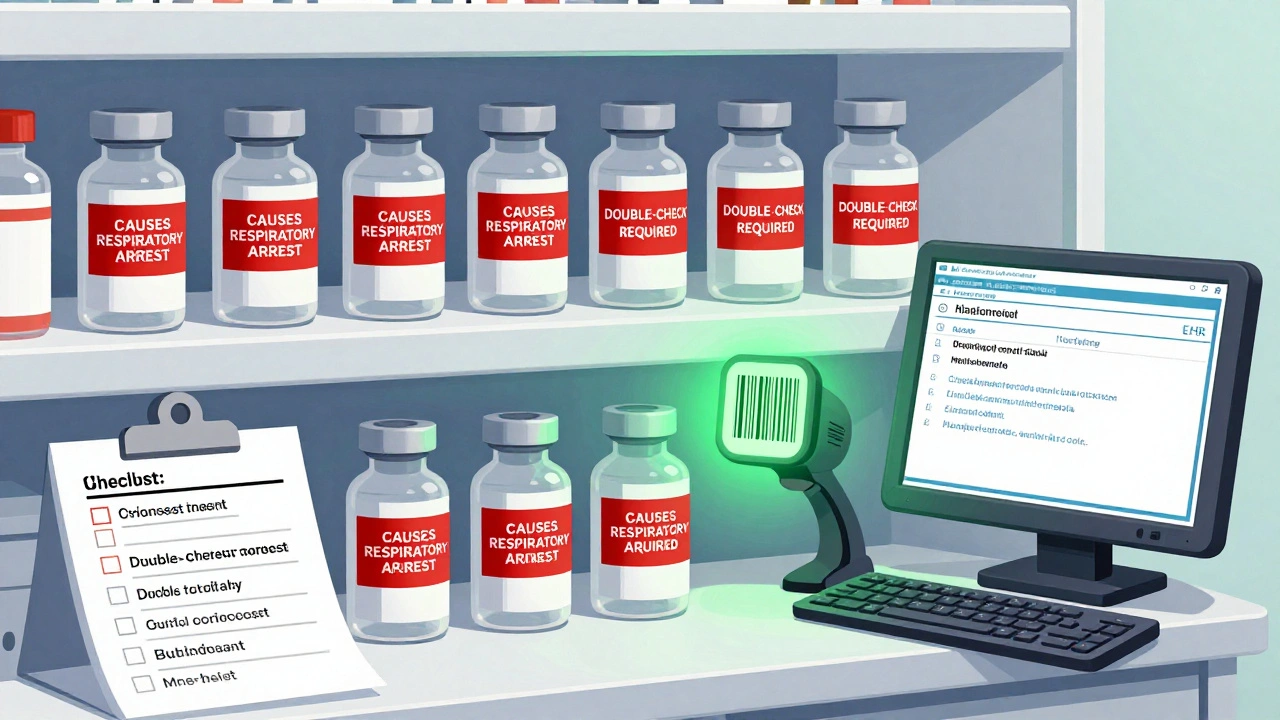
- For neuromuscular blockers: Document that every vial and syringe has an auxiliary label that says: “WARNING: CAUSES RESPIRATORY ARREST - PATIENT MUST BE VENTILATED”.
How to Build a Safety Alert System on Your Medication List
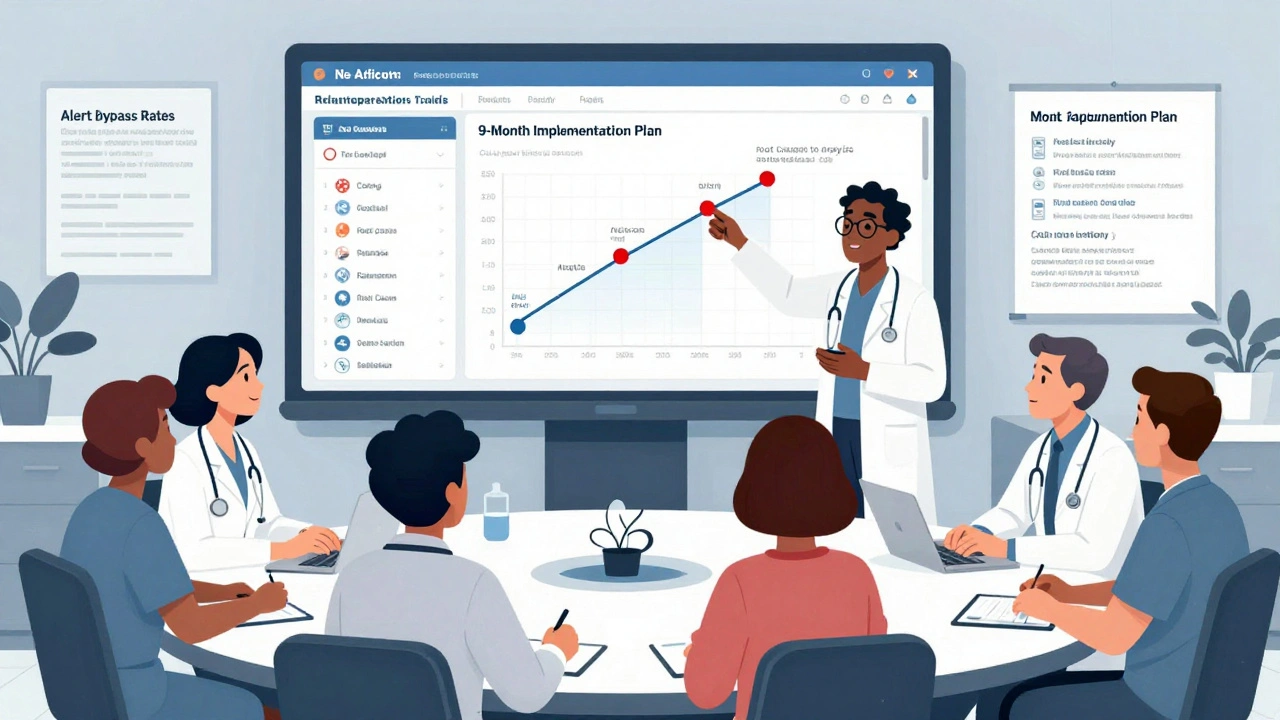
Start with this 9-month plan, based on ISMP’s official roadmap:- Month 1-2: Identify your high-alert list. Use the ISMP master list as your starting point, then tailor it to your facility. Which drugs do you use most? Which have caused near-misses? This step takes about 40 staff hours.
- Month 3-4: Map your current workflow. Where do errors happen? Is the alert bypassed during busy shifts? Are barcode scans skipped? Track this.
- Month 5-6: Install technical controls. Configure your EHR to enforce rules: hard-stop alerts for methotrexate, mandatory double-checks for insulin, and locked dosing defaults.
- Month 7: Add physical labels. Print and apply warning labels to all high-alert medication containers. No exceptions.
- Month 8: Train staff. Don’t just hand out a handout. Show them how the system works, why it matters, and what to do when an alert pops up.
- Month 9: Start auditing. Monitor scanning compliance (target: 95%+). Track how often alerts are bypassed. Do root cause analysis on every bypass over 5%.
What to Document (And What Not To)
Documentation needs to be specific, not vague. Here’s what works:- ✅ Documented action: “Double-check performed by RN and PharmD on 12/2/2025 for insulin glargine 20 units.”
- ✅ System confirmation: “EHR blocked daily methotrexate order; oncology indication confirmed.”
- ✅ Physical evidence: “Auxiliary label applied to all vecuronium vials per ISMP 2024-2025.”
- ❌ “Insulin is high-alert.” (Too vague. No action taken.)
- ❌ “Alerts were bypassed due to workload.” (No root cause, no fix.)
- ❌ “We have an alert system.” (No proof it’s working.)
Common Pitfalls and How to Avoid Them
Even with good intentions, teams run into roadblocks:- Alert fatigue: If your system throws 15 alerts per order, people start ignoring them. The fix? Only keep alerts that prevent serious harm. Cut the noise.
- Staff shortages: Rural clinics often say they can’t keep up. The answer isn’t to skip documentation-it’s to automate. Use EHR audit trails that auto-log when a scan happens or an alert is acknowledged.
- Integration gaps: FDA MedWatch releases 120+ drug safety alerts a year. If your team has to manually update your list, you’re falling behind. Look for systems that auto-feed these updates.
- Over-documentation: Don’t document every single step for low-risk meds. Focus on high-alert drugs. Save your energy where it counts.
Real Results from the Field
At University of Michigan Health, pharmacist Jennifer Martinez implemented the full ISMP documentation system. In 18 months, high-alert medication errors dropped by 63%. The cost? A half-time staff member to manage the paperwork. The payoff? Fewer patient injuries, fewer lawsuits, and better staff confidence. But not every story is smooth. On Reddit, a rural pharmacist wrote: “We’re supposed to document every bypassed alert-but with 3 pharmacists covering 24/7, we just don’t have time.” That’s the reality for many small facilities. The solution? Start small. Pick one high-alert drug. Master the documentation for that. Then expand.The Future: Automation and AI
The future of safety documentation isn’t paper checklists. It’s smart systems. The FDA’s Sentinel Initiative now sends automated safety alerts directly into hospital EHRs, cutting manual entry by 80%. Epic Systems is rolling out an AI module in mid-2025 that prioritizes alerts based on your facility’s own error history. But AI isn’t magic. A 2024 JAMA study found early AI tools missed 18% of critical safety alerts. That’s why human oversight still matters. The goal isn’t to replace staff-it’s to give them better tools so they can focus on what only humans can do: make judgment calls, talk to patients, and catch what the system misses.What’s Next for Your Facility?
By January 1, 2025, the Joint Commission will require documented proof of your high-alert medication controls. CMS will start tying reimbursement to this documentation in 2025. If you’re not ready, you risk accreditation issues-and lost funding. Start today:- Print the ISMP 2024-2025 high-alert list.
- Identify your top 3 most-used high-alert drugs.
- Check your EHR: Do hard-stop alerts exist for them?
- Look at your medication containers: Are warning labels on every vial?
What exactly is a high-alert medication?
A high-alert medication is a drug that carries a higher risk of causing serious harm if used incorrectly. Examples include insulin, opioids like morphine, anticoagulants like warfarin, neuromuscular blockers, and chemotherapy agents. These aren’t necessarily dangerous drugs-they’re dangerous when dosed wrong, given to the wrong patient, or mixed up with other medications.
Do I need to document safety alerts if I’m not in a hospital?
Yes. While the strictest rules apply to hospitals, community pharmacies, long-term care facilities, and even home care providers should document safety alerts for high-alert medications. The ISMP guidelines apply to all settings where medications are dispensed or administered. A wrong insulin dose at home can be just as deadly as in a hospital.
Can electronic alerts alone keep patients safe?
No. Electronic alerts are helpful, but studies show they’re bypassed up to 49% of the time if there’s no supporting documentation or process. A pop-up isn’t enough. You need a system: labels on vials, double-checks, forced stops in the EHR, and records proving those steps happened.
How often should safety alert documentation be reviewed?
At least quarterly, and immediately after any medication error that causes harm. Your medication safety committee should meet monthly to review alert bypass rates, audit documentation, and update controls. The ISMP recommends ongoing monitoring-not annual reviews.
What if my facility can’t afford the software or staff to do this?
Start with low-cost, high-impact steps. Print and apply warning labels to all high-alert meds. Create a simple checklist for double-checks. Use free templates from ISMP or AHRQ. Even basic documentation-written on paper-reduces errors. The goal isn’t perfection; it’s progress. A 2022 ECRI analysis found that even partial implementation reduced errors by 22%.
Are there penalties for not documenting safety alerts?
Yes. Starting in 2025, Medicare’s Hospital Value-Based Purchasing Program will factor in documentation of high-alert medication protocols. Non-compliance with Joint Commission standards can lead to accreditation warnings or loss of certification. Beyond that, failing to document safety steps can be used as evidence of negligence in lawsuits.
Benjamin Sedler
December 3, 2025 AT 13:53Look, I get the ISMP guidelines are gospel now, but let’s be real-half these ‘safety alerts’ are just hospital bureaucracy in a lab coat. I’ve seen nurses bypass a double-check for insulin because the system crashed and the patient was already on the IV pole. Did they almost die? No. Did they get fined? Yes. We’re punishing diligence, not preventing errors. This isn’t safety-it’s liability theater.
Gareth Storer
December 5, 2025 AT 03:20Oh wow, another 12-page PDF from the safety-industrial complex. Next they’ll be requiring us to sign a notarized affidavit every time we hand someone a Tylenol. ‘Auxiliary label required’? For *what*, the existential dread of a misplaced dose? I’m starting to think the real high-alert medication is paperwork.
Pavan Kankala
December 7, 2025 AT 01:29Let’s not pretend this is about patient safety. This is about hospitals covering their asses before the AI takes over. You think the Joint Commission gives a damn about your ‘double-checks’? They care about the audit trail. The FDA’s sending automated alerts? Yeah, but who’s feeding the algorithm? Pharma. Who profits when you over-document? The EHR vendors. The ‘high-alert’ list is just a marketing bundle with a side of fear-mongering. Wake up. They’re not protecting you-they’re monetizing your panic.
Jessica Baydowicz
December 8, 2025 AT 22:57Y’all are overthinking this so hard 😭 I work in a tiny clinic with one pharmacist and a dog named Band-Aid. We started with just insulin labels-printed them on sticky notes, slapped ‘em on every vial, and had the RNs say ‘double-check!’ out loud before giving it. No fancy EHR. No audits. Just human voices and sticky paper. We haven’t had a near-miss in 8 months. You don’t need a 9-month plan-you need to start somewhere. Even a baby step counts!
Yasmine Hajar
December 10, 2025 AT 22:46As someone who’s lost a cousin to a medication error in a rural ER, I’m crying happy tears reading this. This isn’t bureaucracy-it’s life or death. I’ve seen the panic on a nurse’s face when they realize they gave the wrong dose because no one documented the alert. This guide? It’s the difference between a family burying someone and them celebrating their 80th birthday. Please, just start with one drug. One vial. One label. One moment where you say ‘I won’t let this happen again.’ You’re not just documenting-you’re holding someone’s life in your hands.
Karl Barrett
December 12, 2025 AT 14:39There’s a fundamental epistemological tension here: the ontological primacy of the documented act versus the phenomenological reality of clinical practice. While the ISMP framework provides a robust axiomatic structure for risk mitigation, its implementation is contingent upon the hermeneutic interpretive capacities of frontline providers operating under conditions of bounded rationality and institutional scarcity. The audit trail is not merely a record-it is a performative act of epistemic legitimacy within the biomedical regime. Without this, the clinical encounter becomes a spectral event-unverifiable, unaccountable, and thus, in the logic of liability, non-existent.
Jake Deeds
December 12, 2025 AT 18:33I’m sorry, but if your facility can’t afford to follow these guidelines, you shouldn’t be handling medications at all. This isn’t a suggestion-it’s a moral imperative. You think you’re being ‘practical’ by skipping labels or skipping double-checks? You’re gambling with lives. I’ve seen people die because someone ‘didn’t have time.’ There’s no excuse. Not for rural clinics. Not for understaffed pharmacies. Not ever. If you can’t do it right, you shouldn’t be doing it at all. That’s not harsh-it’s just true.
Elizabeth Crutchfield
December 13, 2025 AT 03:44ok so i read this whole thing and im like… wait so we just need to put like… sticky notes on insulin bottles? and have nurses say ‘double check’? and that’s it? i feel like i could do that in my sleep 😅 also can someone send me that ismp list? i lost my copy and my boss is gonna kill me if i dont have it by monday
Ben Choy
December 13, 2025 AT 22:14Love this. Seriously. I’m in a small UK pharmacy and we just started with warfarin labels last month. We printed the warning on colored tape, put it on every bottle, and now the whole team says ‘red tape, double check’ before handing it out. It’s silly, but it works. We’ve had zero incidents since. And honestly? It’s made us talk more. We’re actually checking in with each other. This isn’t just about safety-it’s about culture. Thanks for the nudge. 🙏
Chad Handy
December 14, 2025 AT 18:19You know what’s worse than a medication error? The soul-crushing weight of being forced to document every single thing you do because some suit in a conference room decided that if you didn’t write it down, it never happened. I’ve been in this game 22 years. I’ve seen people die from bad meds. I’ve also seen people die from burnout because they spent 4 hours a day filling out forms that no one ever reads. This isn’t progress. This is institutionalized guilt-tripping disguised as safety. They don’t want you to be safe-they want you to be compliant. And compliance doesn’t save lives. Care does. And care doesn’t come from checklists. It comes from tired nurses who still show up because they care. Stop making us prove we care. Just let us care.
Jenny Rogers
December 15, 2025 AT 06:13While the pragmatic recommendations outlined herein are commendable in their structural rigor, it is imperative to underscore that adherence to the ISMP 2024-2025 guidelines constitutes not merely a best practice, but a non-negotiable ethical obligation under the Hippocratic imperative of non-maleficence. Failure to implement documented, systematized controls for high-alert medications constitutes a dereliction of professional duty, and may, under tort law and statutory regulatory frameworks, constitute actionable negligence. The invocation of resource constraints or operational inefficiencies does not absolve the duty of care. Institutions that fail to comply are not merely inefficient-they are ethically compromised. The Joint Commission’s forthcoming enforcement is not punitive-it is remedial. Act accordingly.
Benjamin Sedler
December 3, 2025 AT 14:44Let’s be real-this whole ‘document everything’ thing is just institutional theater. I’ve worked in three hospitals and every single one had the same checklist: paper trails no one reads, labels no one looks at, and alerts everyone ignores because they’re as useful as a screen door on a submarine. The real problem? We’re treating symptoms, not the disease. The disease is burnout. The disease is understaffing. The disease is a system that rewards paperwork over patient care. You want to reduce errors? Hire more pharmacists. Pay them more. Stop making them choose between documenting a double-check and stopping a code blue. That’s the real safety alert.
Gareth Storer
December 4, 2025 AT 20:34Oh wow. Another ‘ISMP says so’ manifesto. Let me guess-next you’ll tell me we need a notarized affidavit before giving Tylenol? 🤡
Meanwhile, in the real world, a nurse in rural Nebraska is giving insulin to a diabetic grandma using a pen she found in her purse because the hospital’s ‘high-alert’ vial had no label and the EHR was down for maintenance. But hey, at least the checklist was filled out in triplicate. Progress, baby.
Pavan Kankala
December 6, 2025 AT 04:12They say ‘document the alerts’ like it’s some holy ritual. But who really benefits? The patients? Or the lawyers? The Joint Commission? The EHR vendors? Let’s not pretend this isn’t a compliance circus designed to make administrators look good while frontline staff get crushed under the weight of digital bureaucracy.
And don’t get me started on AI. ‘Smart systems’? More like smart surveillance. They’re not saving lives-they’re collecting data to sell to insurers who’ll deny care later. This isn’t safety. It’s surveillance capitalism wrapped in a white coat.
Jessica Baydowicz
December 6, 2025 AT 22:01Y’ALL. I just implemented the double-check system for insulin at my clinic and OMG-it changed EVERYTHING. 💕 We started with ONE drug, ONE label, ONE checklist. Now our RNs actually talk to each other before giving meds. We even made a little ‘Safety Squad’ sticker for the fridge. One old nurse cried because she said she finally felt safe. It’s not about the EHR. It’s about the culture. You don’t need fancy tech-you need heart. And maybe a printer. 🖨️❤️
Yasmine Hajar
December 8, 2025 AT 09:01As someone who’s worked in rural clinics for 15 years, I want to say thank you for writing this. Not everyone gets how hard it is to do this stuff with 2 pharmacists, 1 tech, and a 30-minute lunch break.
But here’s the thing-we did it. We started with warfarin. Printed labels on sticky notes, taped them to bottles. Made a quick checklist on a clipboard. Trained everyone in 10 minutes during shift change. No software. No budget. Just grit.
And guess what? No errors in 14 months. You don’t need a 9-month plan. You need one person who refuses to let a patient get hurt because of paperwork.
Karl Barrett
December 9, 2025 AT 12:31There’s a deeper epistemological tension here: the ontological primacy of documentation versus the phenomenological reality of clinical practice. We are attempting to codify the ineffable-the tacit knowledge of the nurse who knows when a patient’s pupils are ‘just a little off’-into discrete, audit-ready data points.
But the system doesn’t capture intentionality. It captures compliance. And compliance ≠ safety. The ISMP guidelines are valuable, but they’re artifacts of a technocratic paradigm that conflates measurement with meaning. We must resist the seduction of quantification as proxy for care. The vial label is not the safeguard. The human who sees the label and pauses-that’s the safeguard.
Jake Deeds
December 11, 2025 AT 12:22Look. I’ve seen this movie before. ‘Oh, let’s just document it!’ as if that magically makes the system better. Meanwhile, the guy who actually administers the meds is working 80 hours a week, getting yelled at by families, and now has to fill out a 7-page form every time he gives insulin?
And you wonder why people burn out?
Don’t get me wrong-I’m all for safety. But this isn’t safety. It’s performative virtue signaling dressed up as policy. If you really cared, you’d fix the staffing ratios. You’d pay people a living wage. You’d stop outsourcing patient care to a corporate spreadsheet.
But no. Let’s just make the nurses write more.
Elizabeth Crutchfield
December 12, 2025 AT 22:46omg i just read this and i’m crying?? like i work in a tiny clinic and we dont even have a printer that works right but we started putting sticky notes on insulin bottles and now my coworker and i high five before we give it?? its so dumb but it feels so good?? like we’re actually doing something??
also my boss said ‘why are you writing on the bottles’ and i said ‘because if it saves one life i dont care if you hate it’ and she just nodded and bought me coffee. love my job.
Ben Choy
December 14, 2025 AT 07:55Love this thread. Really. 🙌
At our hospital, we started with just one drug-morphine. Made a simple checklist: 1) label on vial, 2) two nurses sign, 3) EHR logs it. No fancy tech. Just people talking. We even put a little ‘Team Check’ sticker on the med cart.
Now, other units are asking how we did it. That’s the real win-not the audit, not the compliance, but the culture shift. One small step. One team. One life saved. That’s the kind of progress that matters.
Also, shoutout to Jessica Baydowicz-your comment made my day. 💛
Chad Handy
December 15, 2025 AT 11:18Let me tell you what’s really going on here. This isn’t about safety. It’s about liability. The hospitals don’t care if you live or die. They care if you die and your family sues them. That’s why they need you to document everything. So when the lawyer comes knocking, they can say, ‘We followed protocol.’
But here’s the ugly truth: the protocol doesn’t save lives. The exhausted nurse who stays late to double-check the dose saves lives. The pharmacist who calls the doctor because something feels off saves lives. The unit clerk who notices the patient’s chart hasn’t been updated in three days saves lives.
So stop pretending this is about safety. It’s about covering your ass. And until we fix the system that turns humans into compliance robots, none of this matters.
Jenny Rogers
December 15, 2025 AT 12:35While the sentiment expressed herein is commendable in its intent, the underlying methodology remains fundamentally flawed due to its reliance on procedural compliance as a surrogate for clinical excellence. The Joint Commission’s forthcoming requirements, while administratively expedient, represent a paradigmatic misalignment between operational metrics and therapeutic outcomes. One must interrogate the epistemic foundations of documentation: Is the act of recording synonymous with the act of safeguarding? The answer, empirically and ethically, is no. True safety arises not from the presence of auxiliary labels or EHR hard-stops, but from the cultivation of a moral ecology wherein every clinician internalizes the sanctity of the patient’s life as a non-negotiable imperative. Until such a culture is institutionalized, all documentation remains, at best, a performative artifact of institutional anxiety.