

When you pick up a generic pill at the pharmacy, you expect it to work just like the brand-name version. But how does the FDA make sure it’s safe after it hits the market? Unlike brand-name drugs, which go through years of clinical trials before approval, generic drugs are approved based on one key fact: they’re bioequivalent to the original. That means they deliver the same active ingredient in the same amount, at the same rate. But bioequivalence doesn’t tell the whole story. What if the tablet doesn’t dissolve right? What if the capsule breaks open too early? What if the preservative causes a reaction in some patients? That’s where post-approval surveillance comes in - and it’s far more complex than most people realize.
The Hidden System Behind Generic Drug Safety
The FDA doesn’t just approve generics and walk away. Behind the scenes, a specialized team called the Clinical Safety Surveillance Staff (CSSS), part of the Center for Drug Evaluation and Research, watches every generic drug after it’s sold. They don’t rely on luck or patient complaints alone. They use data - millions of data points - to catch problems before they become widespread.
Every year, the FDA receives about 1.2 million reports of adverse events through MedWatch. That includes everything from dizziness to heart palpitations. But here’s the catch: most of those reports don’t say which generic brand was taken. The CSSS team has to dig deeper. They cross-reference those reports with pharmacy sales data from IMS Smart and Symphony, which track exactly how much of each generic version is being sold. If one manufacturer’s version accounts for 70% of complaints but only 30% of sales, that’s a red flag. It doesn’t mean the drug is dangerous - it means something about that specific product is triggering more reports than expected.
What They’re Looking For
Generic drugs aren’t just about the active ingredient. The problem often lies in the extras - the fillers, the coatings, the way the tablet is pressed. These are called excipients and manufacturing details. A pill from Manufacturer A might dissolve in 15 minutes. The same pill from Manufacturer B might take 45. For most drugs, that’s fine. But for drugs with a narrow therapeutic index - like warfarin, levothyroxine, or seizure medications - even small differences can cause serious harm.
The CSSS team tracks specific failure patterns:
- Tablets that don’t dissolve properly (17% of quality complaints)
- Oral liquids that form strange clumps or precipitates (12%)
- Patches that fall off too soon (9%)
- Extended-release capsules that release all the drug at once instead of slowly
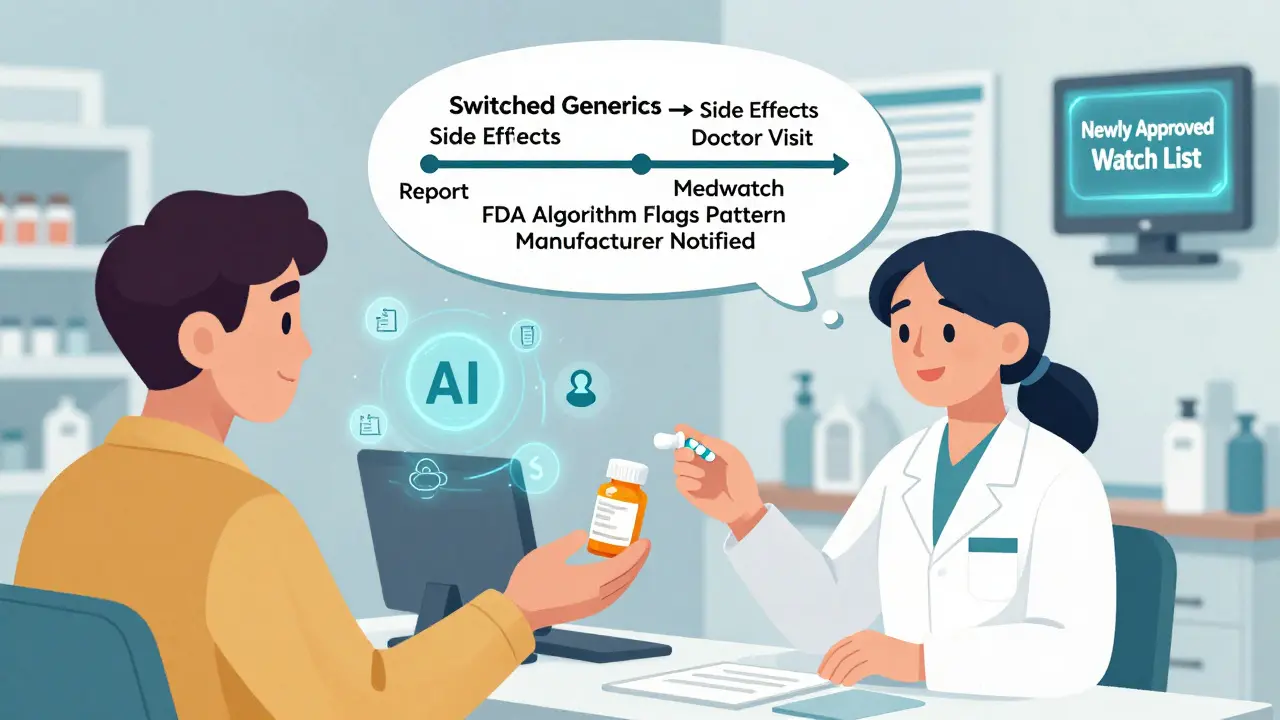
These aren’t rare. In fact, they’re common enough that the FDA has a special list called the “Newly Approved Generic Watch List.” Every generic drug that’s been on the market for less than a year gets extra scrutiny. Why? Because of something called the Weber Effect. When a new generic hits the shelves, doctors and pharmacists start noticing and reporting issues - not because the drug is suddenly worse, but because people are paying attention. Reports can spike by 300-400% in the first year. The FDA expects this. They plan for it.
How They Find Problems Before They Spread
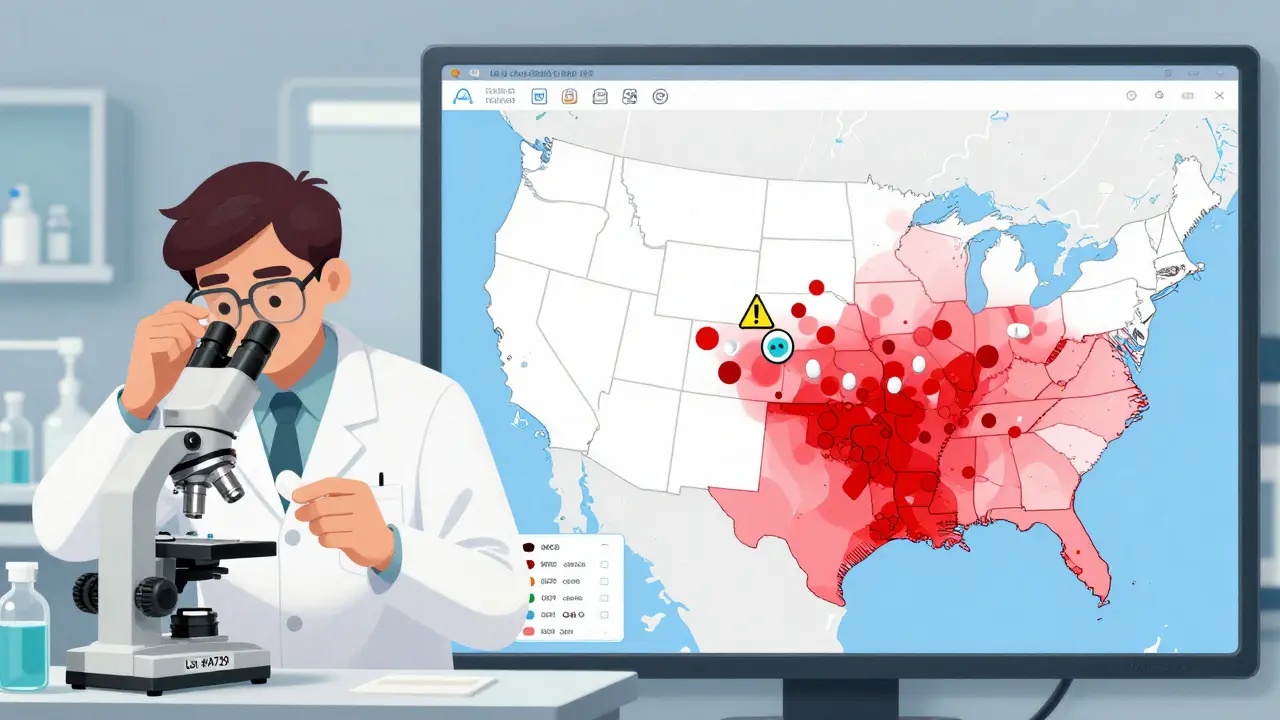
The system doesn’t wait for hundreds of complaints. It uses algorithms to spot clusters. Every month, the CSSS exports about 45,000-60,000 quality complaints from the Drug Quality Reporting System (DQRS) into a custom SAS program. The software looks for patterns: same manufacturer, same lot number, same defect. If 12 different people in 5 states report that their metformin tablet crumbles in their mouth - all from the same batch - that’s not coincidence. That’s a manufacturing flaw.
Each complaint is reviewed by a trained evaluator. About 5-7% of cases go to a medical officer for deeper analysis. They ask: Is this a one-off? Or is it a sign of something bigger? They classify the risk: Is the adverse event likely to happen? And how severe could it be? Mild? Moderate? Life-threatening?
They also scan medical journals, talk to healthcare providers, and monitor patient forums. A Reddit thread from March 2023 described 15 patients whose extended-release metformin stopped working after 18 hours. That’s not normal. The FDA picked up on that pattern within weeks and contacted the manufacturer. Turns out, the coating had changed slightly - enough to alter release timing. The company issued a voluntary recall.
Where the System Falls Short
Here’s the uncomfortable truth: the FDA’s system is excellent at catching manufacturing defects. It’s not as good at catching therapeutic inequivalence - when a generic drug just doesn’t work as well as the brand name, even if it’s technically bioequivalent.
Dr. Robert Temple, former FDA deputy director, admitted in a 2018 JAMA article that the system is “less sensitive to subtle efficacy differences.” Why? Because bioequivalence testing is done once - before approval. There’s no mandatory retesting after the drug hits the market. For drugs like levothyroxine, where a 10% change in absorption can throw off a patient’s entire hormone balance, that’s a big gap.
In 2019, over 200 MedWatch reports came in about inconsistent effects from generic levothyroxine. It took 18 months for the FDA to fully investigate. Why? Because they didn’t have enough staff to chase every signal. A 2021 Government Accountability Office report found that only 65% of potential therapeutic inequivalence signals got proper follow-up.
And here’s another problem: many doctors think the FDA tests generics after approval. A 2018 survey found 63% of family physicians believed that. They don’t. The FDA doesn’t retest. They only monitor what’s reported.
Who’s Reporting - And Who’s Not
Most reports come from healthcare professionals: pharmacists, nurses, doctors. Pharmacists alone make up 42% of professional reporters. That makes sense - they’re the ones handing out the pills and hearing from patients. But patients themselves? Only about 30% of reports come from them. And even then, only 28% of patients who report an issue ever get a response from the FDA.
That’s a huge disconnect. If a patient feels their generic thyroid med isn’t working, they might call their doctor. But unless the doctor files a MedWatch report, the FDA won’t see it. And many doctors don’t know how to file one.
What’s Changing - And What’s Coming
The FDA knows the system has limits. That’s why they’re upgrading it.
- In 2023, they started using AI to sort through reports. It cut false alarms by 27%.
- In 2024, they’re adding five more generic drug categories to their active surveillance network (Sentinel Initiative).
- By late 2024, they’ll start pulling in real-time pharmacy claims data - so they’ll know exactly how many pills of each generic are being filled each week.
- By mid-2025, they plan to require post-approval bioequivalence studies for drugs with narrow therapeutic windows.
- Also in 2025, they’ll launch a patient portal so people can directly report issues like “my pill didn’t work” or “I had a reaction.”
These changes are expensive. The FDA’s Generic Drug User Fee Amendments (GDUFA III) budgeted $220.5 million for safety monitoring in 2023. But analysts say they’ll need another $120 million a year by 2027 just to keep up with complex generics - like inhalers, patches, and injectables that are harder to copy.
What You Can Do
If you’re on a generic drug and something feels off - if it’s not working like it used to, or you’re having new side effects - don’t ignore it. Talk to your pharmacist. Ask if your prescription was switched. Write down the name of the manufacturer on the pill bottle. If you think it’s the drug, report it.
Go to MedWatch and file a report. You don’t need a doctor’s note. You don’t need proof. Just your experience. Your report could be the one that triggers a nationwide review.
And if you’re a healthcare provider: know the difference between bioequivalence and therapeutic equivalence. Know that generics aren’t all identical. And if you see a pattern - even just three patients with the same issue - file a report. The system only works if people use it.
Frequently Asked Questions
Are generic drugs less safe than brand-name drugs?
No. Generic drugs are held to the same strict quality standards as brand-name drugs. The FDA requires them to have the same active ingredient, strength, dosage form, and route of administration. The main difference is in how they’re tested - generics don’t go through full clinical trials. But once approved, they’re monitored just as closely. Most safety issues with generics come from manufacturing variations, not the drug itself.
Why do some people say their generic medicine doesn’t work like the brand?
Sometimes, it’s not the active ingredient - it’s how the drug is made. The coating, filler, or release mechanism might differ slightly. For most drugs, that doesn’t matter. But for drugs with a narrow therapeutic index - like thyroid meds, blood thinners, or epilepsy drugs - even small changes can affect how the body absorbs the drug. If you notice a change in how you feel after switching generics, talk to your doctor. You may need to stick with one manufacturer.
Does the FDA test generics after they’re approved?
The FDA doesn’t routinely retest generics for bioequivalence after approval. Instead, they monitor reports of problems - like pills that don’t dissolve, side effects, or complaints about effectiveness. They use data from pharmacies, patient reports, and lab testing of random samples to spot trends. If something looks wrong, they can demand the manufacturer test the product or even recall it.
How long does it take the FDA to respond to a safety report?
There’s no fixed timeline. Simple reports - like a broken tablet - might be reviewed in days. Complex ones - like a pattern of therapeutic failure - can take months. The FDA receives over a million reports a year and prioritizes based on risk. If a report signals a widespread danger, it’s handled immediately. If it’s an isolated case, it’s logged for future analysis. Only about 28% of patients who report issues get a follow-up, but that doesn’t mean their report wasn’t used.
Can I trust my generic medication?
Yes - for the vast majority of people, generic drugs are safe and effective. Over 90% of U.S. prescriptions are for generics, and the system has caught thousands of manufacturing flaws before they caused harm. But no system is perfect. If you notice a change in how you feel after switching to a new generic, pay attention. Keep the pill bottle. Report it. And if you’re on a critical medication, ask your pharmacist if you can stick with the same manufacturer.
What Comes Next
The future of generic drug safety isn’t about more testing. It’s about better data. Faster connections. Smarter tools. The FDA is moving from passive reporting to active monitoring - using real-time pharmacy records, AI to spot patterns, and patient feedback to fill in the gaps.
But the system still depends on people. Pharmacists who notice a pattern. Doctors who file reports. Patients who speak up. Until everyone understands that safety doesn’t end at approval - it only begins - the system will keep working, but never as well as it could.
kenneth pillet
January 19, 2026 AT 09:23Been on generic levothyroxine for 5 years. Switched brands last year and suddenly my heart was racing at night. Didn't think much of it till I read this. Made me check the bottle - it was a different maker. Went back to the old one and boom, back to normal. FDA needs to make manufacturers print the lot number on the pill itself, not just the bottle.
Stacey Marsengill
January 21, 2026 AT 08:36So let me get this straight - the same drug, same active ingredient, but if the filler is made by a company that uses cornstarch instead of lactose, some people turn into human fireworks? And the FDA just waits for people to die before they care? Classic. They’re not protecting us. They’re protecting profits. Big Pharma owns this whole circus.
Eric Gebeke
January 21, 2026 AT 12:30Everyone’s acting like this is some new revelation. I’ve been telling my patients for years that generics aren’t interchangeable. Especially with warfarin. One guy had a near-stroke because his new generic dissolved too slow. He didn’t even know his script got switched. Pharmacists don’t tell you. Doctors don’t care. The system is broken and everyone’s too lazy to fix it.
Jake Moore
January 23, 2026 AT 09:40Big takeaway: if you’re on a narrow-therapeutic-index drug, stick with one manufacturer. Write the name down. Don’t let the pharmacy switch it without asking. And if you feel weird after a refill - don’t just assume it’s ‘stress’ or ‘aging.’ It might be the pill. Your report matters more than you think.
Joni O
January 24, 2026 AT 19:55My mom’s on seizure meds. She’s had 3 seizures in 18 months since they switched generics. We didn’t connect it till she found a Reddit thread about it. Now we’re fighting the pharmacy every time. It’s exhausting. Why does the burden fall on patients? The FDA should auto-flag high-risk generics and notify prescribers when a switch happens.
Ryan Otto
January 26, 2026 AT 11:34Let’s be brutally honest: the FDA is a regulatory puppet of the pharmaceutical-industrial complex. Generic manufacturers are incentivized to cut corners because they’re bidding against each other for pennies. The ‘bioequivalence’ standard is a joke - it’s measured in ideal lab conditions with healthy volunteers. Real patients have comorbidities, metabolisms, and gut flora that vary wildly. This isn’t safety monitoring. It’s statistical theater.
Max Sinclair
January 28, 2026 AT 00:34Good breakdown. I work in a clinic and I’ve seen the same pattern - patients get switched to a cheaper generic, then come back saying ‘it’s not working like before.’ We don’t have time to chase every case, but I’ve started asking ‘which maker?’ on the chart. Small thing. Might save someone a hospital trip.
Praseetha Pn
January 28, 2026 AT 15:51They’re lying. The FDA doesn’t monitor anything. I work in a pharmacy in Mumbai and we get generics from India, China, and even Egypt. The pills look identical but some dissolve in water like chalk. No one tests them. No one cares. The FDA is just a brand name for global negligence. You think your pill is safe? You’re just lucky.
Emma #########
January 30, 2026 AT 06:45Thank you for writing this. I’ve been too scared to speak up because I thought I was imagining things. I’ve had anxiety attacks since switching my antidepressant generic. I didn’t know I could report it. I’m going to file a MedWatch report tonight. Maybe someone else feels this way too.
Tyler Myers
February 1, 2026 AT 05:10They’re watching us. The FDA’s ‘AI system’? It’s a front. They’re using this data to build profiles on patients who complain. Next thing you know, your insurance will deny your prescription because you ‘triggered too many alerts.’ This isn’t safety. It’s surveillance. And the people who report? They’re marked. Don’t be fooled.