
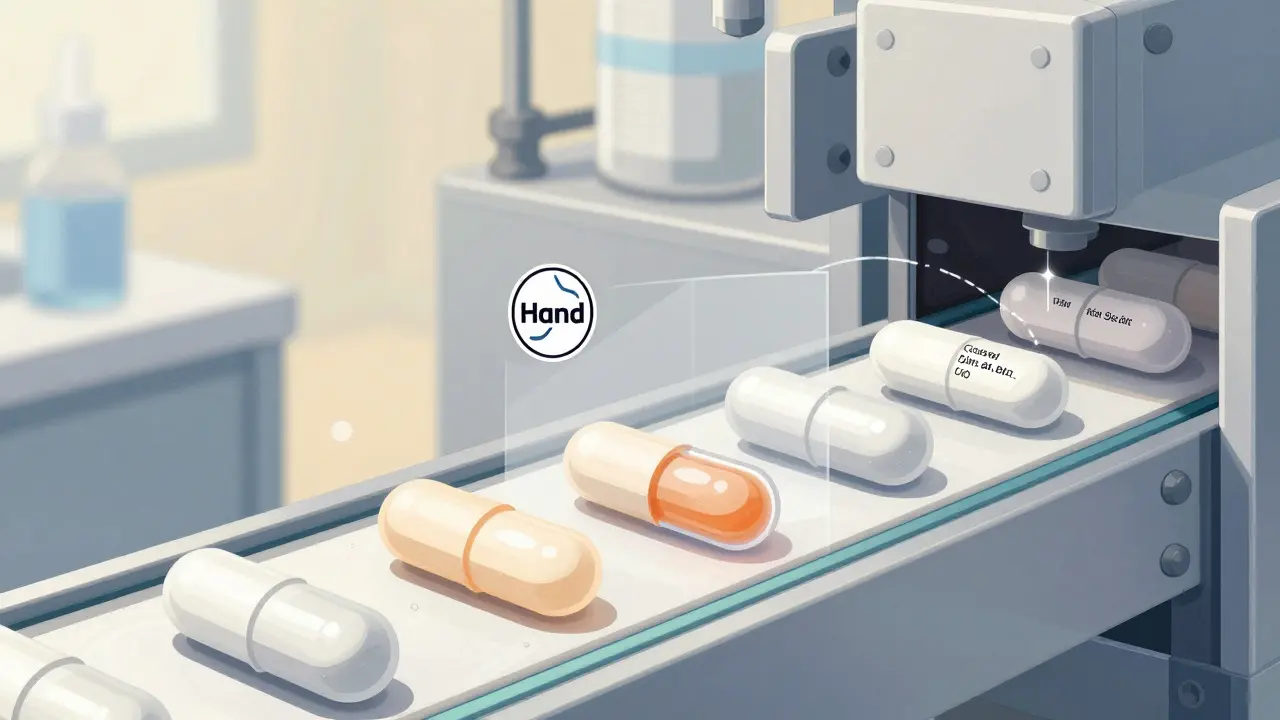
When a brand-name drug loses its patent, prices usually drop by 80% or more. That’s the promise of generics: cheaper, same medicine. But here’s the twist-sometimes, the company that made the brand-name drug also makes the generic version. And it’s not a copy. It’s the exact same pill, same factory, same ingredients. This isn’t a loophole. It’s called an authorized generic, and it’s becoming one of the most common strategies in pharmaceuticals today.
What Exactly Is an Authorized Generic?
An authorized generic is a version of a brand-name drug made by the original manufacturer and sold under a different label. It’s not a separate product. It doesn’t have different ingredients. It doesn’t come from a different lab. It’s the same tablet, same capsule, same coating-just without the brand name on the box. The FDA requires that authorized generics match the brand-name drug in every way: size, shape, color, active ingredient, and even inactive ingredients like fillers and binders. The only difference? The packaging. The brand logo is gone. The name changes to the chemical compound. That’s it. This isn’t something new. The first one launched in 1997 when AstraZeneca released a generic version of Prilosec (omeprazole) the day its patent expired. Within six months, it captured 30% of the omeprazole market. Today, 68% of the top 50 brand-name drugs that lost patent protection between 2018 and 2022 had an authorized generic version introduced by the original maker.Why Do Companies Make Their Own Generics?
It’s not charity. It’s business. When a patent expires, dozens of other companies can start making the same drug. They don’t need to repeat expensive clinical trials. They just need to prove their version works the same way. That’s the whole point of the Hatch-Waxman Act of 1984. But here’s the problem for the brand company: those competitors can undercut prices fast. In the first year after patent expiry, generic prices often drop to 10-15% of the original brand price. If the brand company does nothing, it loses nearly all its revenue. So instead of watching its market vanish, it enters the generic market itself. By launching an authorized generic, it keeps control over production, avoids losing customers to unknown brands, and captures a slice of the new lower-priced market. Pfizer, Johnson & Johnson, Merck, and AbbVie have all done this. In 2019, Teva launched an authorized generic of Copaxone on the exact day its patent expired. Within three months, it held 22% of the generic market. That’s not a small win-it’s a strategic takeover.How Is It Made? Same Factory, Same Line
You might think making a generic requires a whole new setup. It doesn’t. Brand manufacturers already have the FDA-approved manufacturing facilities, the quality control systems, and the data proving the drug works. To make an authorized generic, they don’t need to build new plants or retest the drug. They just switch the label. The process is faster than traditional generics. While a new generic company might wait 17 months for FDA approval, a brand manufacturer can launch an authorized generic in 6 to 9 months. Why? Because they’re using the same application they already submitted for the brand version. They don’t need to file a new Abbreviated New Drug Application (ANDA) from scratch-they just amend their existing one. This gives them a huge advantage. Traditional generic makers often get 180 days of exclusive rights as the first to file. But authorized generics bypass that. The brand company can launch on day one, right alongside the first generic competitor.How Do They Price It?
Price is where things get tricky. Authorized generics don’t usually cost as much as the brand version, but they’re not the cheapest option either. They typically sit in the middle: 10-15% cheaper than the brand, but 5-10% more than the competing generics. Why? Because they’re still the same pill you’ve been taking. Patients who trust the brand might pay a little extra to keep getting the same thing. And pharmacies? They often stock it because it’s reliable. No complaints about side effects. No confusion over appearance. Eli Lilly did this with Cialis (tadalafil) in 2018. Even with multiple generic competitors, the authorized version kept 78% of the drug’s total revenue. That’s not because people loved the price. It’s because they loved the familiarity. But here’s the catch: if you’re shopping for the lowest price, you’ll find cheaper generics made by other companies. That’s where confusion sets in.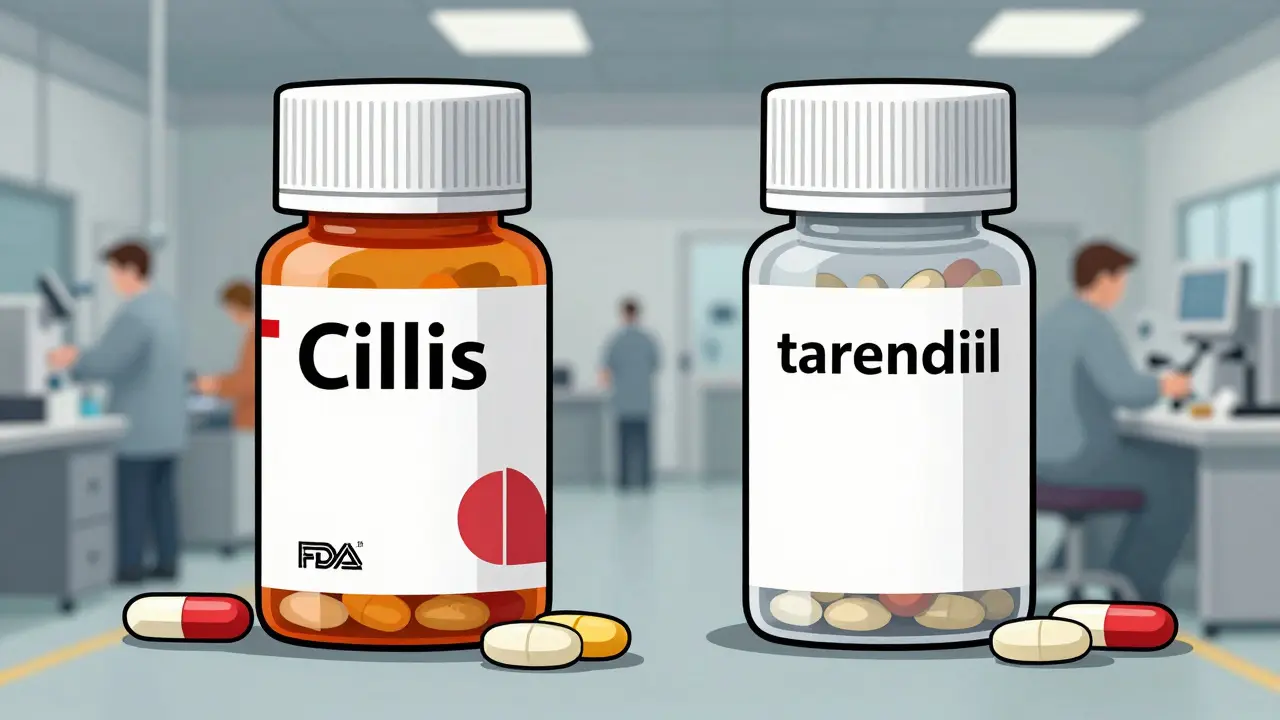
Why Patients Get Confused
Most people don’t know that the generic they’re handed at the pharmacy might be made by the same company that made the brand version. A 2023 Kaiser Family Foundation survey found that 71% of patients preferred authorized generics when they knew about them-but 64% had no idea the brand company made them. That creates a problem. Patients think they’re getting a cheap generic. But they’re actually getting the same drug they’ve always taken, just repackaged. Independent pharmacists report that 63% of their patients get confused. One patient might get a white pill labeled “tadalafil” from the brand maker. Another gets a blue pill labeled “tadalafil” from a different company. They look different. They cost different. But both are the same drug. On Reddit’s r/pharmacy, a 2023 thread asking “Is this actually helping?” got 147 comments. Over half said no. “I paid $85 for the ‘generic’ and the real brand was $90,” one user wrote. “But I could’ve gotten the other generic for $30. So what’s the point?”Regulatory and Legal Controversies
This strategy isn’t without criticism. The Federal Trade Commission (FTC) has filed multiple antitrust cases against companies that used authorized generics to block competition. In 2017, Actavis settled for $448 million after the FTC accused it of using an authorized generic to delay entry by other generic makers. The concern? Sometimes, a brand company will launch its own generic not to compete fairly-but to scare off other generic makers. If a small company knows the brand giant is already in the market, they might decide not to invest in making their own version. That reduces competition. And that keeps prices higher. The CREATES Act of 2019 tried to fix this by forcing brand companies to provide samples to generic manufacturers. But it didn’t stop authorized generics. It just made sure they couldn’t block access to the drug’s formula.What Do Experts Say?
There’s no consensus. Dr. Aaron Kesselheim from Harvard says authorized generics “provide minimal cost savings to consumers while allowing brand manufacturers to maintain disproportionate market control.” His data shows markets with authorized generics saw only a 32% price drop, compared to 68% in markets with only traditional generics. On the other side, PhRMA-the drug industry’s main lobbying group-says authorized generics “increase competition and provide consumers with additional lower-cost options.” They point to FDA data showing 99.7% bioequivalence between brand and authorized generics. Dr. Rachel Sherman, former FDA deputy commissioner, called it a “rational business response to the patent cliff.” She’s right. When a drug’s patent expires, companies have two choices: lose everything, or adapt. Authorized generics are the middle path. The Congressional Budget Office estimated that authorized generics saved $2.3 billion in 2022. But they also noted that’s only 37% of what could’ve been saved if traditional generics had dominated.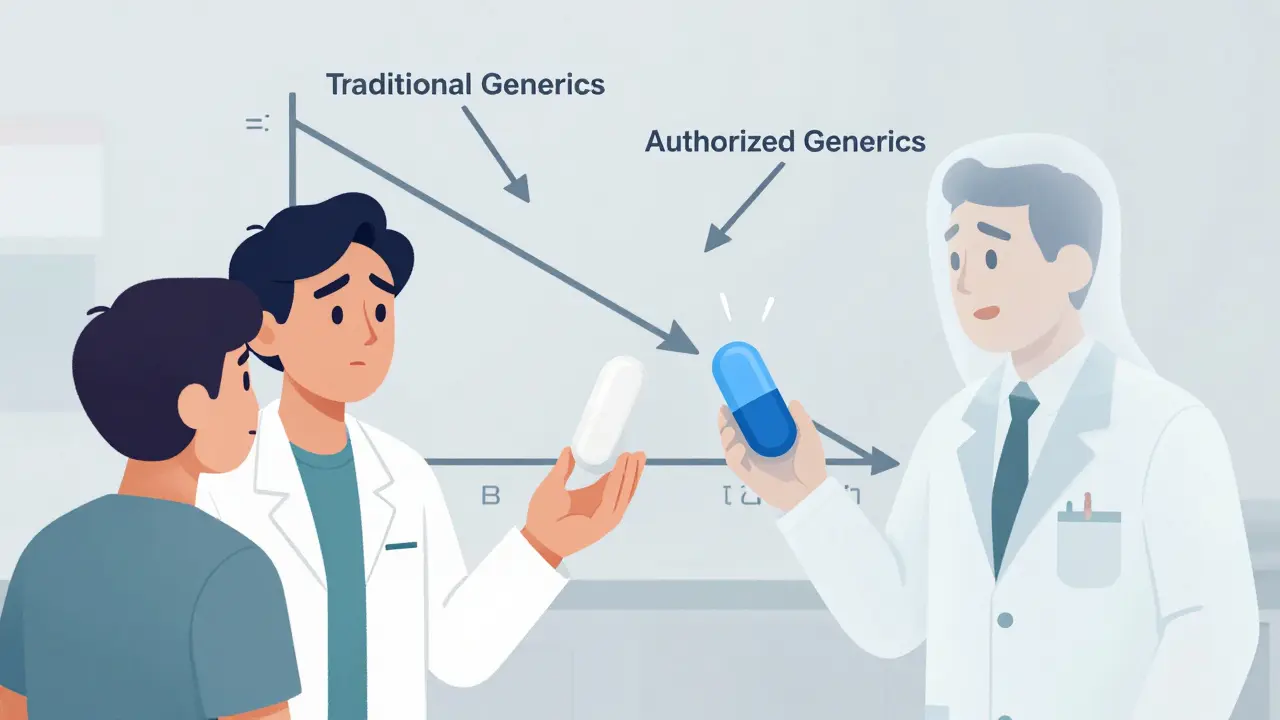
The Future: Biologics and Beyond
The next wave is coming. Most authorized generics so far have been for small-molecule drugs-pills and capsules. But now, companies are starting to make authorized versions of biologics: complex, injectable drugs made from living cells. In 2023, Amgen launched the first authorized biosimilar of its own drug Enbrel. This is a big deal. Biologics are harder to copy. Even generic makers struggle to replicate them exactly. But the original company? They already know how. Analysts at SVB Securities predict that by 2025, 40% of small-molecule drugs losing patents will have an authorized generic version. That number was 25% in 2022. Johnson & Johnson’s 2023 launch of an authorized generic for Invega Sustenna-a long-acting injectable antipsychotic-showed how far this strategy has come. It required new manufacturing techniques. It needed new packaging. But it still came from the same facility, same team, same process.What This Means for You
If you’re on a brand-name drug and it’s going generic soon, here’s what to do:- Ask your pharmacist: “Is this the same pill as the brand?”
- Check the label. If it has the same shape, color, and imprint as your brand pill, it might be an authorized generic.
- Compare prices. The cheapest option isn’t always the one with the brand name removed.
- If you’re happy with your current pill, ask if your pharmacy can keep giving you the same one-even if it’s labeled as generic.
Bottom Line
Authorized generics aren’t evil. They aren’t magic. They’re a business move born out of necessity. The patent system forces companies to innovate and then let go. Authorized generics let them let go-on their own terms. They keep patients on familiar medication. They keep factories running. They keep jobs in place. But they also slow down the price drops that make generics so powerful. The real question isn’t whether they’re legal. It’s whether they’re fair. And that’s something regulators, patients, and pharmacies will keep arguing about-for years to come.Are authorized generics the same as regular generics?
Yes and no. Authorized generics are made by the original brand manufacturer using the same formula, ingredients, and production line as the brand-name drug. Regular generics are made by other companies and may use different inactive ingredients or manufacturing processes, even if they’re bioequivalent. The key difference is who makes them-not what’s inside.
Why are authorized generics sometimes more expensive than other generics?
Because they’re not trying to win on price-they’re trying to win on trust. Authorized generics often cost a little more than competing generics because they’re the exact same pill you’ve been taking. Patients who prefer consistency over savings will pay a bit more. The brand manufacturer knows this and prices accordingly to retain revenue while still offering a discount.
Can I ask my pharmacy for an authorized generic specifically?
Yes, you can. Ask if the generic they’re dispensing is made by the same company as the brand. If you’re concerned about changes in how the pill looks or feels, requesting the authorized version can help avoid confusion. Some pharmacies may need to order it separately, since it’s often stocked less frequently than standard generics.
Do authorized generics have the same side effects as the brand?
Yes. Since they’re identical in active and inactive ingredients, side effects are the same. The FDA requires this. If you’ve had no issues with the brand-name version, you shouldn’t have any new issues with the authorized generic. Many patients report fewer side effects with authorized generics compared to traditional ones, simply because they’re more consistent.
Why do some people say authorized generics are a scam?
Because they don’t always save money. If you’re paying $85 for an authorized generic and $30 for a competing generic, it feels misleading to call it a “generic.” Critics argue it’s a way for big pharma to keep profits high while pretending to offer savings. It’s not illegal, but it’s designed to confuse patients into thinking they’re getting the lowest price when they’re not.
How do I know if my drug has an authorized generic?
Check the drug’s name on your prescription label. If it’s the same chemical name as the brand (e.g., “tadalafil” for Cialis), look up the manufacturer. If it’s the same company that makes the brand (e.g., Eli Lilly), then it’s an authorized generic. Websites like Drugs.com or the FDA’s Orange Book list authorized generics by manufacturer. Your pharmacist can also tell you.
Joy F
January 4, 2026 AT 22:53Let’s be real-this isn’t about patient access, it’s about corporate calculus. Big Pharma doesn’t ‘adapt’ to the patent cliff; they weaponize it. Authorized generics are the pharmaceutical equivalent of a monopolist buying out their own competitors just to keep the market artificially thin. You think you’re saving money? Nah. You’re just paying 15% less to the same entity that charged you $500 last year. It’s not innovation. It’s exploitation dressed in FDA-approved packaging.
Palesa Makuru
January 6, 2026 AT 22:11Wow. So the company that made your drug now makes the ‘generic’ version? That’s not a generic. That’s just the same pill with a different label. Why does this feel like a scam? Because it is. I paid $80 for ‘tadalafil’ thinking I was getting a bargain. Turned out it was still made by Eli Lilly. The real generics? $25. I’m not stupid. I just want to not be played.
Lori Jackson
January 8, 2026 AT 18:43Oh please. The FDA says they’re bioequivalent. Big deal. Bioequivalence doesn’t mean identical. The fillers, the coatings, the binders-they’re different. And those matter. I’ve had patients switch to ‘generic’ tadalafil and get migraines. Switch back to the authorized version? Gone. The ‘same pill’ myth is dangerous. It’s not the active ingredient-it’s the whole damn delivery system that matters. You think your body can’t tell the difference? You’re wrong.
Sarah Little
January 10, 2026 AT 02:44Actually, I work in pharmacy logistics. Authorized generics are stocked less because they’re not always in the primary formulary. Pharmacies push the cheapest option-usually a third-party generic. If you want the authorized version, you have to ask. And most patients don’t. They just grab the first thing labeled ‘generic.’ That’s the real problem-not the strategy, but the lack of patient awareness.
innocent massawe
January 10, 2026 AT 07:21Interesting. In Nigeria, we don’t have this issue-brand drugs are too expensive for most. Generics are our lifeline. But I see what you mean. If the same company makes both, it’s like they’re playing both sides. Still… if it works, why complain? 😊
erica yabut
January 11, 2026 AT 13:37Let me spell this out in crayon for the corporate apologists: this isn’t ‘business.’ This is predatory mimicry. The brand company doesn’t lower prices to help you-they lower them just enough to suffocate the competition. Then they sit on the throne of ‘familiarity’ and milk the loyal. They’re not saving you money. They’re rebranding greed. And the FDA? They’re complicit by calling it ‘authorized.’ Like that makes it ethical.
Vincent Sunio
January 12, 2026 AT 11:08It is a factual error to assert that authorized generics are ‘the same pill.’ While the active pharmaceutical ingredient is identical, the excipients-binders, fillers, disintegrants-are often altered in minor ways to accommodate different manufacturing tolerances. The FDA’s bioequivalence standard permits a 20% variance in pharmacokinetic parameters. Thus, while functionally similar, they are not pharmacologically indistinguishable. To conflate identity with equivalence is scientifically unsound.
Haley Parizo
January 12, 2026 AT 16:19This is capitalism’s most elegant trick: make the poor pay more for the same thing by calling it ‘cheap.’ We’ve been conditioned to believe that ‘generic’ means ‘lower quality’-but here, the quality is unchanged, and the price is only slightly lower. The real villain isn’t the drug company-it’s the system that rewards monopolies and punishes transparency. We’re not fighting for cheaper pills. We’re fighting for honesty.
Angela Fisher
January 13, 2026 AT 10:07Okay, but what if this is all part of a bigger plan? What if the brand companies are using authorized generics to collect data on patients? Like, they track who buys the ‘generic’ version and then target them with ads for their next brand drug? And what if the FDA is in on it? I mean, they approved this. And they’re paid by pharma. And they’re the ones who say it’s ‘safe.’ I’ve seen documentaries. This is how they control the narrative. They don’t want you to know you’re being manipulated. They want you to think you’re saving money. But you’re not. You’re being groomed.
Wren Hamley
January 13, 2026 AT 11:52So if I get the authorized generic of my blood pressure med, and it’s made by the same company, same line, same everything-why does my pharmacy charge me $45 for it but $25 for the other generic? Is it because they know people will pay more for the ‘trust’ factor? That’s not capitalism. That’s psychological pricing. And it’s brilliant. And also kind of disgusting.
Tru Vista
January 13, 2026 AT 14:53Authorized generics = scam. End of story. 🤡
JUNE OHM
January 14, 2026 AT 22:17THIS IS WHY AMERICA IS BROKE. Big Pharma owns the FDA. They own Congress. They own your pharmacy. And now they’re selling YOU YOUR OWN DRUG BACK TO YOU FOR LESS. But not THAT much less. They’re laughing. They’re rich. You’re confused. And you’re still paying $80 for a pill that costs $2 to make. This isn’t a market. It’s a rigged game. 🇺🇸💥
Philip Leth
January 15, 2026 AT 14:49Man, I used to be mad about this. Then I realized: if I take the authorized generic, I get the same pill I’ve been on for 10 years. No weird side effects. No weird shape. No weird color. I don’t care if it’s made by the same company. I care that my body doesn’t freak out. I’ll pay $10 extra for peace of mind. And honestly? That’s not a scam. That’s just being smart.
Shanahan Crowell
January 16, 2026 AT 18:56Guys. Stop fighting. Let’s just be real. The system is broken. But here’s the thing-authorized generics keep people on their meds. People who switch to weird-looking generics stop taking them. They get sick. They go to the ER. That costs more. So maybe… maybe this isn’t perfect. But it’s better than nothing. Let’s fix the system. Not the patients.