
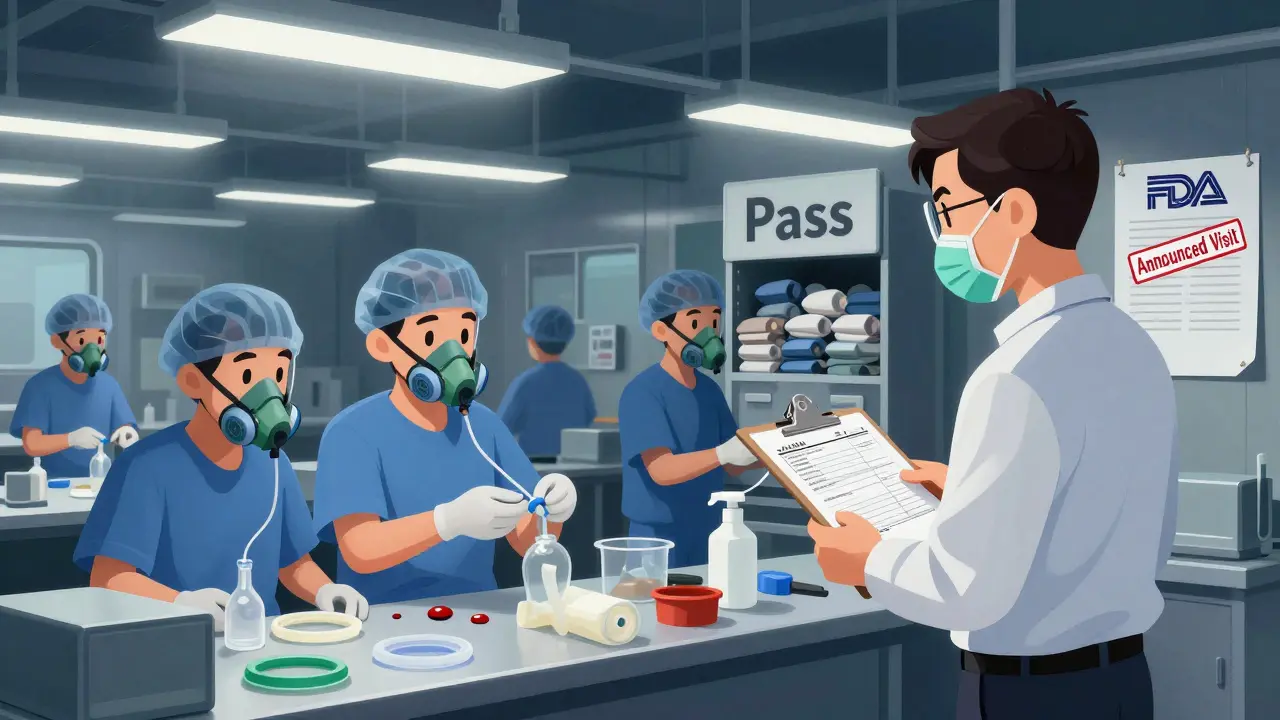
When you buy a pill, a medical device, or even a children’s toy made overseas, you assume it’s safe. But what if the factory that made it is cutting corners-hiding contamination, swapping materials, or falsifying test results? This isn’t fiction. It’s happening right now, and the consequences are showing up in hospital emergency rooms and FDA recall notices.
Why Quality Crashes Happen Overseas
The problem isn’t just bad workers or lazy managers. It’s a system built on incentives that reward speed and cost-cutting over safety. In countries like China, India, and Vietnam, factories compete for foreign contracts by offering the lowest price. That pressure trickles down. Workers are pushed to meet impossible quotas. Supervisors turn a blind eye. And when inspections are announced days in advance, manufacturers have time to clean up, hide defects, and stage fake compliance. The FDA found that in 2024, 47% of Chinese drug manufacturing sites received official warnings for quality violations-nearly double the rate of U.S. facilities. In one case, a factory in Wuhu replaced medical-grade silicone with industrial-grade plastic in a respiratory device. The result? 12,000 units failed biocompatibility tests. Patients could’ve suffered chemical burns or allergic reactions. The supplier never told the buyer. This isn’t rare. Brookings Institution found that 68% of inspected Chinese facilities were caught substituting raw materials. Another 42% skipped critical process validation steps. And 29% outright forged documents. These aren’t mistakes. They’re calculated risks.The Double Standard in Inspections
Here’s the kicker: the FDA inspects foreign factories differently than U.S. ones. In China, 78% of inspections in 2024 were announced ahead of time. That means factories get a heads-up to fix problems, hide evidence, or bring in temporary workers who know how to pass the audit. In the U.S., only 5% of inspections are announced. The rest are surprise visits-no warning, no cleanup, no lies. This isn’t fairness. It’s a loophole. And it’s why so many contaminated products slip through. FDA Commissioner Marty Makary admitted in May 2025 that staffing shortages made it impossible to match inspection rigor overseas. But now, the agency is changing course. By the end of 2025, 40% of foreign inspections will be unannounced. By 2027, that number jumps to 75%.Where the Worst Problems Are
China still produces 31.6% of the world’s manufactured goods, but quality is splitting in two. On one side, companies following the government’s Made in China 2025 plan are investing in AI, robotics, and real-time monitoring. Their defect rates are dropping. On the other side, thousands of smaller factories are drowning in debt. They’re cutting costs by any means necessary. India is another hotspot. Despite making up only 25% of foreign drug facilities, Indian manufacturers accounted for 34% of FDA import alerts in 2024. Many lack trained quality staff. Some don’t even have functional lab equipment. Vietnam is improving. Since 2022, quality metrics there have risen by 18%. But that’s still not enough. Many U.S. companies are moving production there hoping for lower risk-but they’re bringing the same flawed oversight models with them.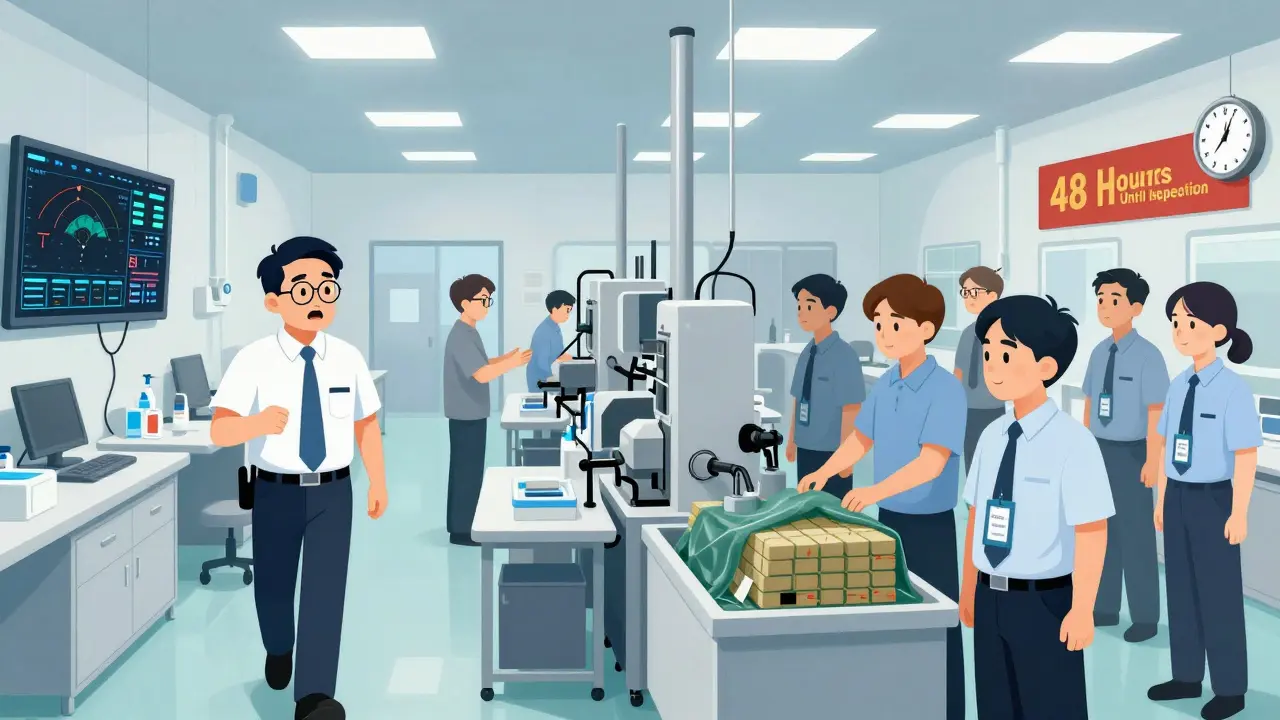
What Goes Wrong in Practice
Let’s say you’re a small medical device company in Minnesota. You hire a Chinese supplier because their price is 40% lower than your local option. You get samples. They look fine. You approve the order. Six months later, your customers start reporting malfunctions. You send someone to the factory. They find:- Raw materials swapped for cheaper alternatives
- Batch records backdated to hide failed tests
- Quality control staff paid under the table, with no authority to stop production
How Some Companies Are Fighting Back
Not everyone is losing. A few companies are winning by doing things the hard way. One Minnesota medical device maker implemented a “China-specific quality triad”:- A full-time local quality manager-hired directly, not through a middleman
- Blockchain traceability-every component scanned and logged from raw material to finished product
- Third-party audits every 30 days-unannounced, with no notice to the factory

What You Need to Do Now
If you’re sourcing products overseas, here’s what you can’t afford to skip:- Verify certifications: Don’t trust a certificate of analysis. Demand access to raw test data and lab logs.
- Conduct unannounced audits: Show up without warning. Bring your own inspector. Don’t rely on the supplier’s team.
- Write ironclad contracts: Vague quality standards cause 58% of recoverable losses. Define exact tolerances, materials, and testing methods.
- Use AI-powered inspection tools: Systems that scan products with machine vision catch 99.2% of defects-far better than human eyes.
- Require batch certification: Like the EU’s Qualified Person system, insist that a certified professional signs off on every shipment-personally, with legal liability.
The Bigger Picture
The global market for quality assurance is set to hit $14.3 billion by 2027. Why? Because companies are finally realizing that cheap manufacturing isn’t cheap at all. When a single batch of contaminated medicine triggers a recall, the cost isn’t just the product. It’s lost trust. Lawsuits. Regulatory fines. And sometimes, lives. The FDA’s new push for parity inspections is a turning point. But it won’t fix everything. Real change comes from companies that refuse to cut corners. From buyers who demand transparency. From factories that treat quality as a core value-not an afterthought. If you’re relying on overseas production, you’re not just managing a supply chain. You’re managing risk. And right now, the stakes have never been higher.Are all foreign-made products unsafe?
No. Many factories overseas produce high-quality, safe products. The issue isn’t location-it’s oversight. Companies that invest in real quality systems, unannounced audits, and direct oversight have defect rates as low as 1%. The problem is the majority that don’t.
Can I trust certifications like ISO 9001 from overseas suppliers?
Not by itself. ISO 9001 is a good baseline, but it’s often obtained through paperwork, not practice. Many factories in China and India hold ISO certificates while still falsifying test results. Always verify with on-site audits and real-time data-not just documents.
Why are unannounced inspections so important?
Because announced inspections give factories time to hide problems. Unannounced visits catch real conditions: dirty equipment, untrained staff, falsified records. The FDA found that 80% of serious violations were only visible during surprise inspections.
What’s the biggest hidden cost of poor overseas quality?
It’s not rework or recalls. It’s brand damage. When a product harms a patient, the company loses trust forever. A single recall can cost 10x more than the product’s value in lost sales, lawsuits, and regulatory scrutiny. Reputation is the most expensive thing to rebuild.
Should I stop manufacturing overseas altogether?
Not necessarily. But you must change how you manage it. The cost savings are real-but only if you invest in oversight. Companies that use local quality managers, blockchain tracking, and third-party audits see 30-45% lower labor costs without the risks. The key isn’t where you make it-it’s how you control it.
rasna saha
January 25, 2026 AT 21:08My cousin works in a pharma lab in Hyderabad, and she told me how they get these 'quality checks' from US companies-paperwork stamped before the product even leaves the warehouse. It breaks my heart. Not because they’re bad people, but because they’re trapped in a system that punishes honesty. I wish more buyers would pay a little more and actually visit the floor, not just the conference room.
It’s not about blaming countries. It’s about holding power accountable.
James Nicoll
January 27, 2026 AT 08:06So let me get this straight-we outsource manufacturing to save $0.20 per widget, then spend $2 million on lawsuits, PR fluff, and FDA fines… and still can’t get a decent rubber seal?
Man, capitalism’s got a better marketing team than a moral compass.
John Wippler
January 28, 2026 AT 11:00Listen-I used to think ‘Made in China’ meant cheap junk. Then I visited a factory in Shenzhen that had a robot arm inspecting every single pacemaker component with laser precision, and a quality engineer who spoke fluent English and had a PhD from MIT.
The problem isn’t geography. It’s choice. Companies that treat suppliers like partners-investing in training, transparency, and trust-get stellar results. The ones that treat them like disposable vendors? They get what they deserve: a headline on CNN with a dead baby in the background.
We’re not victims of globalization. We’re complicit in its worst abuses. And if you’re still outsourcing without unannounced audits? You’re not saving money. You’re gambling with lives.
It’s time to stop pretending this is about cost. It’s about character.
Kipper Pickens
January 29, 2026 AT 02:08From a supply chain risk management perspective, the systemic failure here is rooted in asymmetric information asymmetry within global value chains, exacerbated by regulatory arbitrage and the principal-agent problem between OEMs and contract manufacturers. The FDA’s unannounced inspection initiative represents a partial correction to the moral hazard inherent in pre-announced audits, but until we implement blockchain-enabled immutable audit trails with zero-knowledge proof verification at the component level, we’re just rearranging deck chairs on the Titanic.
Also, ISO 9001 is a compliance theater artifact-most certifications are procured via third-party consultants who’ve never set foot in the facility. We need real-time IoT-enabled process capability indices, not paper trails.
Aurelie L.
January 29, 2026 AT 17:07My neighbor’s kid got sick from a toy. It was from Vietnam. No one talked about it. Just quietly replaced it. That’s how this works.
Angie Thompson
January 30, 2026 AT 07:21OMG YES. I bought a ‘medical-grade’ humidifier for my mom’s COPD. It broke after 3 weeks. Then I found out the filter was made of recycled plastic bottles. 😡
My mom’s still fine, but I cried for an hour. Why do we let this happen? We need to vote with our wallets. Support companies that DO the right thing-even if they cost more. 💪❤️
Also, AI inspections? YES PLEASE. Let machines catch lies. Humans are too tired (or bribed) to care.
eric fert
February 1, 2026 AT 00:57Let’s be real-this whole thing is a distraction. The real issue is that Americans want everything cheap and fast, and then act shocked when things break. You want safe products? Pay $100 for a pill instead of $5. Stop blaming foreigners when you’re the one demanding the discount.
Also, the FDA’s ‘unannounced inspections’? Please. They’ve got 30 inspectors for 10,000 factories. You think a 48-hour surprise visit is going to catch a factory that’s been hiding defects for 5 years? You’re delusional.
And don’t get me started on ‘blockchain traceability.’ That’s tech bro nonsense. The factory owner doesn’t even have Wi-Fi. He’s using Excel on a 2010 laptop.
Meanwhile, the real solution? Bring manufacturing back. But no one wants to say that out loud. Too scary. Too… American.
Curtis Younker
February 2, 2026 AT 23:26Hey everyone-I run a small medical device company in Ohio. We used to source from China like everyone else. Then we lost a client because a batch of IV tubing leaked. Turned out the silicone was 60% cheaper… and 100% dangerous.
We did the hard thing. We hired a local quality manager in Guangdong. Paid her $80k/year. Gave her authority to shut down production. Gave her a company car. Gave her a bonus for every defect caught before shipment.
Our defect rate dropped from 14% to 0.9%. Our clients trust us more. Our team sleeps better. And yes-we pay 22% more per unit.
But here’s the thing: we’ve doubled our revenue in two years. Why? Because people will pay more for peace of mind.
If you’re still outsourcing without real oversight-you’re not saving money. You’re just delaying a nightmare.
Do the hard thing. It’s worth it.