
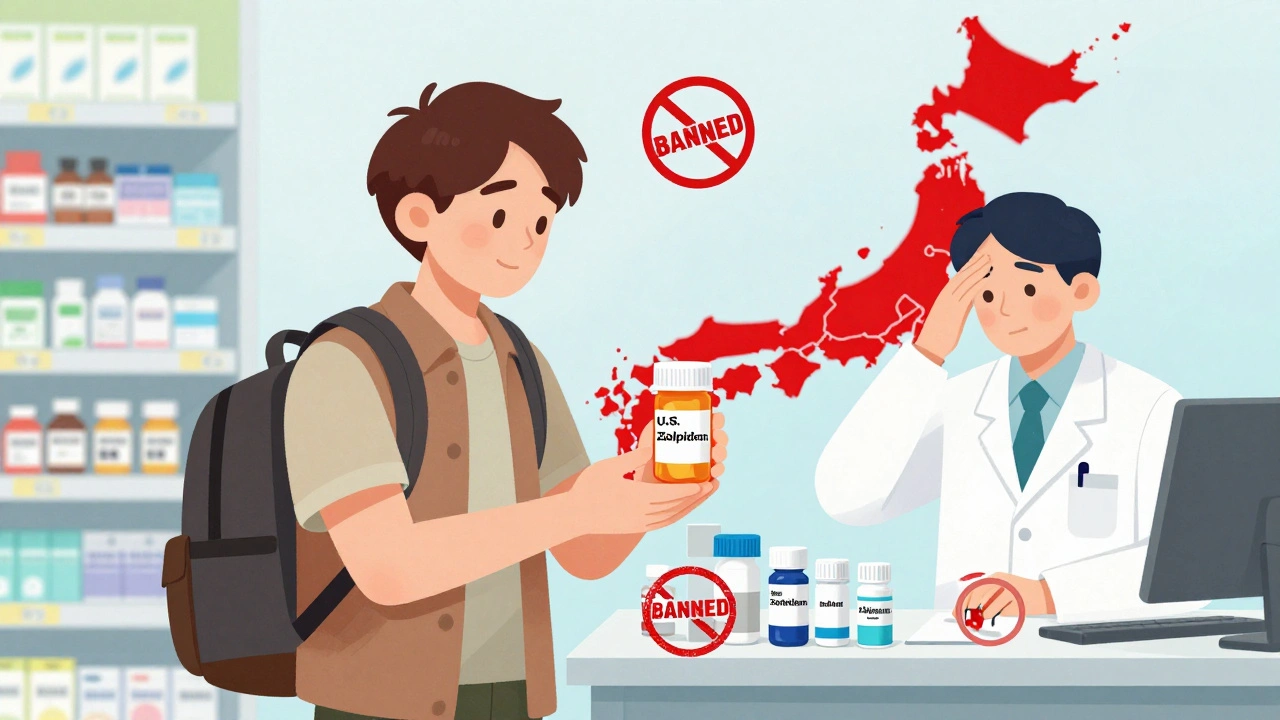
Imagine you’re in Tokyo, halfway through a two-week trip, when your anxiety medication runs out. You walk into a pharmacy, hand over your U.S. prescription, and are told: "This is illegal here. We cannot fill it." That’s not a hypothetical. It happens to thousands of travelers every year - not because they’re careless, but because medications abroad don’t work the same way everywhere. What’s legal in Sydney is banned in Dubai. What’s over-the-counter in Mexico needs a special permit in Australia. And if you’re carrying stimulants, sedatives, or painkillers, you’re walking a legal tightrope.
Why Your Prescription Doesn’t Travel Well
Your doctor’s prescription is valid in your home country. That’s it. Every country has its own list of controlled substances, and many don’t recognize foreign prescriptions at all. The World Health Organization says 80% of the world’s population lacks reliable access to essential pain medications - and travelers often get caught in the middle. A drug like hydrocodone is Schedule II in the U.S. but completely banned in Japan. Codeine is sold freely in Mexico but requires a special license in Australia. Even common cold meds like pseudoephedrine are illegal in Australia, New Zealand, and the UAE because they can be used to make methamphetamine. In 2025, Sydney Airport seized 387 packages of pseudoephedrine-containing products in just the first quarter.What You Can and Can’t Bring
The general rule? Only bring what you need for the duration of your trip - and stick to the 90-day limit. Most countries allow up to a three-month supply for personal use. But exceptions are common. Japan limits narcotics to 30 days. Singapore caps them at 14 days. Some countries, like the UAE, require pre-approval for even common sleep aids like zolpidem. If you’re carrying ADHD meds like Adderall or Ritalin, you’re in high-risk territory. The U.S. ranks 23rd globally for traveler medication access, mainly because stimulants are tightly controlled everywhere outside North America.How to Pack Medications the Right Way
Never transfer pills to a different container. Always keep them in their original pharmacy bottles with the label intact. This isn’t just common sense - it’s required by the TSA, Australian Customs, and most international airports. Labels must show:- Your full name (must match your passport)
- The drug name (brand and generic)
- Dosage and quantity
- Prescriber’s name and contact info
Doctor’s Letters Are Non-Negotiable
For controlled substances, a simple prescription isn’t enough. You need a letter from your doctor on official letterhead. It must include:- Your full name and date of birth
- The diagnosis using ICD-11 codes (e.g., F41.1 for generalized anxiety disorder)
- The medication name (generic preferred)
- Dosage, frequency, and total quantity
- Reason for use (e.g., "chronic pain management")
- Doctor’s signature, license number, and contact details

Getting a Local Prescription Abroad
If you run out, or your meds are confiscated, you can sometimes get a local prescription. But it’s not easy. You’ll need to visit a licensed doctor in that country - not a pharmacy clerk or tourist clinic. Bring your original prescription, doctor’s letter, and medical records. Some countries, like Thailand and Germany, have systems that recognize foreign prescriptions if you have proper documentation. Others, like Malaysia, ban entire classes of drugs - including diazepam and alprazolam - even with a prescription. The European Union is the exception. Thanks to the EU Falsified Medicines Directive, a prescription from one member state can usually be filled in another. One traveler reported getting sertraline filled in France within two hours using their German e-prescription. That’s the gold standard. Outside the EU, it’s hit or miss.Where It’s Easiest (and Hardest) to Find Medications
Easy: The EU, Canada, and New Zealand (for non-controlled meds). Canada’s 2025 importation law lets travelers bring in 90-day supplies from certified foreign pharmacies. The EU’s system works seamlessly for 450 million people. Hard: Japan, Singapore, the UAE, and Southeast Asian countries like Malaysia and Indonesia. In Japan, 89% of travelers with controlled meds face issues. In the UAE, 82% report problems - mostly with sleep aids and anxiety meds. In 2024, over 1,200 travelers were delayed or denied entry over zolpidem or tramadol. Unpredictable: Latin America and parts of Africa. Medications may be available, but quality control is inconsistent. Fake drugs are a real risk. Stick to licensed pharmacies and avoid street vendors.What to Do If Your Meds Are Confiscated
If customs takes your pills, don’t argue. Stay calm. Ask for a receipt. Contact your country’s embassy immediately. They can’t get your meds back, but they can help you find a local doctor, provide a list of approved pharmacies, or connect you with a medical assistance network like IAMAT (International Association for Medical Assistance to Travellers). IAMAT has over 1,400 verified clinics worldwide that understand international medication rules.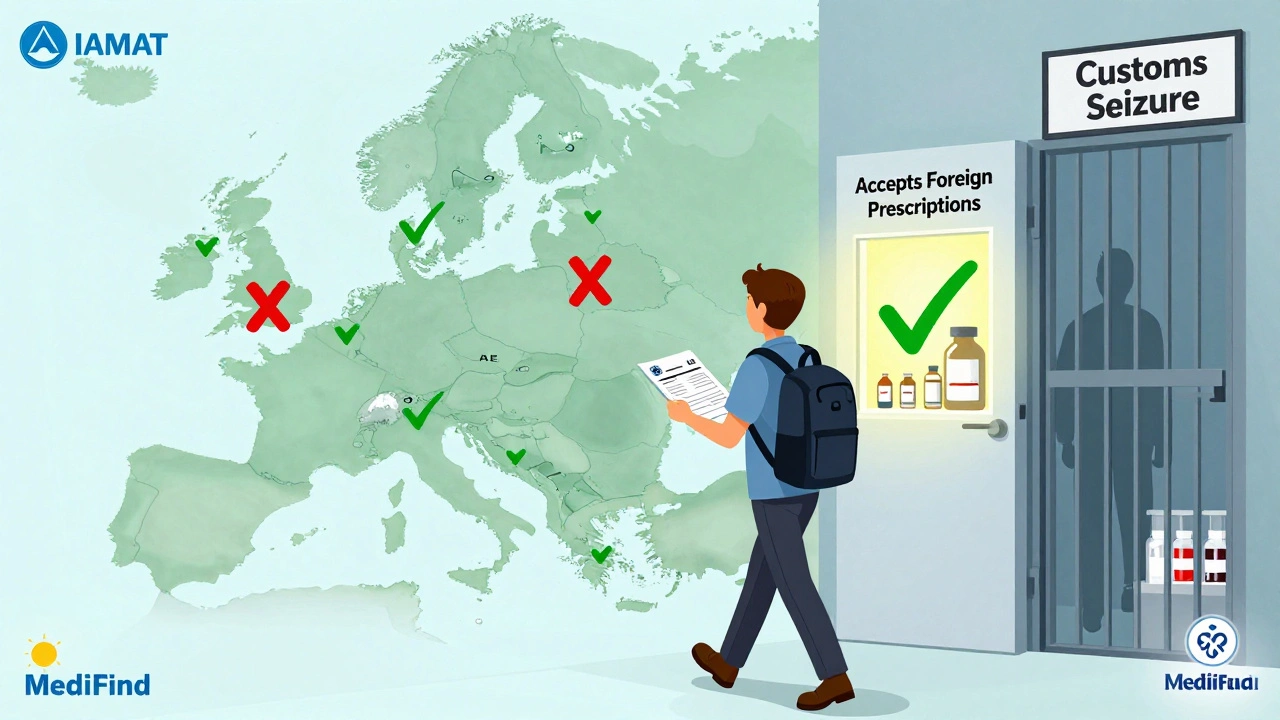
Plan Ahead - Start 8 to 12 Weeks Before You Go
This isn’t something you do the night before your flight. If you need controlled substances, start planning 90 days out. Here’s your checklist:- Check your destination’s rules on the INCB’s Country Regulations database (updated October 2025).
- Contact the embassy or consulate of your destination country. Ask: "What are the rules for bringing [medication name] into the country?"
- Ask your doctor for a detailed letter with ICD-11 codes.
- If the country requires it, get the letter notarized and translated.
- Verify airline policies - some require advance notice for controlled substances.
- Carry extra copies of everything - digital and paper.
Emerging Solutions
New services are starting to fill the gap. MediFind operates in 28 countries and helps travelers locate pharmacies that accept foreign prescriptions - with an 85% success rate. MyTravelMed covers 47 countries but struggles with controlled substances (62% success). Telemedicine is growing fast: 41 countries now allow tourists to get prescriptions via video consult. The WHO is rolling out standardized documentation templates in 2026 - a big step toward global consistency.Real Stories, Real Consequences
On Reddit, a traveler named u/TravelMedWoe lost three days of his vacation fighting Dubai customs over 10mg of zolpidem. He had a doctor’s note, WHO documentation, and the original bottle. Still, they confiscated it. Another traveler, a student in Germany, couldn’t get Adderall filled in France because her prescription didn’t include the generic name - a detail her U.S. doctor never provided. The CDC reports a 22% yearly increase in benzodiazepine-related travel incidents. Alprazolam (Xanax) is the most common problem. If you’re on it, assume it’s banned unless proven otherwise.Bottom Line: Know Before You Go
Traveling with medication isn’t about luck. It’s about preparation. You wouldn’t fly without checking your visa. Don’t fly without checking your meds. The rules are complex, inconsistent, and sometimes unfair. But they’re real. And ignoring them can mean losing your medicine, your trip, or worse - your health.Carry your pills in original bottles. Get the doctor’s letter. Check the embassy website. Know your limits. And if you’re unsure - call ahead. It takes six hours on average to get this right. For controlled substances, it can take nearly 20. Don’t wait until you’re stranded.
Can I bring my prescription meds on a plane?
Yes, but only if they’re in their original containers with your name on the label. Keep them in your carry-on. You can bring more than 3.4 ounces of liquids if they’re medically necessary, but you must declare them at security. Never pack them in checked luggage.
What if my medication is banned in the country I’m visiting?
If your medication is illegal in your destination, you cannot bring it in - even with a prescription. You’ll need to find an alternative treatment before you go. Talk to your doctor about switching to a permitted drug, or plan to get a local prescription after arrival. Never risk smuggling - you could face fines, detention, or jail.
Do I need a doctor’s letter for all medications?
No, but you need one for any controlled substance: opioids, benzodiazepines, stimulants, sedatives, or any drug listed in your destination’s controlled substances schedule. Even if it’s not required, having one reduces the chance of delays or confiscation. For antibiotics or blood pressure meds, the original bottle is usually enough.
Can I get a prescription filled abroad if I run out?
Possibly. You’ll need to see a local doctor, show your original prescription and doctor’s letter, and possibly undergo an exam. Success depends on the country. In the EU, it’s often straightforward. In places like Japan or the UAE, it’s extremely difficult. Always plan ahead to avoid running out.
Are there services that help find medications abroad?
Yes. The International Association for Medical Assistance to Travellers (IAMAT) has a network of 1,400 verified clinics worldwide that understand international medication rules. Services like MediFind and MyTravelMed also help locate pharmacies and navigate local laws - especially useful for travelers with complex needs.
What should I do if my meds are seized at customs?
Stay calm. Ask for a written receipt. Contact your country’s embassy or consulate immediately. They can’t return your meds, but they can help you find a local doctor, recommend pharmacies, or connect you with medical assistance networks. Never argue with customs officers - it makes things worse.
Is it safe to buy medications online while traveling?
No. Online pharmacies abroad are often unregulated. You risk getting counterfeit, expired, or contaminated drugs. Only use licensed pharmacies - look for official seals, verified contact info, and local regulatory approval. When in doubt, ask your hotel front desk for a trusted pharmacy.
Shannara Jenkins
December 3, 2025 AT 02:39Just got back from Thailand and learned the hard way - my Xanax was confiscated at customs. I had the prescription, but no doctor’s letter. Lesson learned: never fly without that letter. Now I carry it with my passport. 🙏
Alicia Marks
December 3, 2025 AT 16:21Same. I ran out of my anxiety med in Berlin and got it filled in 20 minutes. EU rules are a lifesaver.
Jay Everett
December 4, 2025 AT 23:15Y’all are lucky you even made it out alive. I once had my Adderall taken in Dubai and spent three days in a hotel room crying while my embassy played phone tag with customs. No joke - I had the letter, the bottle, the ICD code, everything. They still said no. 🤡 Now I travel with CBD oil and pretend I’m ‘just chillin’. The system is broken. But hey, at least I’m not in jail. 😅
Elizabeth Grace
December 6, 2025 AT 01:14Ugh. I had to fly to Japan last year with my SSRIs. They asked me if I was ‘emotionally unstable’ because I had 30 days’ worth. I nearly cried in the customs line. I just nodded and smiled. No one cares about your mental health until it’s inconvenient. 💔
Paul Keller
December 6, 2025 AT 22:11The systemic failure here is not the traveler’s ignorance - it’s the complete lack of international coordination. We live in a globalized world where people commute across borders for work, family, and medical care, yet we still treat medication like contraband. The WHO’s 2026 standardized template is a start, but it’s a Band-Aid on a hemorrhage. Until countries recognize each other’s prescribing frameworks as legally binding - not as suggestions - we’re just playing Russian roulette with mental health. This isn’t about ‘following rules.’ It’s about human dignity.
Rebecca M.
December 8, 2025 AT 12:30Wow. So now we’re supposed to carry a 12-page dossier just to take a pill on vacation? Next they’ll ask for my birth certificate and a notarized letter from my therapist explaining why I deserve to be happy. 🙄
मनोज कुमार
December 9, 2025 AT 21:12India has same problem. No one checks your meds here but if you bring something from US, customs will take it. No letter, no chance. Simple. No drama. Just don't bring it.
ATUL BHARDWAJ
December 10, 2025 AT 19:06My cousin got arrested in Indonesia for carrying paracetamol with codeine. No prescription. No warning. Just taken away. Now he’s in a hospital with no meds. This is not about rules. This is about power.
Steve World Shopping
December 11, 2025 AT 05:58Let’s be clear: the pharmacopeia of the Global North is not a universal right. Many nations restrict stimulants and benzodiazepines because they are not medically necessary in their public health context. The burden of compliance lies with the traveler, not the state. Your privilege to medicate does not override sovereign drug policy. Stop whining and plan ahead.
Arun kumar
December 12, 2025 AT 03:08i was in thailand last year and bought meds from a pharmacy near my hotel. looked legit. turned out it was fake. i got sick for 3 days. never do that. always ask hotel staff for the pharmacy they use. they know.
Zed theMartian
December 12, 2025 AT 12:55Oh wow, a 2000-word essay on how to not get arrested while taking your antidepressants. How novel. The real issue isn’t the paperwork - it’s that we’ve turned mental health into a bureaucratic performance art. You need a doctor’s letter in 14 languages? A notarized translation? A government stamp? This isn’t travel. This is a Kafkaesque nightmare dressed up as a ‘guide.’
Ella van Rij
December 13, 2025 AT 01:01Wait, so I need to get a doctor’s letter with ICD-11 codes… but my doctor just wrote ‘anxiety’? And now I’m supposed to get it translated and notarized? 😭 I’m not a lawyer. I’m just trying to get through my trip without crying in a Tokyo subway.
Lynn Steiner
December 14, 2025 AT 03:43Why do we even let these people into our countries? If you can’t follow the rules, don’t travel. This isn’t a ‘guide’ - it’s a cry for special treatment. If your meds are banned, tough. Go get therapy. Or stay home. 🇺🇸
Joel Deang
December 14, 2025 AT 16:18Just got back from Mexico. Bought my anxiety meds at a pharmacy like I was buying soda. No questions. No paperwork. Just handed them the cash and walked out. 🤷♂️ I’m not saying it’s safe… but it worked. Now I just carry a fake bottle with pills from home in case I get asked. 😅
Steve Enck
December 16, 2025 AT 11:42One must ask: Is the individual’s right to pharmacological self-regulation a natural extension of bodily autonomy, or is it an ideological artifact of late-capitalist medical hegemony? The state’s monopoly over psychoactive substances is not a public health measure - it is a mechanism of social control. The traveler, in seeking continuity of care, becomes a subversive agent against the pharmaco-bureaucratic apparatus. To demand a notarized letter is to demand submission. To carry a prescription is to perform compliance. The real crisis is not logistical - it is ontological. Are we citizens, or are we patients under surveillance?