
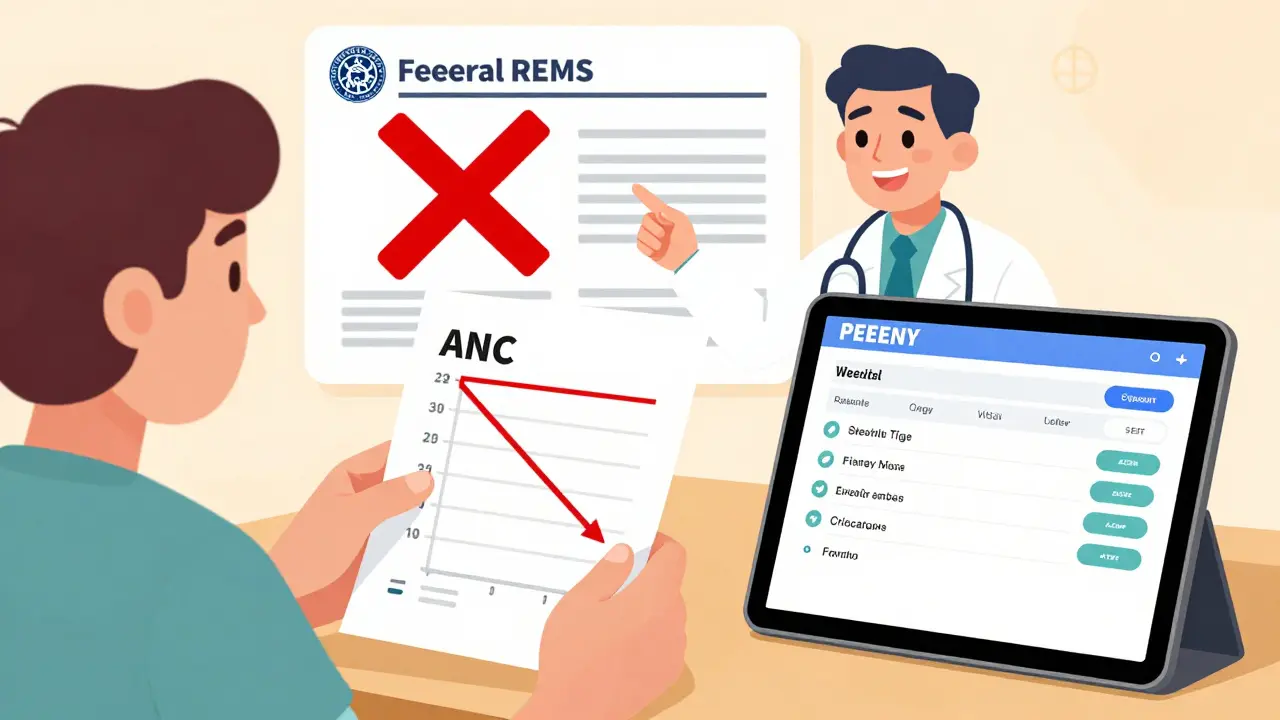
Clozapine ANC Monitoring Calculator
Calculate when your next ANC blood test should occur based on treatment duration
How This Tool Works
Enter your starting date, and we'll calculate your next required ANC test based on FDA guidelines. Remember: monitoring is still required even though REMS is gone.
Your Monitoring Schedule
Monitoring Timeline
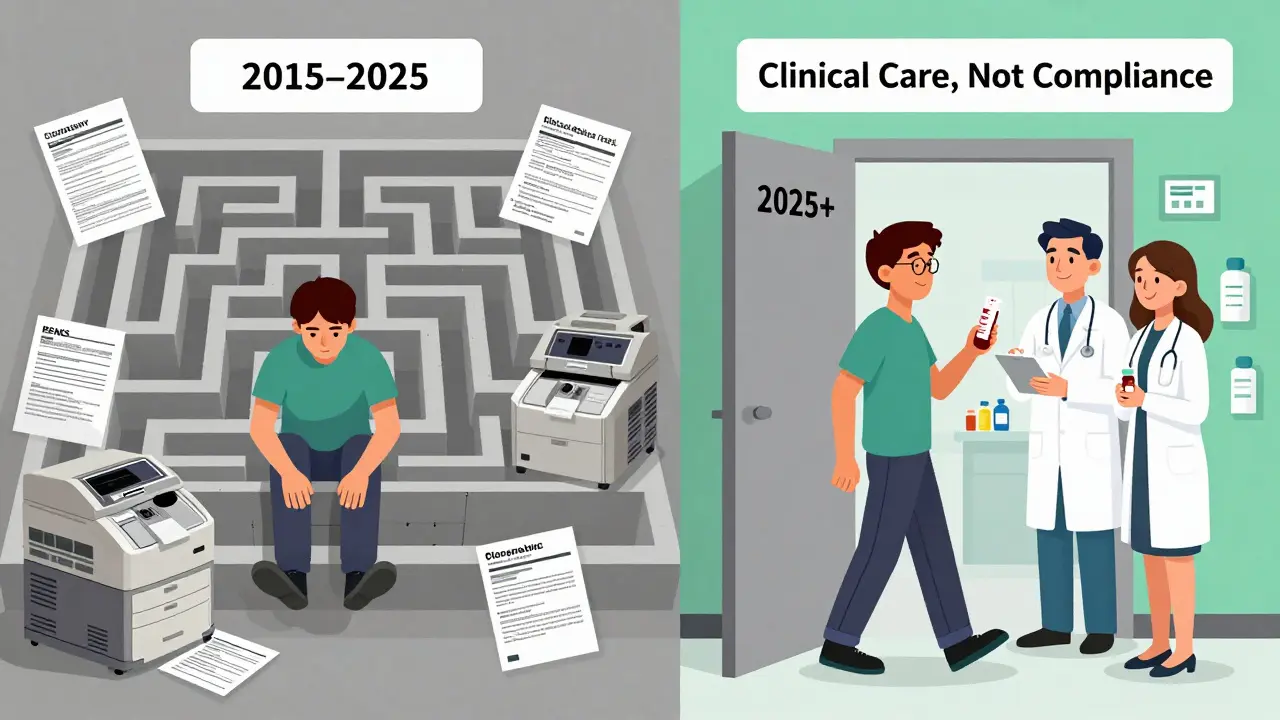
For years, getting clozapine meant jumping through a maze of paperwork, certifications, and blood test reports. If you or someone you know was prescribed this powerful antipsychotic for treatment-resistant schizophrenia, you likely remember the frustration: waiting days for a pharmacy to verify your last ANC result, filling out monthly forms, re-certifying every few years just to keep the medication flowing. That changed on February 24, 2025, when the U.S. Food and Drug Administration (FDA) officially removed the mandatory Risk Evaluation and Mitigation Strategy (REMS) for clozapine.
What Was the Clozapine REMS Program?
The REMS program was created in 2015 to manage a serious but rare risk: severe neutropenia - a drop in white blood cells that can lead to life-threatening infections. Clozapine is the most effective medication for people with schizophrenia who haven’t responded to other drugs. But because of this blood-related risk, the FDA required every prescriber, pharmacy, and patient to enroll in a strict monitoring system. No ANC (Absolute Neutrophil Count) report? No clozapine. It wasn’t just a recommendation - it was a legal requirement.The rules were detailed. Before starting clozapine, you needed a baseline ANC test. Then, weekly blood draws for the first six months. Biweekly for months seven through twelve. After that, monthly. These weren’t suggestions. Pharmacies had to confirm each result through the REMS portal before filling the prescription. Prescribers had to submit monthly Patient Status Forms. If you missed a test, even by a day, your prescription was blocked.
Why Did the FDA Remove the REMS?
The FDA didn’t remove the REMS because the risk disappeared. Severe neutropenia still happens - about 0.8% of patients, mostly in the first 18 weeks. But after a four-year review using real-world data from the VA, Brigham and Women’s Hospital, and the FDA’s own Sentinel System, the agency found something surprising: doctors were already doing the right thing.Even without the REMS enforcement, clinicians kept monitoring ANC levels at the same frequency. Hospitals, clinics, and private practices had built the checks into their routines. The monitoring wasn’t just happening - it was becoming standard care. The FDA concluded that the mandatory system wasn’t adding safety. It was adding delays, stress, and barriers.
Patients were missing doses or not starting clozapine at all because of the bureaucracy. One study found that 30% of eligible patients faced delays due to REMS paperwork. Clinicians in rural areas struggled with slow verification systems. Pharmacies spent 10-15 extra minutes per clozapine prescription just to verify compliance. That’s time that could’ve gone to patient counseling.
What Changed on February 24, 2025?
Here’s the simple version: you no longer have to submit ANC results to a federal registry. Pharmacies no longer need to check a government portal before dispensing clozapine. Prescribers don’t need to re-certify. Patients don’t need to fill out monthly forms.But here’s what didn’t change: the risk of neutropenia is still real. The FDA still requires the Boxed Warning on every clozapine label. The prescribing information from Novartis (the main manufacturer) still says to monitor ANC weekly for six months, biweekly until 12 months, then monthly. The American Psychiatric Association, the American Society of Health-System Pharmacists, and the Department of Veterans Affairs all still recommend this schedule.
The difference? It’s now a medical standard - not a legal requirement. Your doctor still orders the blood tests. Your pharmacy still expects them. But they’re not checking a federal database to make sure you did.

What Should Patients and Prescribers Do Now?
If you’re starting clozapine today, here’s what to expect:- Baseline ANC: Get tested before your first dose. No exceptions.
- Weeks 1-26: Weekly blood tests. This is when the risk is highest.
- Months 7-12: Every two weeks, as long as your ANC stays above 1,500/μL (or 1,000/μL if you have benign ethnic neutropenia).
- After 12 months: Monthly tests, with your doctor’s input. Shared decision-making matters here.
Your doctor will still track your ANC - just like they track your liver enzymes or cholesterol. They’ll use your clinic’s electronic health record, not a federal portal. If your ANC drops below safe levels, they’ll pause clozapine. That hasn’t changed.
For prescribers: You no longer need to complete REMS training or register with the Clozapine REMS website. But you still need to know the guidelines. The American Psychiatric Association updated its clinical guidance in March 2025 to reflect the change. If you’re unsure, refer to the CLOZARIL prescribing information. The FDA still expects you to follow the monitoring schedule.
How Has This Affected Access to Clozapine?
Before the REMS removal, only about 12% of Americans with treatment-resistant schizophrenia got clozapine - even though it works for 30-50% of people who fail other drugs. The rest either didn’t get it because the process was too hard, or their doctors didn’t want to deal with the paperwork.Now, things are changing fast. Anthem’s provider network projected a 25-30% increase in new clozapine starts over the next two years. Evaluate Pharma raised its 2026 sales forecast from $487 million to $612 million, citing improved access as the main driver. Smaller clinics and rural pharmacies, which struggled most under the REMS, are now able to prescribe without special certification.
One clinic in rural Kansas reported that since February 2025, they’ve started five new patients on clozapine - more than they had in the previous three years combined.
What About the Risks? Is It Safe Now?
Yes - but only if monitoring continues. The FDA didn’t say the risk is gone. They said the system to manage it was broken. The same data that led to REMS removal also showed that when clinicians follow the monitoring schedule, the rate of severe neutropenia stays low. In the VA system, where monitoring was consistent, the rate was under 0.5%.The key is consistency. Skipping a test after six months? That’s risky. Relying on a patient to remember to get blood drawn without reminders? That’s dangerous. The responsibility hasn’t shifted - it’s just simpler now. No federal portal. No forms. Just good clinical practice.
What’s Next?
The FDA will keep watching. Through the Sentinel System, they’re tracking neutropenia cases in real time. If the rate of severe cases jumps, they can act. For now, early data shows no increase in adverse events since the REMS ended.Professional organizations are stepping up. The American Society of Health-System Pharmacists is rolling out updated clinical guidelines in Q3 2025. Medical schools are revising their psychiatry curricula. Pharmacist training programs are removing REMS-specific modules.
The goal isn’t to make clozapine easier to get - it’s to make it easier to use safely. The old system treated every patient like a risk. The new one treats them like people who need careful, thoughtful care.
What About Benign Ethnic Neutropenia?
Some populations - particularly people of African, Middle Eastern, or Mediterranean descent - naturally have lower ANC levels without increased infection risk. This is called benign ethnic neutropenia. Under the old REMS, these patients were often denied clozapine because their ANC fell below the 1,500/μL cutoff.The updated guidelines now recognize this. For these patients, the safe threshold is 1,000/μL. If you have this condition, make sure your doctor knows. It can make a big difference in whether you get access to a drug that could change your life.
Common Misconceptions
- Myth: You don’t need blood tests anymore. Truth: You still do. The FDA didn’t remove the need for monitoring - just the federal registry.
- Myth: Any pharmacy can fill clozapine now. Truth: Yes, but they still expect you to have current ANC results. Don’t show up without them.
- Myth: The risk is gone. Truth: The risk is still there - it’s just being managed by doctors, not regulators.
Is clozapine still considered high-risk after the REMS removal?
Yes. Clozapine still carries a Boxed Warning for severe neutropenia and agranulocytosis. The FDA removed the mandatory reporting system, not the risk. The drug is still one of the most effective for treatment-resistant schizophrenia, but it requires ongoing blood monitoring. The difference is that now, your doctor manages the monitoring as part of your care - not as a federal compliance task.
Do I still need to get my ANC tested every week for the first six months?
Yes. The medical recommendation hasn’t changed. The highest risk for severe neutropenia occurs in the first 18 weeks of treatment. Weekly testing during this period is critical to catch any drop in white blood cells early. Even though you don’t have to report results to the FDA anymore, your prescriber still needs to see them to make safe decisions about continuing treatment.
Can my pharmacy refuse to fill my clozapine prescription if I don’t have an ANC result?
Yes - but not because of the FDA. Pharmacies are still legally responsible for dispensing medications safely. If you show up without a recent ANC result, they may delay filling the prescription until you get tested. This isn’t REMS enforcement - it’s standard clinical practice. Always bring your latest blood test results with you.
What happens if my ANC drops below the safe level?
If your ANC falls below 1,000/μL (or 1,500/μL if you don’t have benign ethnic neutropenia), your doctor will stop clozapine immediately. You’ll need to repeat the test and wait until your count recovers before restarting. This hasn’t changed. The protocol for handling low ANC is the same - it’s just no longer reported to a federal database.
Will clozapine become cheaper now that REMS is gone?
Not directly. The price of the medication itself hasn’t changed. But with fewer administrative delays, more patients will be able to start and stay on clozapine. This increased use may lead to better insurance coverage and bulk purchasing discounts over time. Some insurers are already adjusting their prior authorization policies to reflect the new guidelines.
Isaac Jules
January 5, 2026 AT 19:28Also, anyone else notice how the VA data was the only thing that convinced them? Typical. Real-world evidence only matters when it’s convenient.
Lily Lilyy
January 7, 2026 AT 08:16We’re moving toward a system that cares for people, not just compliance forms. ❤️
Joann Absi
January 8, 2026 AT 09:41Meanwhile in Europe, they’re still forcing patients to fill out 12-page forms just to get aspirin. We’re leading the world again. The woke left can’t stop progress. 🚀
Tom Swinton
January 9, 2026 AT 18:20Now, I can actually focus on the person: their sleep, their mood, whether they’re eating, whether they’re still hearing voices. The blood tests? Still happening. But now, they’re part of care, not a compliance audit. That’s the difference between a system that protects and a system that paralyzes.
Gabrielle Panchev
January 10, 2026 AT 12:17Cam Jane
January 12, 2026 AT 07:14Dana Termini
January 13, 2026 AT 20:24Wesley Pereira
January 15, 2026 AT 19:10Also, bening ethnic neutropenia? Took them 10 years to catch that? Good job, guys.
Amy Le
January 16, 2026 AT 22:52And let’s be real - the real reason they removed it? Liability. No one wants to be sued for a patient’s neutropenia when they didn’t have a federal form to prove they ‘tried’ to prevent it.
Pavan Vora
January 17, 2026 AT 10:49Stuart Shield
January 19, 2026 AT 10:16Now let’s get the price down. This drug should be affordable, not a luxury for the paperwork-savvy.