
When your nose won’t stop running, your eyes are itchy, and you can’t shake the sneezing fits, reaching for an antihistamine feels like the only solution. But if you’ve ever felt sluggish after taking Benadryl, you know the problem: drowsiness ruins your day. You need relief - without the nap.
The good news? You don’t have to choose between allergy symptoms and being functional. Second- and third-generation antihistamines were developed specifically to block histamine without crossing into your brain. That means no haze, no slowed reflexes, and no missed deadlines. These aren’t just marketing claims - they’re backed by pharmacology, clinical trials, and millions of real-world users.
What Makes an Antihistamine Non-Drowsy?
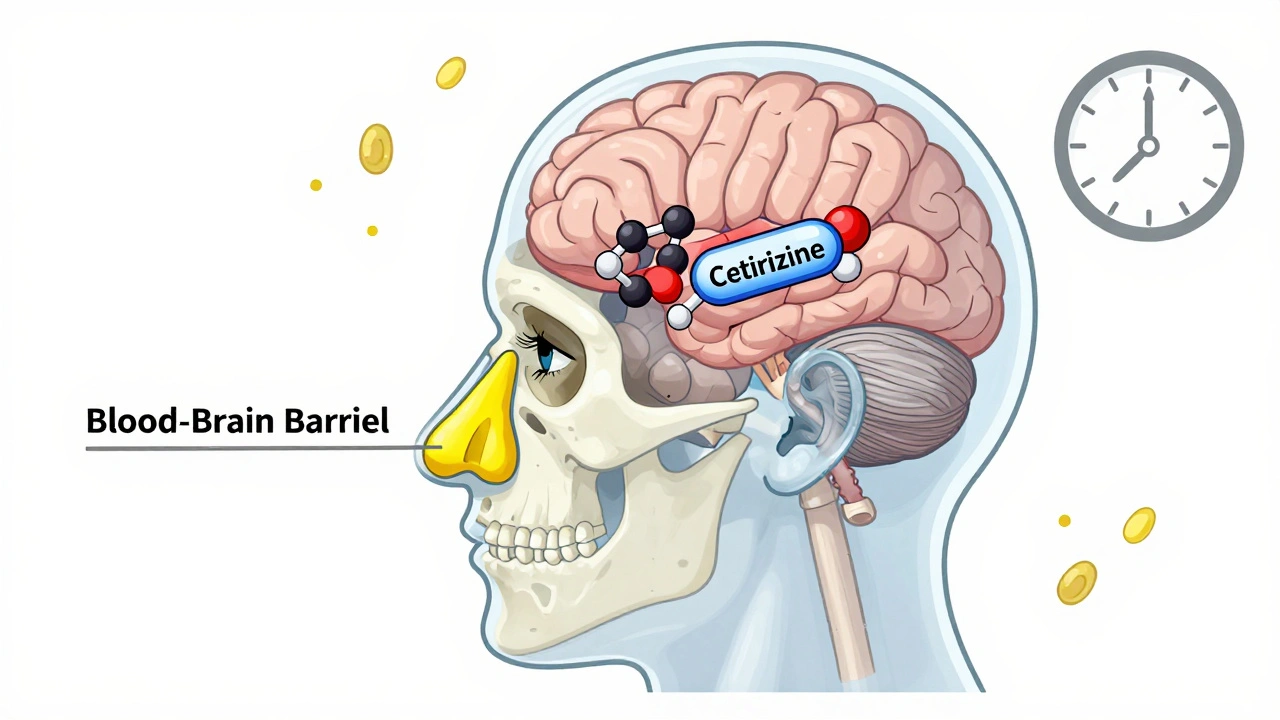
First-generation antihistamines like diphenhydramine (Benadryl) and chlorpheniramine cross the blood-brain barrier easily. That’s why they make you sleepy - they interfere with histamine receptors in your brain that help keep you alert. Second- and third-generation antihistamines are chemically tweaked to be less lipid-soluble. This small change keeps them mostly out of your central nervous system while still working perfectly in your nose, throat, and eyes.
The result? Relief that lasts 24 hours without the fog. The Cleveland Clinic confirms this design was intentional - scientists engineered these drugs to target peripheral histamine receptors only. That’s why you can drive, study, or operate machinery without worrying about side effects.
The Top Three Non-Drowsy Options
Three medications dominate the non-drowsy antihistamine market: cetirizine (Zyrtec), loratadine (Claritin), and fexofenadine (Allegra). All are available over-the-counter, all work for 24 hours, and all are sold in generic forms that cost a fraction of the brand names.
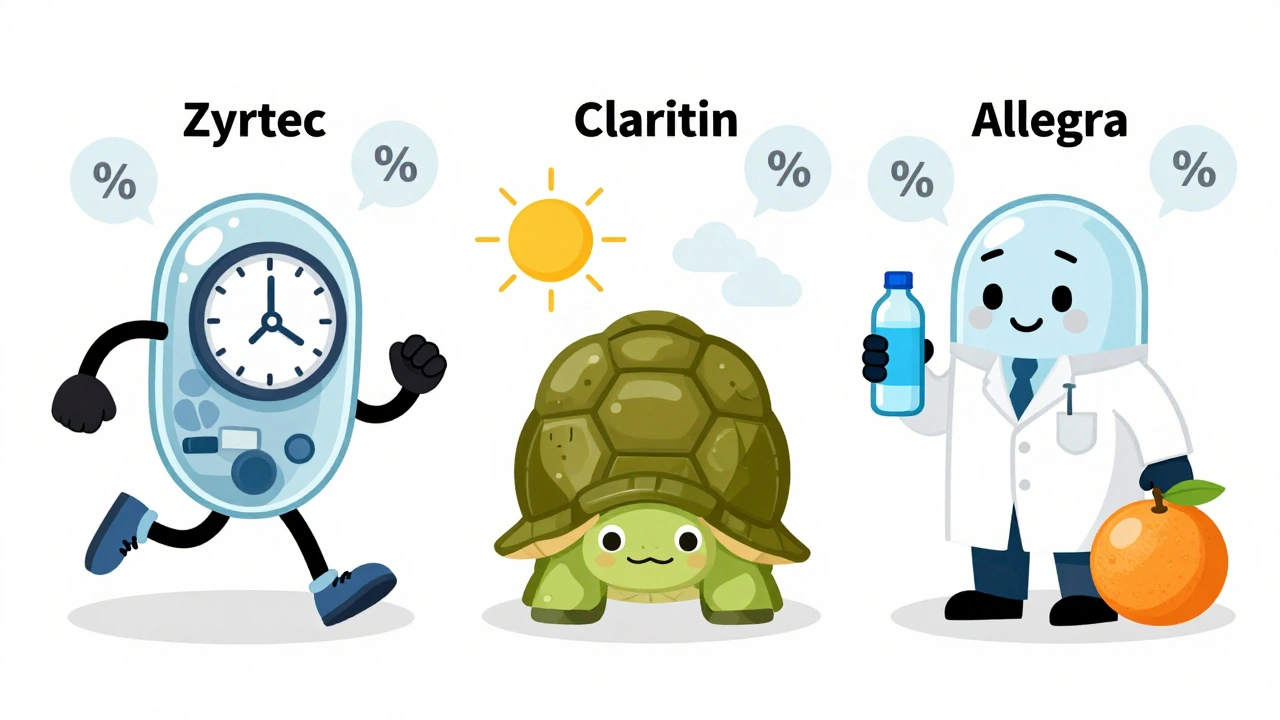
Zyrtec (cetirizine) kicks in fast - often within an hour. It’s effective for sneezing, runny nose, and itchy eyes. But here’s the catch: about 10-15% of users report drowsiness, even though it’s labeled non-drowsy. If you’re sensitive, take it at night. For others, it’s the go-to for quick, strong relief.
Claritin (loratadine) is the slowest to start - it can take 1 to 3 hours to kick in. But once it does, it lasts all day with minimal sedation. Only 5-7% of users feel sleepy. It’s the most widely used, partly because it was the first second-gen antihistamine to go OTC in 2002. Some experts, including Dr. Taylor-Black from Dartmouth Health, say it’s the weakest of the three. But for mild allergies, it’s often enough.
Allegra (fexofenadine) has the lowest chance of drowsiness - less than 5% of users report it. It doesn’t cross the blood-brain barrier at all, making it the top choice for pilots, truck drivers, and nurses. It works within an hour and lasts 12-24 hours. But there’s a catch: grapefruit, orange, and apple juice can cut its absorption by up to 40%. Always take it with water.
Comparing Effectiveness and Side Effects
Which one works best? It depends on your body. Clinical studies show Xyzal (levocetirizine) - the active ingredient in Zyrtec - may offer slightly stronger relief, especially for nasal congestion. But there’s no head-to-head study that definitively declares a winner.
Here’s how they stack up:
| Medication | Onset of Action | Duration | Drowsiness Risk | Key Limitation |
|---|---|---|---|---|
| Cetirizine (Zyrtec) | 1 hour | 24 hours | 10-15% | Can cause drowsiness in some |
| Loratadine (Claritin) | 1-3 hours | 24 hours | 5-7% | Slower to work; may be less effective for severe symptoms |
| Fexofenadine (Allegra) | 1 hour | 12-24 hours | <5% | Avoid with citrus juices |
Side effects are generally mild. Zyrtec users sometimes report headaches or dry mouth. Allegra may cause nausea or stomach upset in a small number of people. Claritin is the gentlest on the gut. None of these cause the same level of sedation as older antihistamines.
When to Try Something Else
Antihistamines are great for sneezing, itching, and runny nose. But if your main problem is nasal congestion, they might not cut it. That’s because congestion is driven by inflammation - not just histamine.
The Mayo Clinic recommends nasal corticosteroids like Flonase or Nasacort for persistent congestion. These work directly in the nasal lining and are more effective for long-term control. Many people use both: a non-drowsy antihistamine for itching and sneezing, plus a steroid spray for stuffiness.
If you’ve tried all three main antihistamines and still aren’t getting relief, it might not be allergies at all. Sinus infections, environmental irritants, or even non-allergic rhinitis can mimic allergy symptoms. A doctor can help rule those out.
Cost and Accessibility
Generic versions of these drugs are dirt cheap. At Walmart in 2020, generic cetirizine cost $10 for 90 tablets. Brand-name Zyrtec was $25. Claritin was $16, and Allegra was $20. That’s a 100% price difference between the cheapest and most expensive.
Today, generics are even more widely available. You can buy 30 days of loratadine for under $5 at most pharmacies. Use GoodRx or pharmacy discount programs to save up to 80% on brand names if you prefer them.
Most insurance plans cover these generics at the lowest tier. Even without insurance, you’re looking at less than $1 a day for reliable relief.

How to Find What Works for You
There’s no universal best. Your body responds differently than mine. One person swears by Zyrtec. Another can’t tolerate it and feels fine on Allegra. That’s normal.
Here’s how to test them:
- Start with the cheapest generic: loratadine (Claritin). Take one daily for 5-7 days. If your symptoms don’t improve, move on.
- Try cetirizine (Zyrtec). If you feel drowsy, take it at night. If not, keep using it during the day.
- If neither works well, try fexofenadine (Allegra). Take it with water - never juice.
Keep a simple log: what you took, when, and how your symptoms changed. After 1-2 weeks, you’ll know what fits your body.
Don’t give up after one try. Network Health’s 2020 study found that if one second-gen antihistamine doesn’t help, switching to another often does.
What About Combination Products?
Products like Zyrtec-D, Claritin-D, and Allegra-D add pseudoephedrine - a decongestant - to fight stuffiness faster. They work well, but they come with trade-offs.
Pseudoephedrine can raise your blood pressure, make your heart race, or keep you awake at night. If you have high blood pressure, heart issues, or trouble sleeping, avoid these. Stick to plain antihistamines unless your congestion is severe and short-term.
For long-term congestion, nasal sprays are safer and more effective than oral decongestants.
Final Thoughts
You don’t need to suffer through allergy season with a foggy head. Non-drowsy antihistamines give you real freedom - to drive, to focus, to live without interruption. Zyrtec, Claritin, and Allegra are all solid choices. The difference isn’t in the science - it’s in your body.
Start with the cheapest generic. Give it a week. If it doesn’t work, try another. Track your symptoms. Talk to your pharmacist. And remember: if congestion is your main issue, add a nasal steroid. You’re not stuck with one solution.
Allergy relief shouldn’t cost you your focus. With the right choice, you can breathe easy - and stay wide awake.
Jaswinder Singh
December 1, 2025 AT 17:14Bro just take Zyrtec and stop overthinking it. I’m a nurse in Delhi and I’ve seen 500 people with allergies - 90% of ‘em work fine on generic cetirizine. No juice, no drama, just take it and live.
patrick sui
December 3, 2025 AT 03:03Interesting breakdown, but I’m curious - has anyone done a meta-analysis on bioavailability differences between fexofenadine and levocetirizine in CYP3A4 polymorphic populations? 😅 I’ve got a cousin in Cork who swears Allegra doesn’t work for him but Zyrtec does, and his CYP2D6 genotype is *wildly* heterozygous. Maybe it’s not just about the blood-brain barrier…
Conor Forde
December 4, 2025 AT 13:15Ohhhh so THAT’S why my uncle who flies cargo planes for Ryanair only takes Allegra with distilled water and a prayer? 🤯 I thought he was just a weirdo. Turns out he’s a pharmacological ninja. Meanwhile I’m over here chugging grapefruit juice with my Claritin like a barbarian. My bad. 😭
Jeremy Butler
December 4, 2025 AT 15:57While the article presents a cogent and empirically grounded taxonomy of second- and third-generation antihistaminergic agents, it remains regrettably deficient in addressing the epistemological underpinnings of patient-reported outcomes vis-à-vis pharmacodynamic variability. The implicit assumption that symptom relief is a unidimensional construct is, in my estimation, methodologically unsound.
Lydia Zhang
December 4, 2025 AT 23:35Allegra with juice? dumb
Shashank Vira
December 6, 2025 AT 17:58Let me tell you something - you people are still using *oral* antihistamines? In 2025? I’ve been using intranasal azelastine with fluticasone for two years. It’s like magic. Zyrtec? Claritin? Those are for people who still believe in the placebo effect of pharmaceutical marketing. Real relief is localized. Real relief is targeted. Real relief doesn’t come in a pill you swallow while scrolling Instagram.
Courtney Co
December 8, 2025 AT 13:51Ugh I tried Zyrtec and felt so tired I cried. Like, actual tears. I was on my couch for 3 hours. I thought I was having a breakdown but it was just the histamine blocking my serotonin? I feel seen. I’m so tired of being told ‘it’s non-drowsy’ when it’s literally the opposite. Why do they even make these drugs? Do they not have daughters?
Declan O Reilly
December 9, 2025 AT 03:03So we’re all just… guessing what works? Like ancient alchemists mixing potions? I mean, I took Claritin for 10 days and it did nothing. Then I switched to Zyrtec and suddenly I’m a superhero. But my buddy took Allegra and said it felt like his brain was wrapped in velvet. We’re all just biology experiments with different wiring. Maybe the real answer is… we don’t know. And that’s kinda beautiful. 🤔
Kay Lam
December 9, 2025 AT 15:39I want to say thank you for this because I’ve been struggling with seasonal allergies since I moved from Arizona to Boston and I tried everything from nasal sprays to neti pots to those weird herbal teas and nothing worked until I followed your step-by-step trial method. I started with loratadine because it was cheapest and honestly I didn’t expect much but after five days I could breathe through my nose for the first time in months. Then I tried cetirizine and it was too much for me so I went back to loratadine and added Flonase and now I’m actually looking forward to spring. I didn’t think I’d ever say that. You saved my spring. Thank you.
Bee Floyd
December 10, 2025 AT 02:30Just wanted to add - if you’re on a tight budget and live in the US, check your local library. They often have free health clinics with pharmacists who can help you pick the right OTC med. No judgment, no sales pitch. Just real advice. I got my first Zyrtec prescription through one. It changed my life. 🙏